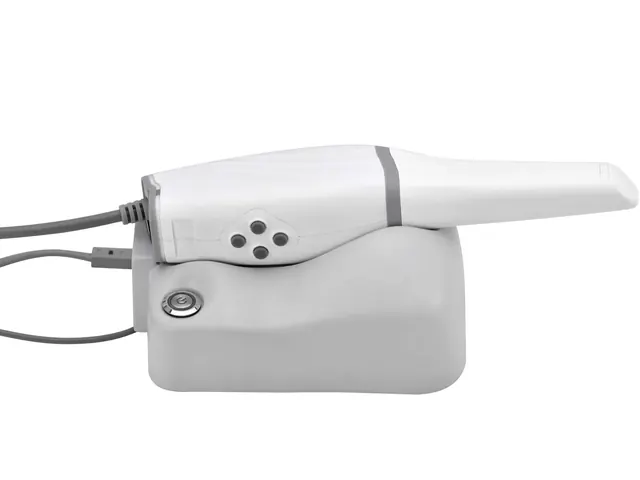
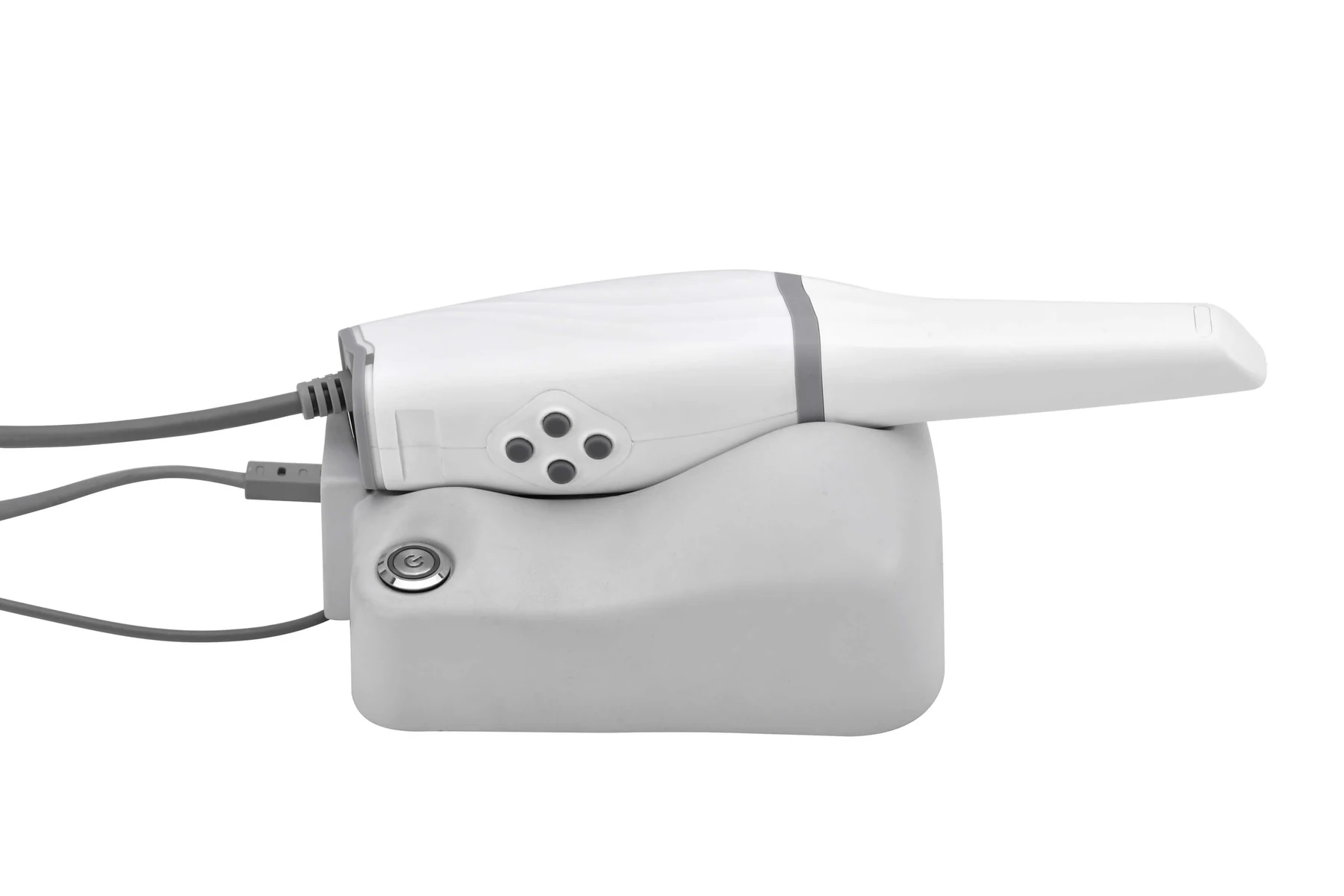
A dentist in India asked about intraoral scanners that handle three specific workflows: clear aligners, implant prosthesis, and fixed partial dentures. These sound similar but they actually stress scanner hardware in different ways. A scanner that's great for aligners can be mediocre for implants, and vice versa. Here's how the choices break down for an Indian mixed-case practice.
What each workflow actually demands
Clear aligners need fast full-arch capture and good soft-tissue separation. The scanner has to distinguish tooth structure from attached gingiva cleanly for the aligner software to trim correctly. Accuracy in the 15-20 μm range is fine; speed matters more. Wireless helps because aligner cases often scan multiple quadrants in sequence.
Implant prosthesis needs high accuracy around scan bodies (typically 10-15 μm cumulative across multi-implant cases) and reliable detection of scan body geometry. Full HD color helps the software recognize scan bodies faster. Tip anti-fogging matters because implant scans often happen deep in the mouth with limited airflow.
Fixed partial dentures (crowns, bridges) need precise margin capture — you need to see the finish line clearly whether it's supragingival or subgingival. Small tip size helps access distal posteriors. Depth of field matters for short preparations.
The scanner features that matter for each
For aligners:
- Capture speed: under 60 seconds full arch
- Color + depth information for software AI soft-tissue separation
- Direct export to SureSmile, Clear Correct, or your lab's aligner workflow
For implants:
- Accuracy 15 μm or better
- Scan body compatibility (most scanners support major brands via firmware library)
- Full HD color for scan body recognition
- Anti-fog heated tip
For FPDs:
- Small tip (under 20 mm across at the imaging aperture)
- Depth of field 13 mm or more
- Margin-capture resolution fine enough to resolve 50 μm finish lines
Where our DP/PD/CJ line fits
The three scanners in our range were deliberately designed around these three workflows:
- DP Scanner (fast, calibration-free, 15-20 μm accuracy, 1.2 min full arch): best for aligner-heavy practices
- PD Scanner (flagship, 10 μm precision, full HD color, 228 g aluminum alloy handpiece): best for implant prosthesis where accuracy matters most
- CJ Scanner (small tip, extended 19 mm depth-of-field, LED visible light): best for FPD margin work in posterior sextants
If you're a mixed practice doing all three workflows and only buying one scanner, PD is the right compromise — it handles implants properly and is fast enough for aligner work. For labs specifically, having DP + CJ gives you aligner speed plus FPD margin precision at a combined price similar to a single PD.
Landed cost for Indian clinics
FOB Shanghai pricing per scanner, all three with 3-year warranty:
- DP Scanner: USD 4,800-5,500
- PD Scanner: USD 7,200-8,500
- CJ Scanner: USD 5,500-6,500
Indian import costs on HS 9018.49: 7.5% BCD + 0.75% SWS + 12% IGST. Effective add-on to FOB is roughly 22-24%. Air freight for a single scanner (3-5 kg kit) runs USD 80-150 — practical for scanners because the unit is small and you want it fast. For a PD, landed-at-clinic in Mumbai is around USD 9,500-11,000 all-in.
What to test on demo
Before paying for a scanner, ask for a factory demo video or arrange a loaner trial:
- Full-arch capture on a typodont — time it yourself, should match the published number within 10 seconds
- Scan of a prepared tooth with 0.5 mm chamfer margin — check whether the margin line is visible and clean in the exported STL
- Export speed: STL should save in under 30 seconds for a single arch
- Compatibility test: import the STL into whatever aligner or CAD software you actually use, and confirm it opens cleanly with no mesh errors
Ready to price this out?
Tell us the model, quantity and destination port. We reply with FOB or CIF pricing, current stock status and a video demo where the unit is in our Shanghai warehouse.