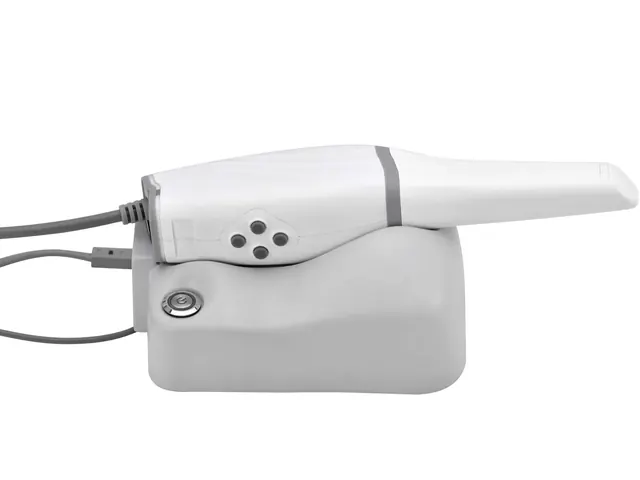
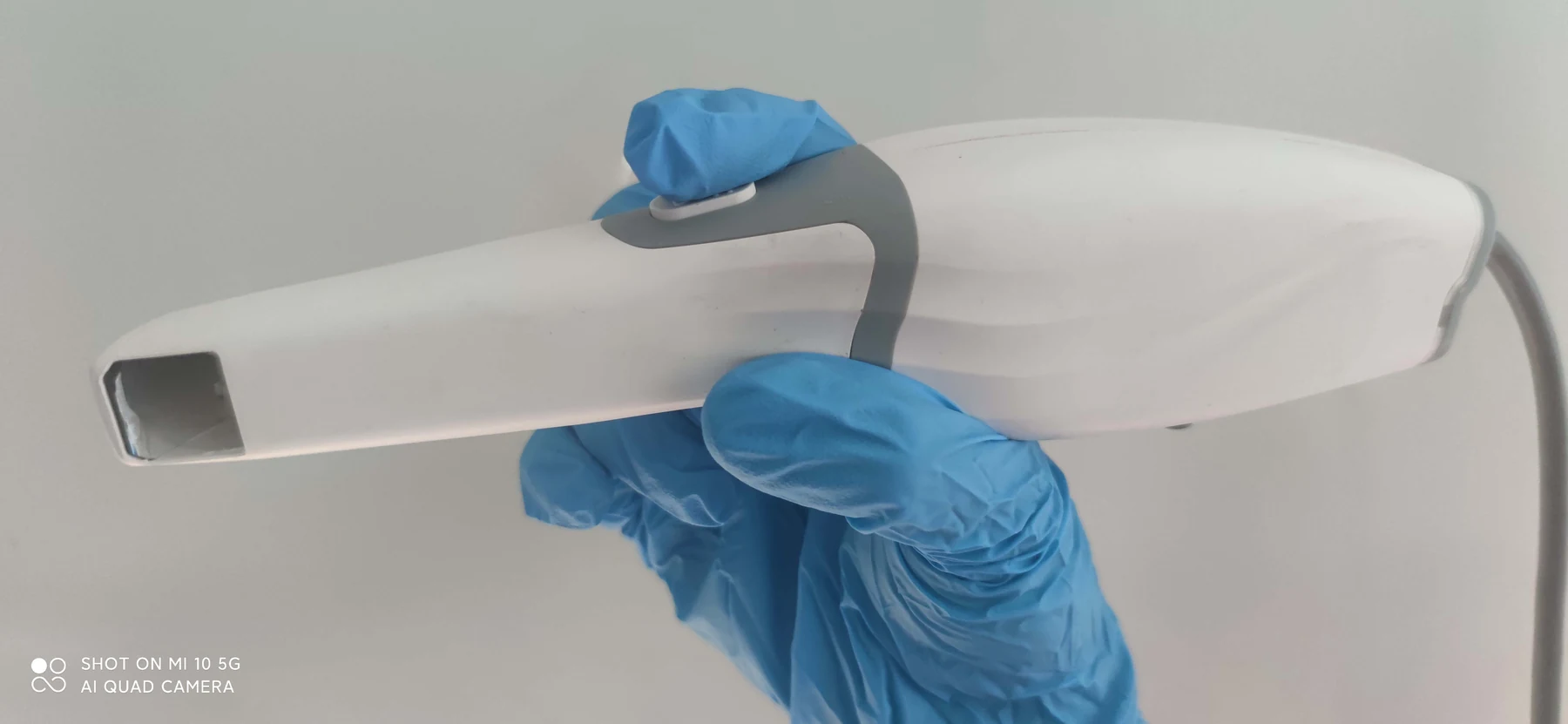
Entry-tier intraoral scanner (IOS) procurement — roughly the USD 5,000–10,000 FOB Shanghai price band — represents the fastest-growing segment of digital dentistry adoption globally. Clinics that historically deferred IOS investment due to USD 18,000–35,000 factory-new premium brand pricing are now entering digital workflow at half the capital commitment, with clinically adequate scan quality for mainstream restorative and orthodontic work. This guide walks through entry-tier IOS selection, what you actually get at this price point, and the workflow implications of choosing value-tier digital scanning.
Why entry-tier IOS exists at this price point
Two convergent factors make USD 5,000–10,000 IOS realistic in 2026:
- CMOS sensor commoditization: the optical sensors at the heart of IOS are now mass-produced for industrial metrology, machine vision, and mobile phone camera markets. Dental-grade CMOS at acceptable noise and resolution performance costs a fraction of what it did in 2015.
- Reconstruction algorithm maturation: the scan-to-STL pipeline (structured light, stereo triangulation, or hybrid approaches) runs on mainstream GPU hardware. Chinese IOS manufacturers license or develop reconstruction pipelines that produce clinically acceptable output without premium-brand R&D overhead.
- Clinical workflow standardization: STL and PLY output formats are universally accepted by CAD/CAM mills, 3D printers, and aligner platforms. Entry-tier scanners interoperate with the same downstream workflow as premium scanners.
What you actually get at USD 5,000–10,000 FOB
Entry-tier IOS specifications have converged around a predictable feature set:
- Scan accuracy: 20–40 µm trueness on full-arch scans, adequate for single-unit crown, inlay, onlay, fixed partial denture, night guard, retainer, and basic orthodontic workflow. Marginal for long-span FPD exceeding 6 units and for high-precision implant-supported prosthesis spanning multiple implants.
- Scan speed: 20–45 seconds per arch in typical clinical conditions — noticeably slower than premium tier (10–20 seconds per arch) but clinically acceptable for standard restorative workflow.
- Color scanning: RGB color texture acquisition standard at this tier. Shade-matching capability varies (usually ballpark match, not spectral calibration).
- Powder-free operation: entry-tier scanners released in 2023 onward are powder-free; older designs or remaining budget-tier units may require anti-reflection powder.
- Heating / anti-fog tip: built-in tip heating to prevent mirror fogging from intraoral humidity. Standard on modern entry-tier.
- Autoclavable tips: 2–4 reusable autoclavable tips included; spare tips approximately USD 80–180 each
- Software: manufacturer software suitable for basic scan capture, order submission, and STL export. Usually open format (STL, PLY, OBJ) allowing integration with any CAD/CAM workflow.
- Hardware: USB-connected wand to dedicated computer or laptop. Typical wand weight 240–320 grams.
- Integrated laptop option: some entry-tier packages include laptop at approximately USD 1,200–1,800 incremental
- Warranty: 12–24 months factory warranty typical
What you don’t get at this price point
- AI-powered scan correction: premium scanners use ML models to auto-correct soft tissue artifacts, tongue intrusion, and patient-movement gaps. Entry-tier scanners rely on operator re-scanning.
- Caries detection or subgingival visualization: premium features like near-infrared imaging for proximal caries detection or fluorescence imaging are absent at entry tier.
- Cloud workflow and lab integration: premium scanner ecosystems (3Shape Unite, Medit Link, 3M Connection Center equivalents) offer integrated lab-to-clinic workflow. Entry-tier workflow typically uses manual STL file transfer.
- Premium accuracy for complex full-arch implant cases: scan accuracy at 30–40 µm is adequate for most restorative work but marginal for precision full-arch implant-supported prosthesis where stitched error accumulates
- Premium service network: local authorized service in most destinations unavailable; remote video support and parts courier is the service model
Clinical application fitness
Entry-tier IOS performs clinically well for:
- Single-unit crowns, inlays, onlays: well within entry-tier accuracy envelope
- Short-span FPD (2–4 units): acceptable, within normal clinical error budget
- Night guards, occlusal splints, retainers: trivial for entry-tier
- Orthodontic initial records and progress scans: adequate for most clear aligner cases
- Diagnostic records and treatment planning: sufficient detail for clinical documentation
- Patient communication: chairside 3D visualization for case acceptance — one of the highest ROI applications of any IOS regardless of tier
Entry-tier IOS is marginal or inadequate for:
- Precision full-arch implant-supported prosthesis (consider premium tier or conventional impression + verification jig)
- Long-span FPD exceeding 6 units spanning full arch
- Clinical cases requiring caries detection integration
- Research or publication work requiring documented micrometer-level accuracy
Sample order verification protocol
Before committing to entry-tier IOS purchase, run sample order through these tests:
- Typodont full-arch scan: scan standardized typodont, export STL, measure known reference dimensions. Report trueness and precision vs. specified.
- Clinical patient scan (with patient consent): scan 3 different patients with varying intraoral complexity (normal, tight contacts, partially edentulous). Evaluate operator experience and output quality.
- CAD/CAM workflow test: send STL to your standard mill or lab. Verify crown fit on resulting restoration.
- Software workflow evaluation: case capture, order submission, patient record management, STL export — does the software match your clinical workflow efficiently?
- Durability under clinical conditions: wand handling, cable flex, tip autoclave cycles, foot pedal or button controls
- Technical support responsiveness: submit a test support inquiry during trial period — response time, language capability, and problem-solving competence
Cost-benefit economics at entry tier
Worked example: USD 7,500 FOB Shanghai entry-tier IOS, shipped to a 2-chair general practice:
- FOB Shanghai: USD 7,500
- Air freight (scanner approx 8 kg crated): USD 60
- CIF destination: USD 7,560
- Customs duty 3% (representative): USD 227
- VAT 12% (representative): USD 934
- Broker + inland: USD 150
- Landed cost typical destination: approximately USD 8,870
Revenue-side impact of IOS adoption at typical general practice:
- Case acceptance improvement: chairside 3D visualization typically increases full treatment plan acceptance by 20–35% vs. conventional impression + 2D imaging workflow
- Chair time reduction per crown case: 15–25 minutes saved vs. conventional impression (impression, bite registration, remake frequency). At USD 120–350/hour opportunity cost, this is USD 30–150 per case.
- Remake rate reduction: well-trained IOS operators achieve 3–8% remake rate vs. 12–22% for conventional impressions at comparable practices
- Clear aligner case attachment: IOS unlocks clear aligner treatment in general practice, adding USD 1,800–4,500 per case revenue
- Typical payback: 4–10 months for a busy general practice adopting entry-tier IOS
Operator training and adoption curve
Entry-tier IOS requires meaningful training investment despite lower capital cost:
- Initial training: 1–2 day operator training on scan technique, software workflow, troubleshooting
- Adoption curve: first 20–50 clinical cases typically 50–100% slower than conventional; efficiency crossover at case 30–80 depending on operator aptitude
- Scan technique matters more at entry tier: premium scanners tolerate operator error better; entry tier rewards careful technique
- Auxiliary staff training: if delegating scanning to dental assistant or hygienist, include their training and compensation for the additional skilled task
- Clinical protocol evolution: plan 3–6 months for workflow integration — deciding which cases to scan, which to impression, how to archive, how to order lab work
Regulatory and documentation considerations
- CE marking or FDA 510(k) clearance available on most entry-tier Chinese IOS from established manufacturers. Verify specific product and manufacturer before ordering.
- ISO 13485 manufacturer certification standard expectation
- Destination country registration (ANVISA, CDSCO, SFDA, etc.) may require authorized representative arrangement for commercial distribution; simplified path for single-unit clinical imports by licensed practitioners
- Clinical acceptance by local dental associations and insurance reimbursement frameworks varies; some jurisdictions recognize only specified premium-brand scanners for certain reimbursement pathways
When to upgrade from entry-tier
Practices typically consider upgrading from entry-tier IOS when:
- Full-arch implant-supported prosthesis case volume grows beyond 1–2 per quarter
- Lab integration or clinic group requires specific cloud ecosystem
- Scan volume exceeds 40–60 scans per week and efficiency matters more than capital cost
- Practice positioning requires specific brand name on marketing materials
- Caries detection, fluorescence imaging, or other premium features become clinically indicated
Most general practices never hit these thresholds and operate profitably on entry-tier IOS indefinitely.
Practical procurement recommendations
- Order sample first, always: entry-tier IOS quality varies meaningfully across suppliers; sample testing in your specific clinical workflow is the only reliable quality verification
- Budget for spare tips and consumables: USD 300–600 first-year consumable reserve
- Include laptop/computer in procurement unless existing clinic hardware meets IOS minimum specifications (typically i7/Ryzen 7+, 16GB RAM, dedicated GPU, Windows 10/11 Pro)
- Verify open STL/PLY export with no DRM lock-in — this protects your clinical workflow flexibility
- Confirm remote service capability in your destination before purchase
- Plan commissioning timeline: 2–4 weeks from order to first clinical case is realistic
Evaluating entry-tier IOS for your practice?
WhatsApp us with your practice scale (chair count), primary clinical applications (restorative, orthodontic, implant-supported work), destination country, and existing CAD/CAM or lab workflow. We’ll propose entry-tier IOS options matched to your clinical priorities, arrange sample order for evaluation, quote FOB Shanghai pricing, and walk through landed cost with destination-specific documentation.
Ready to price this out?
Tell us the model, quantity and destination port. We reply with FOB or CIF pricing, current stock status and a video demo where the unit is in our Shanghai warehouse.