
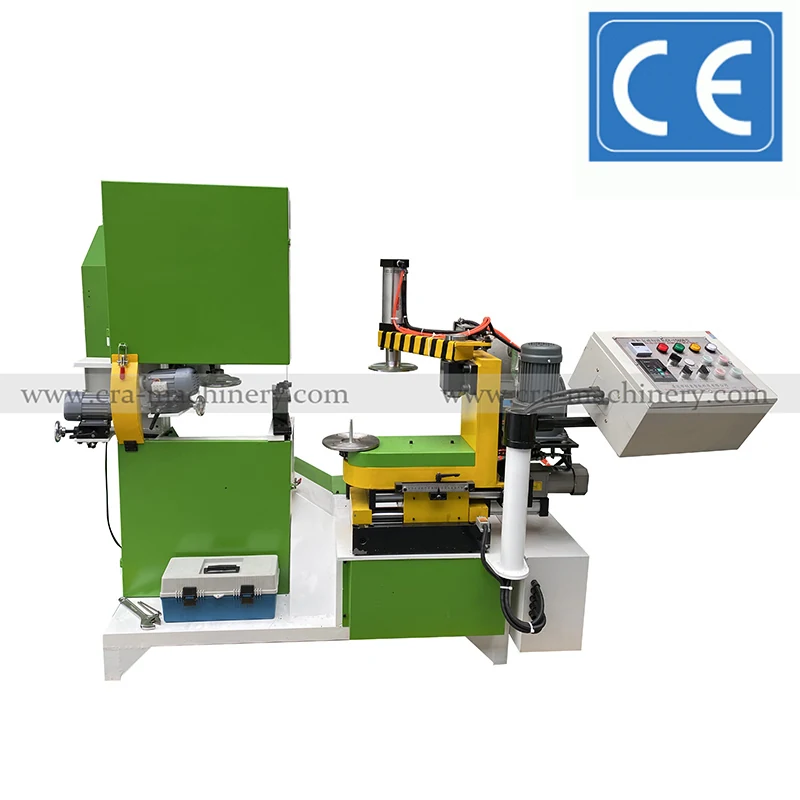
How an Airway Buffing Wheel Is Made
An airway buff, also sold as a ventilated sisal buff, airflow buff or bias airway buff, is a polishing wheel whose plies are folded onto a metal centre so that air passes through the body while the wheel runs. The open structure keeps the workpiece cooler than a solid pleated or disc wheel on long...
What An Airway Buff Is
An airway buff, also sold as a ventilated sisal buff, airflow buff or bias airway buff, is a polishing wheel whose plies are folded onto a metal centre so that air passes through the body while the wheel runs. The open structure keeps the workpiece cooler than a solid pleated or disc wheel on long polishing cycles.
The wheel is built from three inputs: fabric or sisal cut on the bias, a metal centre in the form of an iron claw or an iron plate, and the machine time to fold and clamp the plies in a repeatable pattern.
Step One Bias Cutting And Rolling
Fabric has to enter the forming machine on the bias. Straight cut material will not fold evenly and shows up later as loose ply spacing. A CRA-500 bias fabric cutting slitting and rolling machine cuts the cloth on the bias and winds it into the roll the former takes.
The same step applies to sisal cloth. Sisal grades commonly used are African white sisal 10x8, Brazil sisal and China Guangxi sisal 8x7.
Step Two Forming
The forming machine folds ply after ply onto the metal centre while a turntable indexes the wheel body. The CRA-800 covers 200 to 600 mm outer diameter, runs on 380 V three phase at 6 kW, measures 2.8 m by 1.8 m by 1.6 m and is rated up to 5000 pieces per day with one operator. For smaller wheels the CRA-300 iris machine covers 100 to 250 mm.
Moulding and finishing pressure are both held at 7 MPa. If the gauge drops, ply density loosens before the wheel diameter changes, so the pressure reading is the first thing to check when wheels start running soft.
Step Three Pressing And Step Four Trimming
Formed bodies go to a CRA-600 pressing machine, which compacts the plies against the centre. Send them the same shift, because a ply stack that sits overnight relaxes.
Edge cutting on a CRA-700 gives the wheel its running face and its final outer diameter. After that the wheel is inspected and packed.
Choosing The Centre
Forming machines accept iron claws in 2 inch, 2.5 inch and 5 inch, and iron plates with round or hexagon holes. Iron clinch rings are pressed from 1.2 mm steel plate through 5 to 8 operations, in diameters from 3 inch to 8 inch with 43 teeth as standard. Square teeth rings come in 1.5 mm and 2.0 mm thickness.
The centre decides how the wheel mounts on the customer's spindle, so it is usually fixed by what the end user already runs rather than by the wheel maker.
Questions On This Topic
Why does the fabric have to be cut on the bias?
Bias cut cloth folds evenly onto the centre. Straight cut material creases and gives uneven ply spacing.
Can one machine cover all wheel diameters?
No. The CRA-800 covers 200 to 600 mm and the CRA-300 covers 100 to 250 mm. Within a machine you change the clamp set for the diameter band.
How many operators does a line need?
The forming machines run with one operator each. Total line staffing depends on how you handle material and packing.
What output can I plan for?
Up to 5000 pieces per day on the CRA-800 at maximum rate, less for large diameters and high ply counts.
Do you supply the fabric and centres as well as the machines?
Yes. Treated fabric, sisal cloth, poplin cotton, iron plates and clinch rings are all part of the range.
Products Mentioned Here

CRA-700 Buffs Trim/Edge Cutting Machine
View Details
CRA-500 Bias Fabric Cutting Slitting Rolling Machine
View Details
CRA-600 Buffing Polishing Wheel Pressing Machine
View Details
CRA-800 Bias Airway Buffs Ventilated Sisal Buffs Forming Machine (OD 200-600 mm)
View DetailsStill Not Sure Which Machine Fits
Send us the wheel or the cut you need to produce and we will tell you which model covers it, and which one does not.