
Choosing Magnet Strength and Backing
A souvenir magnet that slides down a fridge door or drops off in the bag is a returned product, and both failures come from the same two decisions.

Two decisions that decide whether it holds
The first is how the magnet is attached: set into a recess in the moulded body, or glued onto a flat back. The second is where it sits relative to the shape's centre of mass.
Get either wrong and the product fails in a way the customer blames on quality, even though the moulding itself may be perfect.
Set in beats glued on
A magnet set into a recess is surrounded by material on all sides and cannot shear off when parts rub together in a bulk bag. A glued magnet relies entirely on the adhesive bond to a flat surface.
It is worth asking any supplier which method they use, because the difference is invisible in a photograph and obvious after a month in a shop bin.
Placement and tilt
On an irregular shape, a magnet placed away from the centre of mass lets one side of the piece hang away from the door. It looks like a weak magnet, but the cause is placement.
On wide or heavy pieces the answer is either a larger magnet or two smaller ones spread across the footprint. We specify this per design on the mould drawing rather than fitting the same magnet to everything.
Sizing to the piece
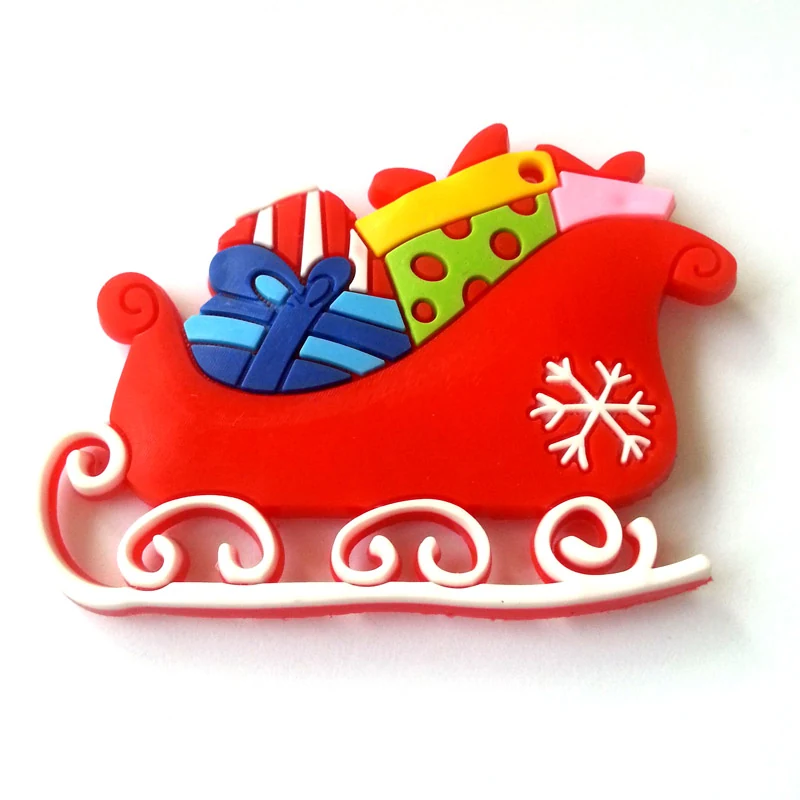
Magnet size follows the footprint and the weight of the moulded body. A large scene piece such as a loaded sleigh needs more holding force than a small candy cane, and giving both the same magnet guarantees one of them is wrong.
This is a per-design decision that costs nothing to get right and is expensive to correct after tooling.
Surfaces that are not steel
Many modern fridge doors are stainless steel or aluminium clad, and some will not hold a magnet at all. This is not a product fault, and it is worth a line on your packaging in markets where such appliances are common.
If the product is intended for a specific surface other than a fridge, tell us at quotation so holding force can be specified against it.
Lead times, minimums and certifications quoted here are Rich Industry's own, as published on rich-gifts.cn. Confirm current figures with your quotation.

Read Next
How Custom Soft PVC Fridge Magnets Are Made
A soft PVC magnet is not printed. It is moulded, colour by colour, in an aluminium tool, and almost every quality problem you can see in a finished magnet was decided before production started.
Soft PVC Versus Rubber and Silicone
Three materials cover almost everything in moulded promotional products. Choosing the wrong one usually shows up as a part that looks right and feels wrong.
Preparing Artwork Files for Custom Moulded Products
Most delays in a first order are artwork delays, and almost all of them are avoidable if you know what the factory actually needs.
Questions on This Topic
Why do some magnets tilt away from the door?
Because the magnet sits away from the centre of mass of an irregular shape. It is a placement problem, not a strength problem, and it is fixed on the mould drawing.
Can magnets come loose in shipping?
Set-in magnets do not shear off the way glued ones can. We set the magnet into a recess in the moulded body for exactly this reason.
Will it hold on a stainless steel fridge?
Some stainless and aluminium-clad doors are not magnetic at all. If your market has many of these appliances, a note on the packaging saves customer complaints.
Apply This to Your Own Project
Send the artwork or the brief and we will tell you what is achievable, what it costs and how long it takes. Quotation within 8 working hours.