
How to Choose a Shelf Bracket Size and Thickness
Bracket sizes are quoted as wall leg x shelf leg x material thickness. This guide explains how to read that notation, how to match it to a shelf board, and where the gauge steps up in our range.
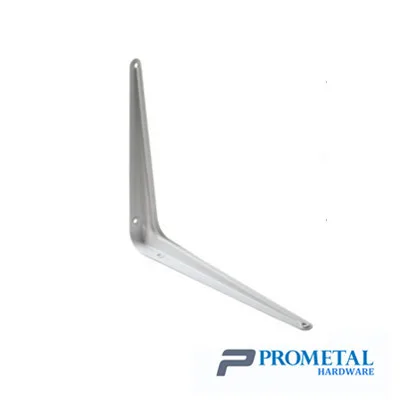
Read the Size Notation First
A shelf bracket size such as 200 x 250 x 0.8 mm gives the wall leg, the shelf leg and the material thickness in that order. Some profiles add a fourth figure, as in 150 x 200 x 25 x 3.5 mm, where the third figure is the width of the bearing face and the last is the thickness. Once you know which figure is which, comparing two suppliers becomes arithmetic rather than guesswork.
Match the Shelf Leg to the Board Not the Wall
The shelf leg should be equal to or slightly shorter than the board depth so the board covers the bracket. A bracket that projects past the front edge catches sleeves and looks unfinished. For a 250 mm board, the 200 x 250 mm size is the usual choice across our utility profiles.
Thickness Is Where a Range Quietly Steps Up
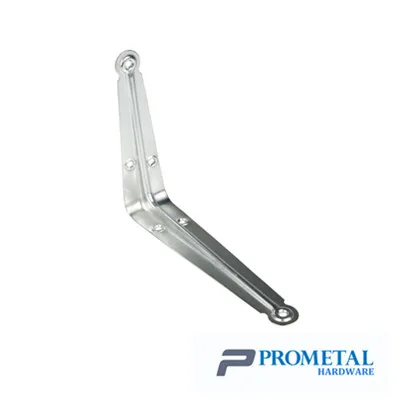
On the 101 London bracket the thickness climbs with the size: 0.7 mm through the small sizes, 0.8 mm from 200 x 250 mm, 0.9 mm at 300 x 350 mm, 1.0 mm at 350 x 400 mm and 1.1 mm at 400 x 450 mm. That ladder exists because a longer arm puts more bending stress into the same fold. A supplier who holds one gauge across every size is not doing you a favour.
When to Move to a Braced or Heavy Duty Profile
Once the shelf carries tools, paint or stock rather than books, the plain folded bracket is the wrong part. The 106 heavy duty bracket runs 4 mm thick with a 30 mm bearing face, and the 119 stayed bracket adds a diagonal stay up to a 400 x 500 mm size. Both are punched for wood mounting screws and are meant to be fixed into a stud.
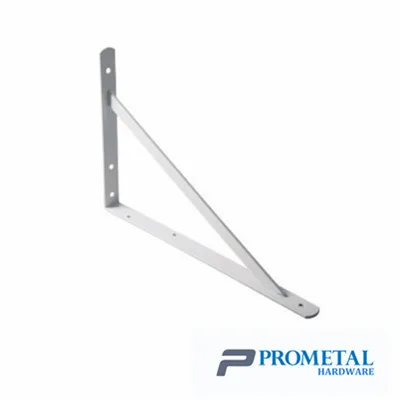
Spacing Matters as Much as the Bracket
Most shelf failures are span failures, not bracket failures. Keep the unsupported span at or below 600 mm for heavy storage, and under about 800 mm for 18 mm plywood. Adding a third bracket is nearly always cheaper than moving up a bracket size and a board thickness.
Specifications Referenced Above
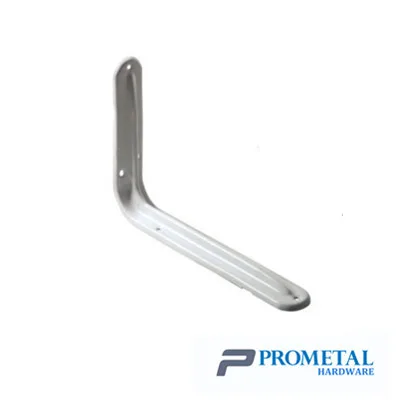
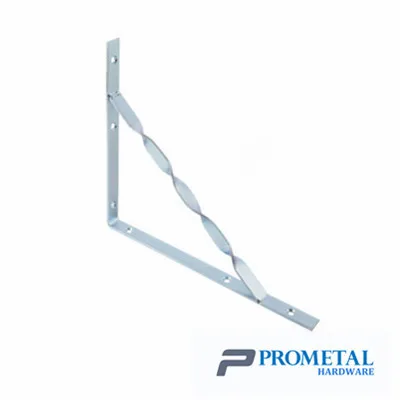
Questions on This Topic
What does the fourth number in a bracket size mean?
On profiles quoted with four figures, the third is the width of the bearing face and the fourth is the material thickness.
Which bracket suits a garage shelf carrying tools?
Use a heavy duty or stayed profile such as the 106 or 119, fixed into studs, with spans kept at or below 600 mm.
Do you supply imperial sizes?
Yes. The 105 zinc plated shelf bracket is listed in inch sizes from 3 x 4 inch up to 12 x 14 inch.
Still Deciding What to Specify
Tell us the application and the load, and we will point you at the model and size rather than the category.