How Torsional Rubber Springs Replace Mechanical Assemblies
A conventional steel spring suspension requires separate coil springs, guide bushings, bump stops, and external dampers to control oscillation. Torsional rubber springs combine spring action, joint articulation, and vibration damping into a single compact element. The internal rubber inserts, such as Rubmix 10, absorb rotational and angular deflection without sliding metal contact, eliminating the regular greasing and maintenance cycles that open coil springs demand in harsh working environments.
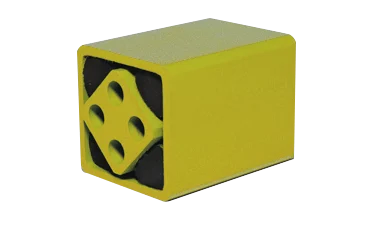
DR-S Rubber Suspension Unit specifications
Vibration Damping and Frequency Control in Machinery Mounts
Steel coil springs offer elastic deflection but deliver minimal inherent damping, causing systems to bounce or transmit high residual forces into the supporting chassis. Oscillating mountings like the AB series provide natural frequencies around 2 to 3 Hz across 7 standard sizes covering 50 N to 10000 N per element. This low natural frequency achieves high vibration isolation and minimal residual force transmission in processing machinery without requiring secondary hydraulic dampers.
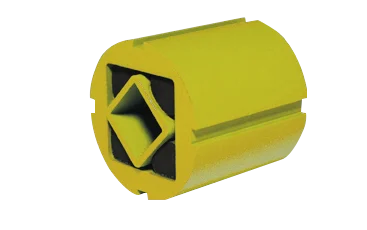
DR-A Rubber Suspension Unit specifications
Material Construction and Environmental Operating Bands
Where standard steel springs face corrosion, fatigue cracking, and hinge pin seizure, torsional rubber units are configured with protective finishes and stable elastomer cores. NR types feature powder metallurgy housings, steel inner cores, and green protective paint, maintaining operation across a working temperature range of -40 C to +80 C (with specific types rated up to +90 C). Other configurations like DR-S, DR-A, DK-S, and DK-A incorporate light metal profiles or steel housings finished in yellow or green protection paint for continuous duty.
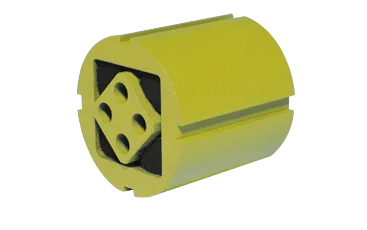
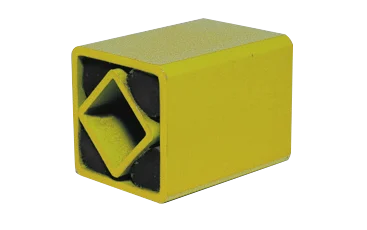
DK-S Rubber Suspension Unit specifications
Selecting Elements for Alternating and Plug In Connections
Machine construction determines the mounting profile needed on the drawing. The DR-S and DK-S designs use a steel tube configuration for direct plug-in connections. For alternating motions traversing over a neutral element position, DK-A units use light metal profiles (or steel from size 60 upward) with a steel inner square. Matching the inner core profile and housing material to the stroke angle ensures the rubber inserts handle reversing torque loads without mechanical backlash.