
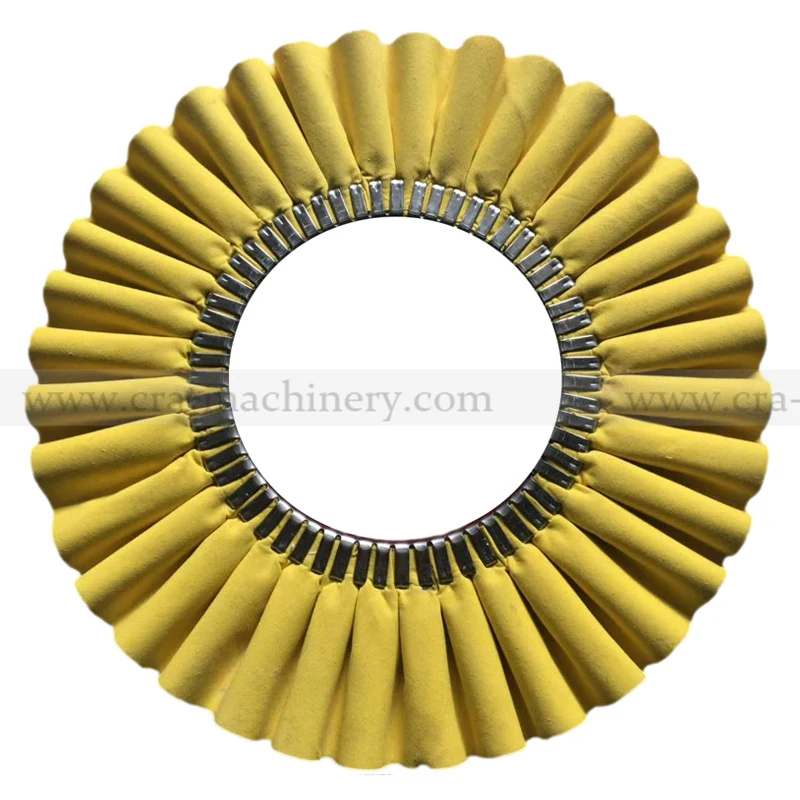
Selecting Treated Cloth and Fabric for Buffing Wheels
Orange, blue and yellow treated fabric are used in polishing wheels for different levels of aggressiveness and finish quality. The colour indicates the resin treatment level and the resulting wheel stiffness. Treated fabric has resin applied to the fibres to reduce fraying during forming and to...
Treated Fabric Types For Buffing Wheels
Orange, blue and yellow treated fabric are used in polishing wheels for different levels of aggressiveness and finish quality. The colour indicates the resin treatment level and the resulting wheel stiffness.
Treated fabric has resin applied to the fibres to reduce fraying during forming and to maintain shape under pressure. The resin also affects how the wheel cuts into the workpiece and how long it lasts before wearing down.
Sisal cloth is used for heavy-duty polishing, especially in metal finishing and cookware tableware lines. It is more abrasive than treated fabric and holds up under high pressure and heat.
Poplin cotton fabric is used in airway buffing wheels where a softer, more flexible surface is needed. It is less aggressive than sisal and ideal for fine finishing on delicate surfaces.
Why Fabric Must Be Cut On The Bias
Cutting fabric on the bias ensures that the fibres stretch and fold evenly around the metal centre during forming. Straight cut material does not fold uniformly and results in uneven ply spacing.
Uneven ply spacing causes soft spots in the wheel, which lead to inconsistent polishing and early wear. The bias cut allows the plies to conform to the wheel shape without creasing or bunching.
The CRA-500 bias fabric cutting slitting and rolling machine is designed to cut the cloth at a 45-degree angle to the grain, then wind it into a roll ready for the forming machine.
Preparing The Fabric Roll
The CRA-500 machine cuts the fabric on the bias and winds it into a roll that feeds directly into the forming machine. It handles widths from 100 mm to 1200 mm and can process up to 100 meters per hour.
The roll must be wound tightly and evenly to prevent slack during forming. Loose rolls cause misalignment and ply gaps in the finished wheel.
For sisal cloth, the same machine can be adjusted to handle the thicker, stiffer material. The blade angle and tension are set to prevent tearing during the cut.
Cutting Sisal Cloth In Stacks
For high volume production, sisal cloth is cut in stacks using the XLJP3-350 four column hydraulic press. It can cut up to 10 layers at once, with a maximum stack height of 50 mm.
The hydraulic press applies even pressure across the entire cutting surface, ensuring clean, straight cuts. The blade is adjustable for different thicknesses and fibre density.
After cutting, the stack is separated and rolled for use in forming machines. This method reduces material waste and speeds up the prep process.
Questions On This Topic
What does resin treatment do to the fabric?
Resin treatment reduces fraying during forming, increases stiffness, and controls how aggressively the wheel cuts the workpiece.
Why is bias cutting necessary for all fabrics?
Bias cut ensures even folding of plies around the centre. Straight cut fabric causes uneven spacing and soft spots in the wheel.
Can the CRA-500 handle sisal cloth?
Yes. The CRA-500 can be adjusted for sisal cloth with proper blade angle and tension settings to prevent tearing.
How many layers can the XLJP3-350 cut at once?
The XLJP3-350 can cut up to 10 layers of sisal cloth in a single pass.
What fabric is best for fine finishing?
Poplin cotton is best for fine finishing due to its softness and flexibility on delicate surfaces.
Products Mentioned Here

Bias Fabric Corrugated Polish Buffs
View Details
200A Mini Cloth Sisal Buffs Forming Machine for Angle Grinder Wheel
View Details
Fold and Stitch Machine&Fabric Feed Rack for Pleated Buffs Produce
View Details
Orange Treated Fabric Cloth for Buffing Wheel
View DetailsStill Not Sure Which Machine Fits
Send us the wheel or the cut you need to produce and we will tell you which model covers it, and which one does not.