
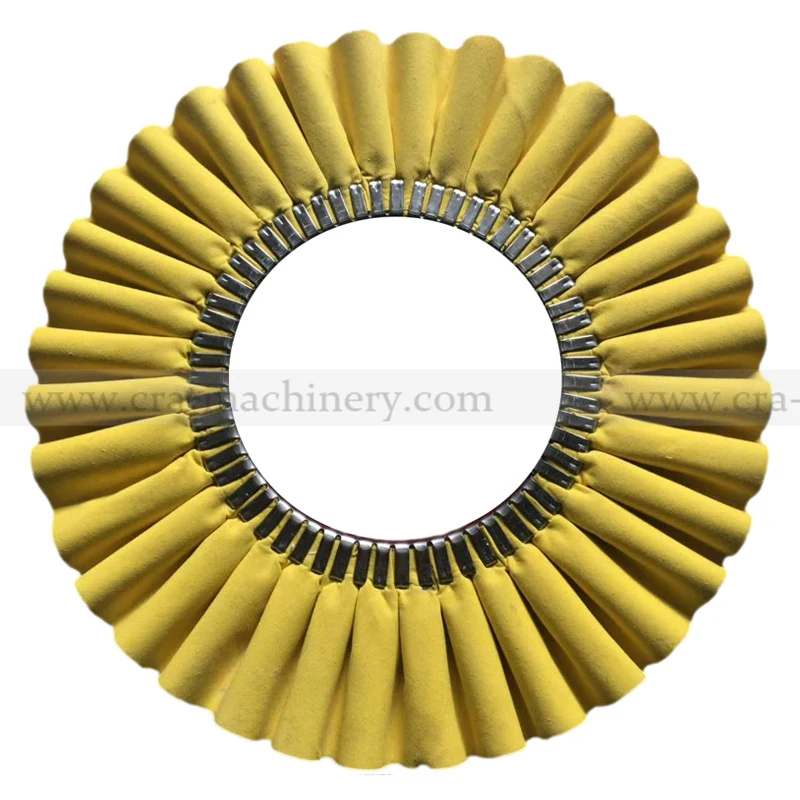
Bias Fabric Corrugated Polish Buffs
Bias Fabric Corrugated Polish Buffs are designed for polishing and pre-bright finishing of stainless steel, chrome, and iron surfaces such as pots, pans, tableware, tubes, and pipes. The wheel structure features a regular airflow pattern that maintains shape during use, making it suitable for...
Product Overview
Bias Fabric Corrugated Polish Buffs are designed for polishing and pre-bright finishing of stainless steel, chrome, and iron surfaces such as pots, pans, tableware, tubes, and pipes. The wheel structure features a regular airflow pattern that maintains shape during use, making it suitable for applications where a single, non-opening wheel is required—such as polishing the edges of cookware. The buff is made from bias-cut fabric with a corrugated weave, available in multiple weaves, diameters, and thicknesses. It uses a 1.5 mm or 2.0 mm iron clinch ring with square teeth for secure mounting.


Key Benefits
- Maintains consistent wheel shape during polishing, ideal for edges and tight contours
- Regular airflow structure reduces heat buildup and prevents clogging during extended use
- Available in multiple weave counts and diameter ranges to match specific polishing tasks
- Uses iron clinch rings with square teeth for secure attachment to machinery
- Can be produced on a mechanised line including CRA-500, CRA-800, CRA-600 and CRA-700 machines
- Reduces manual handling and variation compared to hand-assembled buffs
Application Scenarios
- A cookware manufacturer needing consistent edge polishing on pots and pans without wheel deformation
- A tableware producer replacing hand-made buffs with a repeatable, machine-made corrugated buff
- A metal finishing shop requiring a durable buff for stainless steel tubes and pipes with minimal heat rise
- A workshop adding a new buff type to their line that does not open out under pressure
Who It Is For
- Cookware and tableware manufacturers
- Metal finishing shops working with stainless steel and chrome parts
- Sanitary ware polishing lines
- Jewellery and small metal part polishing workshops
- Distributors of polishing buffs seeking a new product with a stable structure
Problems It Solves
- Hand-assembled buffs often lose shape during polishing, especially on curved or edged surfaces
- Lack of consistent airflow structure leads to heat buildup and faster wear
- Inconsistent ply spacing and weave tension cause uneven finish quality across batches
- Manual buff construction limits output and increases labour cost per unit
- No standardised structure for single-use, non-opening wheels in high-volume production
Technical Features
- Corrugated weave structure with regular airflow channels
- Bias-cut fabric used for even tension and consistent folding
- Iron clinch ring with square teeth for secure attachment
- Available in 20, 32, 34, 36, and 44 weaves with defined inner and outer diameter ranges
- Fixed thickness of 30 mm across all sizes
- Designed for use with iron claw or iron plate centres in standard sizes
Specifications
| Model | Bias Fabric Corrugated Polish Buffs |
|---|---|
| Thickness | 30 mm |
| Weave Count | 20, 32, 34, 36, 44 |
| Inner Diameter Range | 60 to 180 mm |
| Outer Diameter Range | 150 to 500 mm |
| Iron Clinch Ring Thickness | 1.5 mm or 2.0 mm |
| Ring Teeth Type | Square teeth |
| Fabric Type | White untreated or treated in yellow, blue, green |
| Material | Bias-cut fabric with corrugated weave |
Values taken from the manufacturer data for this model. Anything not listed is confirmed on request before order.
Materials
- White untreated bias fabric
- Treated bias fabric in yellow, blue, green
- Iron clinch rings with square teeth, 1.5 mm or 2.0 mm thickness
- Iron claw or iron plate centres for mounting
Manufacturing And Process
Step 1
Prepare bias-cut fabric rolls using a CRA-500 bias cutting and rolling machine
Step 2
Load the fabric roll and select the appropriate iron clinch ring for the wheel size
Step 3
Set the machine to the target weave count and diameter range
Step 4
The forming machine (CRA-800 or CRA-300) folds and indexes the fabric into a corrugated structure
Step 5
The formed body is pressed on a CRA-600 to consolidate the layers
Step 6
Edge trimming on a CRA-700 shapes the running face and removes excess material
Quality Control
- Sample buffs tested before shipment to verify weave consistency and ring fit
- Hydraulic pressure maintained at 7 MPa during pressing to ensure uniform density
- Inner and outer diameters measured on a sample batch to confirm range compliance
- Free sample testing available on the buyer's own fabric or treated material
- Installation and operation training provided to ensure correct setup and first run
Customization Options
- Custom weave counts and diameter ranges available upon request
- Iron clinch ring thickness and tooth type adjusted to match customer centres
- Fabric colour and treatment matched to customer specifications
- Machine line configuration (CRA-500, CRA-800, CRA-600, CRA-700) can be quoted together
Compared With The Alternatives
| CRA-800 Bias Airway Buffs Forming Machine | The CRA-800 forms ventilated airway wheels with open channels; this buff has a solid corrugated weave without open airflow, better for edge work and non-opening use |
|---|---|
| Manual buff construction | Hand-made corrugated buffs vary in weave tension and diameter; machine production ensures repeatable structure and size |
| Standard flat weave buffs | Flat weave buffs lack airflow structure and wear faster under pressure; corrugated design improves heat dissipation and durability |
Use Guide
- Use only bias-cut fabric; straight-cut material will not form correctly
- Select the correct iron clinch ring thickness (1.5 mm or 2.0 mm) to match the wheel's inner diameter
- Verify the weave count matches the intended diameter range before production
- Keep the pressing pressure at 7 MPa to maintain consistent ply density
- Send formed bodies to pressing the same shift to prevent ply relaxation
Bias Fabric Corrugated Polish Buffs FAQ
What is the thickness of the buff?
The thickness is 30 mm for all sizes.
What diameters are available?
Inner diameters range from 60 mm to 180 mm; outer diameters range from 150 mm to 500 mm, depending on the weave count.
What fabric types can be used?
White untreated fabric or treated fabric in yellow, blue, or green.
What iron clinch ring is used?
1.5 mm or 2.0 mm thick with square teeth. The ring fits into the wheel's inner diameter.
Can you make custom sizes?
Yes, special dimensions can be realized upon request.
What machines are needed to produce this buff?
The CRA-500 for bias cutting, CRA-800 or CRA-300 for forming, CRA-600 for pressing, and CRA-700 for trimming.
Is sample testing available?
Yes, free sample testing is available. The buyer covers freight and provides the specific material to be tested.


Lines Industries And Guides
Corrugated and Weave Buff Line
Corrugated and weave buffs are formed on the CRA-360 automatic forming machine using cotton, treated cotton or sisal cloth. The...
Buff Raw Material Supply
CRATOOLS supplies raw materials for buffing wheel production from the Qingyuan buffing polish materials production base. The...
What Corrugated and Weave Buffs Are Used for
Guide
Selecting Treated Cloth and Fabric for Buffing Wheels
Guide
Get A Price On The Bias Fabric Corrugated Polish Buffs
Send the quantity, the diameters and the material you run. We answer with price, lead time and packing within 24 hours.