Steel Hoppers
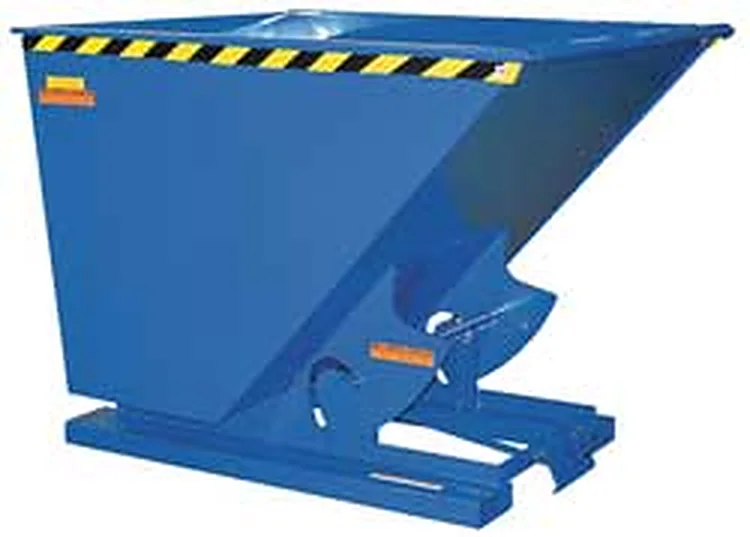
Stackable Self-Dumping Hoppers
The HOP series is the core of the S&L hopper range: eighteen published models across three duty classes. The duty class is set by the steel gauge, 12…
View specificationsThree numbers decide which hopper you need and they are independent of each other. Getting any one of them wrong produces a hopper that is either overloaded, oversized or will not sit on your fork truck.
The S&L tables list the same volume at more than one weight rating on purpose. A 1 cubic yard hopper is offered at 2,000, 4,000 and 6,000 lb.
That is because density varies enormously. Cast iron swarf reaches a 4,000 lb rating in a very small hopper, while packaging offcuts will not reach 2,000 lb in a large one. Work out which limit your material hits first, then specify to that limit.
On the stackable HOP series the duty class is defined by gauge rather than by adjective. 12 gauge is light duty, 10 gauge is medium and 7 gauge is heavy.
Light duty suits packaging waste and light offcuts. Medium duty handles general plant scrap. Heavy duty is for castings, cast iron swarf and anything that is dropped into the hopper rather than placed in it. A 12 gauge body under dropped castings is a short-lived hopper.
A hopper whose pockets do not match your truck is scrap on arrival, and this is not adjustable after the fact.
On the heavy duty sheet the fork opening is 7-1/2 by 2-1/2 inches across every size, but the pocket centre changes: 18 inches up to 1 cubic yard and 28 inches above it. On the low profile range, centres run 11-1/2 inches on the 1/4 cubic yard sizes, 11-3/4 on the 1/2 cubic yard sizes and 21-3/4 inches on the 1 and 1-1/2 cubic yard sizes.
If the hopper has to pass under a machine bed, a press bolster or a conveyor discharge, measure that clearance first. The low profile range starts at 18-1/4 inches overall height in the 1/4 cubic yard sizes.
Where headroom is not a constraint, the stackable HOP series is usually the better buy because stacking cuts stored floor space and container freight.
Hopper net weights run from 219 lb for a small low profile unit to 1,605 lb for HOP-500-HD at 5 cubic yards.
On the largest sizes the empty hopper is a meaningful share of what the truck is rated to lift at that load centre. Add the empty weight to the intended payload before checking the truck's capacity chart.
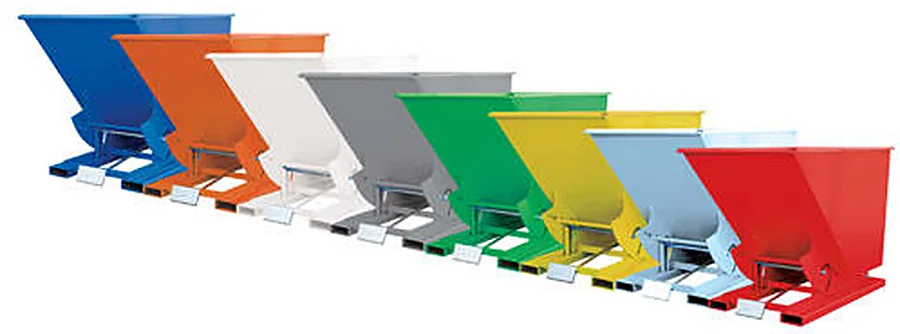
Steel self-dumping hoppers lined up in eight standard paint colours
Steel Hoppers
The HOP series is the core of the S&L hopper range: eighteen published models across three duty classes. The duty class is set by the steel gauge, 12…
View specifications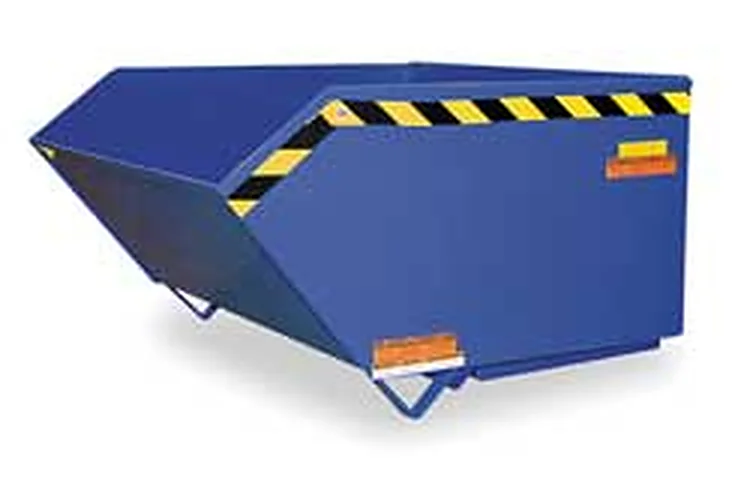
Steel Hoppers
A low profile hopper is the one that fits under a machine bed, a press bolster or a conveyor discharge. The smallest in this range stands 18-1/4…
View specifications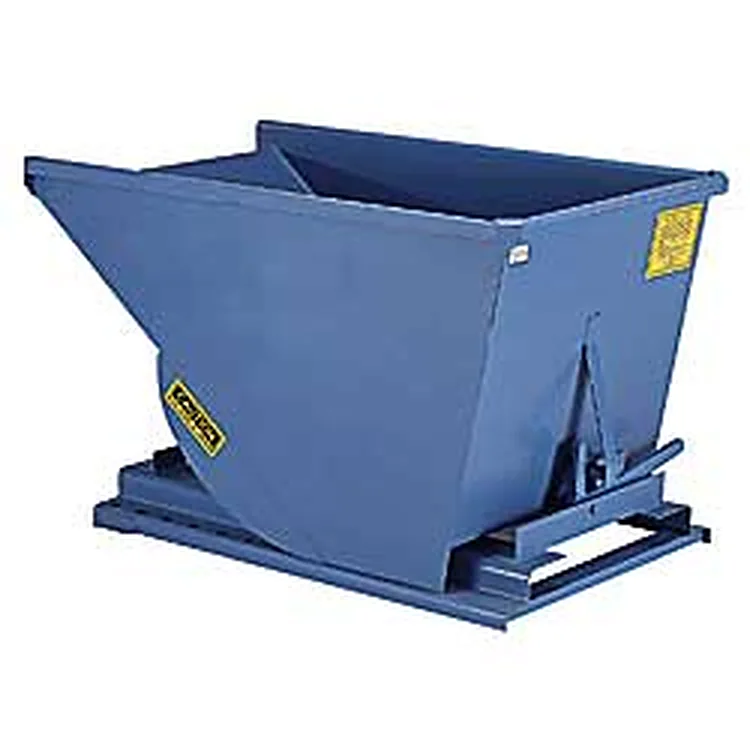
Steel Hoppers
This is the specification sheet buyers ask for when the hopper has to match a particular fork truck. Every size lists the fork opening at 7-1/2 by…
View specificationsOn the HOP series every model from 1/4 through 2 cubic yards is listed as stackable. HOP-300-HD, HOP-400-HD and HOP-500-HD are not.
HOP-500-HD: 5 cubic yards, 105-1/2 by 71-1/2 by 59-1/2 inches, 6,000 lb capacity, 1,605 lb net.
18-1/4 inches overall height on the 1/4 cubic yard sizes.
Material density decides the weight rating, bulk decides the volume and the fork pocket centres decide whether it fits the truck. With those three, the model code follows.