
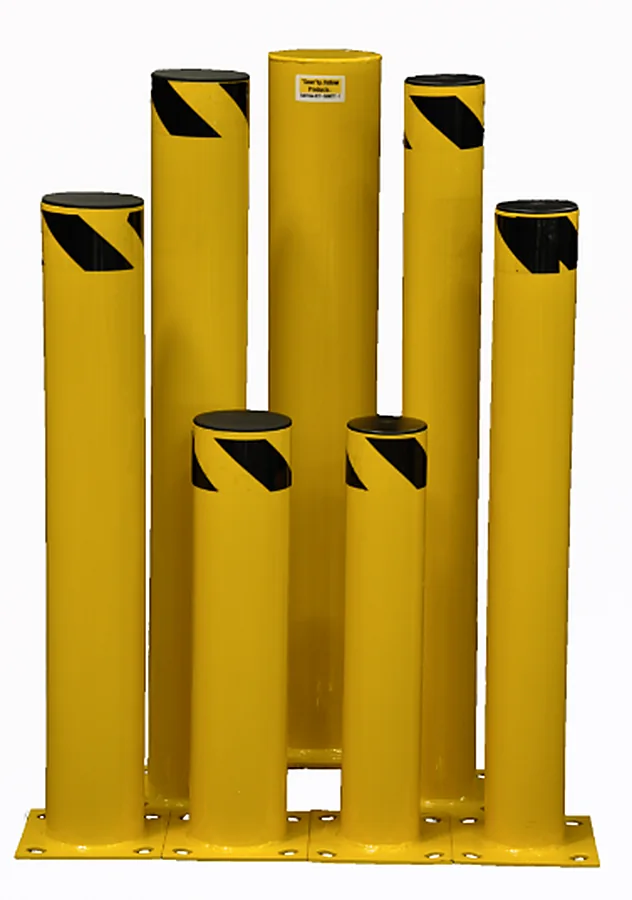
Bollards
Steel Safety Bollards
A steel safety bollard is a length of heavy wall pipe on a bolt-down base plate, set where a fork truck would otherwise reach something expensive.…
View specificationsThree products, three geometries. Get the geometry right and impact protection works unremarkably for years. Get it wrong and the guard becomes the thing that gets hit by the pallet it was meant to protect.
A bollard protects a point: a door jamb, a corner, a single isolator, a gas meter. It takes a direct hit and is replaced on its own.
A guard rail protects a line: a machine face, a bank of panels, the edge of a walkway. The rail spreads the impact between two posts.
A rack guard protects the bottom nine inches of a rack bay. It is deliberately low so a pallet entered at normal height passes over it.
S&L publishes bollards at 24, 36 and 42 inches. Twenty-four inches stops a pallet truck and stays clear of a door swing. Forty-two inches is for positions where a counterbalance mast could otherwise pass over a shorter guard.
Guard rails come in 36 and 48 inch heights. Use 36 inches to protect a machine from traffic, and 48 inches where the rail is also keeping people clear of the machine's working envelope.
Rack guards are 9 inches, and that number is not negotiable. A taller guard in a rack aisle gets struck by the load it exists to protect.
The bollard range offers 4.5 inch tube across all three heights and 5.5 inch tube in the 36 and 42 inch heights. Guard rails are offered in 4 and 5 inch tube. Rack guards use 4 inch tube.
Specify the larger diameter where a loaded counterbalance truck striking the guard at travel speed is a realistic event rather than a theoretical one: the bottom of a ramp, the junction of an aisle and a cross aisle, the approach to a dock door.
A guard fixed hard against the thing it protects transfers the impact straight into it. Set the bollard or rail far enough forward that a deformed guard still has room to move.
The same logic applies to rack guards. Standing the guard clear of the upright is what stops a struck guard from pushing into the frame.
Guard rail lengths are published at 10, 24 and 42 inches, which are designed to be built up into a continuous run on shared posts rather than fabricated as a one-off.
That matters more than it sounds. Cells get relocated, and a run assembled from standard sections can be taken apart and reused, while a one-off fabrication is scrapped.
A bent tube has already yielded. Straightening it restores the shape but not the material, and the next impact will find the same place.
All three products are bolt-down for this reason: replacement is a bolt-out job rather than breaking out the slab.
Range of yellow steel safety bollards with black chevron bands and bolt-down base plates
Bollards
A steel safety bollard is a length of heavy wall pipe on a bolt-down base plate, set where a fork truck would otherwise reach something expensive.…
View specifications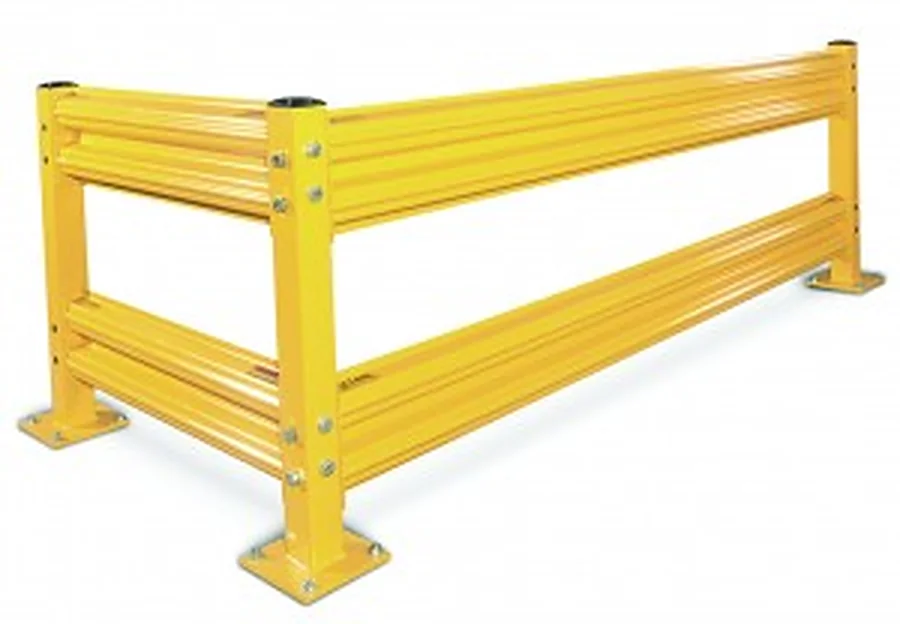
Machine Guards
A machine guard rail protects a line rather than a point. Two bolt-down posts carry one or two horizontal rails along the aisle side of a machine, a…
View specifications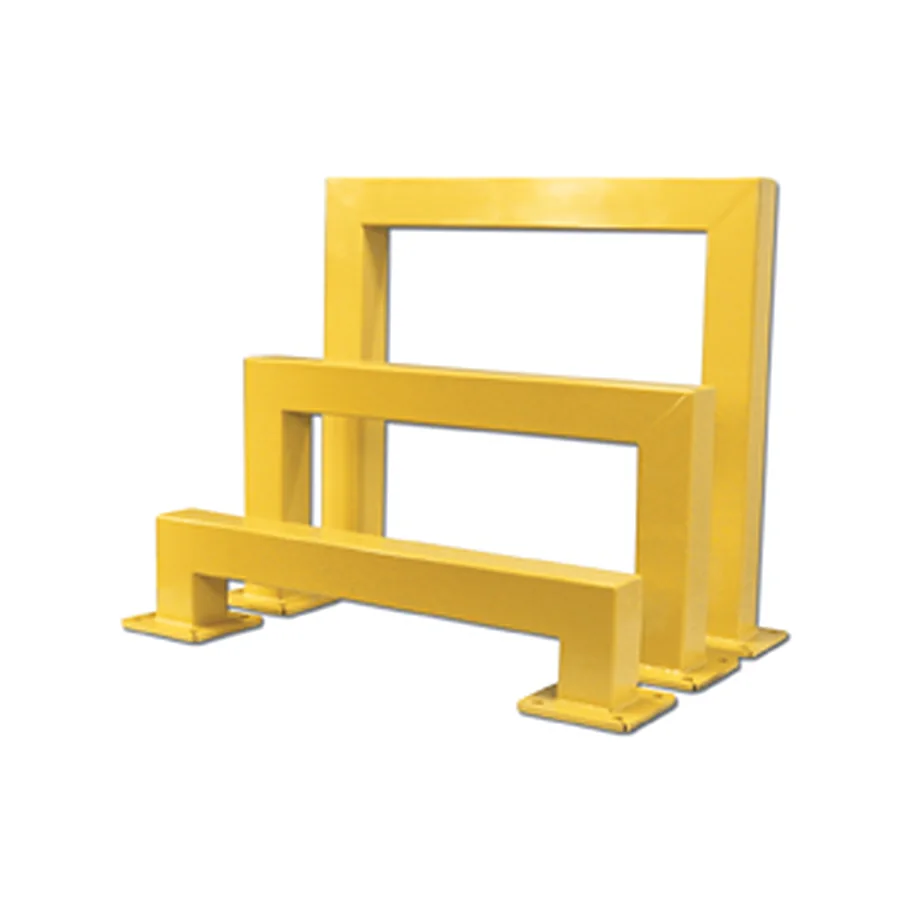
Machine Guards
A rack guard is deliberately low. At 9 inches it takes the hit from a fork tine or a pallet corner without fouling the pallet that has to be entered…
View specificationsHeights of 24, 36 and 42 inches. The 4.5 inch tube is available in all three; the 5.5 inch tube in the 36 and 42 inch heights.
Ten, 24 and 42 inches, in 36 and 48 inch heights, with 4 or 5 inch tube.
So a pallet entered at normal height passes over the guard instead of striking it.
Positions and hazards are enough to come back with heights, tube diameters and quantities across the whole building.