
Choosing Film Faced Plywood for Concrete Formwork
Face, glue, grade and core are four separate decisions. Each one moves the cost per pour, and they are often all left to the supplier.
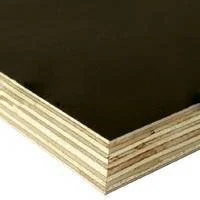
Cost per pour is the only number that matters
A panel that costs thirty per cent less and gives half the pours is more expensive. Before comparing prices, decide how many pours the project needs from each panel, because that determines which of the four specification decisions below you can afford to economise on.
Glue: MR or WBP
MR is moisture resistant, intended for dry interior use with occasional damp. WBP is weather and boil proof, a phenolic bond designed for repeated wet cycles. Formwork is a repeated wet cycle by definition. MR film faced panels exist and are cheaper, and they are appropriate only for very low reuse counts.
Core species
Poplar, combi, hardwood and birch are the four options. Poplar is the lightest and cheapest and gives the fewest reuses. Birch and hardwood are heavier, stiffer and last longer. Combi sits between them. On sites where panels are handled by hand, weight is a labour cost that should be counted alongside panel life.
Grade A and AA
The grade describes the face and construction quality. AA is the higher grade. On a visible concrete finish — exposed columns, architectural walls — grade drives the result. On foundations and hidden work it matters far less.
Face colour
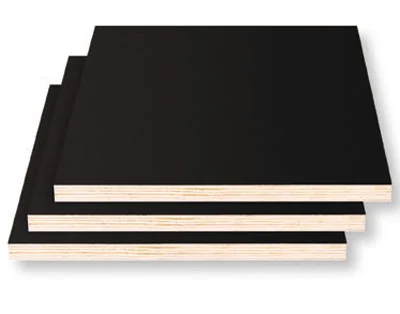
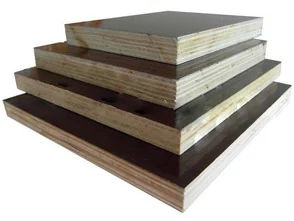
Black and brown films are offered against the same core, glue, grade and thickness options. The choice is usually a project specification rather than a performance difference, so confirm what the specification actually requires before paying a premium for one.
Thickness against span
9, 12, 18 and 21 mm are available. Thickness is chosen against the support spacing and the concrete pressure, not by habit. A thicker panel on close supports is money spent on stiffness that the formwork system does not need.
What ruins good panels
Almost all early formwork panel failure starts at a cut edge. Sealing every site-cut edge with edge paint on the day it is cut is the cheapest intervention available and the one most often skipped. After that: release agent on every pour, cleaning before the concrete fully cures, and flat stacking face to face between uses.

More Guides
How to Cut Oak Plywood Without Chipping
Why thin face veneers tear at the cut, and the blade, feed and support choices that stop it happening.
Read the guide →Buying GuideReading a Truck Tyre Size and Load Index Table
What each column of a TBR specification table means, and how to check a tyre against your axle load before you order.
Read the guide →Comparison ArticleMDF Particle Board and Plywood Compared
Three panel families, three different structures, and the practical consequences for machining, fixing and finishing.
Read the guide →Questions About This Topic
How many pours should I expect from a panel?
It depends on core, glue, grade, edge sealing and site handling. Our catalogue does not publish a reuse figure, because a figure quoted without those variables is meaningless. Describe your project and a specification recommendation will be given.
Which sheet sizes are available?
1220x2440 mm and 1250x2500 mm, in 9, 12, 18 and 21 mm.
Is WBP always the right choice?
For formwork it usually is. MR is only appropriate where the reuse count is very low.
Still Not Sure Which Specification You Need
Send the application, the machine or the part number and a recommendation comes back in writing before any order is placed.