
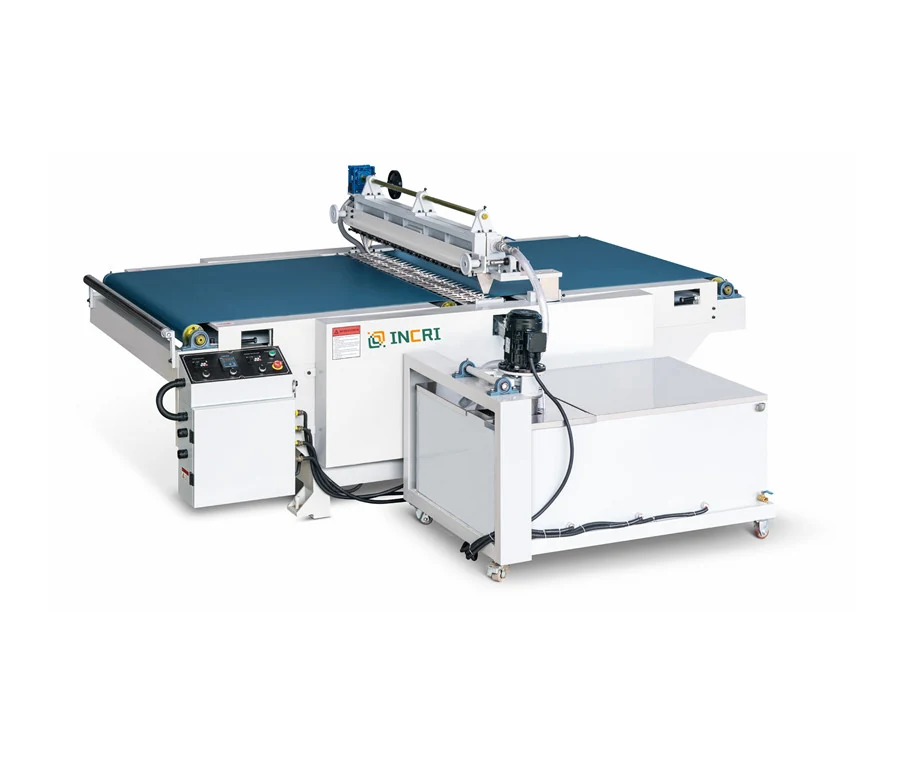
Roller Coating Is For Build
A roller coater transfers paint from an applicator roller to the panel, with a doctor roller setting the film at 5 to 10 g per square metre. Paint that does not transfer is recycled. It is the cheapest way to build primer and filler on a flat panel, and the three head machine puts filler, primer and a third layer down in a single pass at 11.1 kW. What it cannot do is finish a panel that must be mark free, because the roller contacts the wet film.
Curtain Coating Is For Mark Free Finish
A curtain coater passes the panel under a falling sheet of paint. Nothing touches the surface, so there are no roller lines to sand out, and film thickness can be taken down to 0.05 mm. Feed speed reaches 80 m per minute and paint is recycled through a circulation device. This is the high gloss route. The trade off is that a curtain coater needs a flat panel and a minimum length of 300 mm.
Spraying Is For Shapes
Neither roller nor curtain coating will touch a routed shaker front or a moulded door leaf, because both need a flat face. A reciprocating spray machine with photoelectric workpiece detection covers shaped work and edges, at the cost of more air handling and an overspray system. The published figures are worth noting: 900 L per minute of air at 0.6 to 0.8 MPa on a 1300 mm panel machine.
Most Lines Use Two Of The Three
A typical UV flat panel line roller coats the filler and primer, then curtain coats the top coat. A door plant that runs both flat slabs and routed fronts usually needs a roller coating route and a spray route, and the decision is which product volume justifies which line. The 5000 square metre a day roller coating line and the 8 by 45 m spray line are different answers to different product mixes.