Material Guide
PB MDF Plywood And Solid Wood Compared For Cabinet Work
The four panel materials used across the Sayea range, what each one is actually good at, and where buyers routinely specify the wrong one.
Four Materials One Cabinet
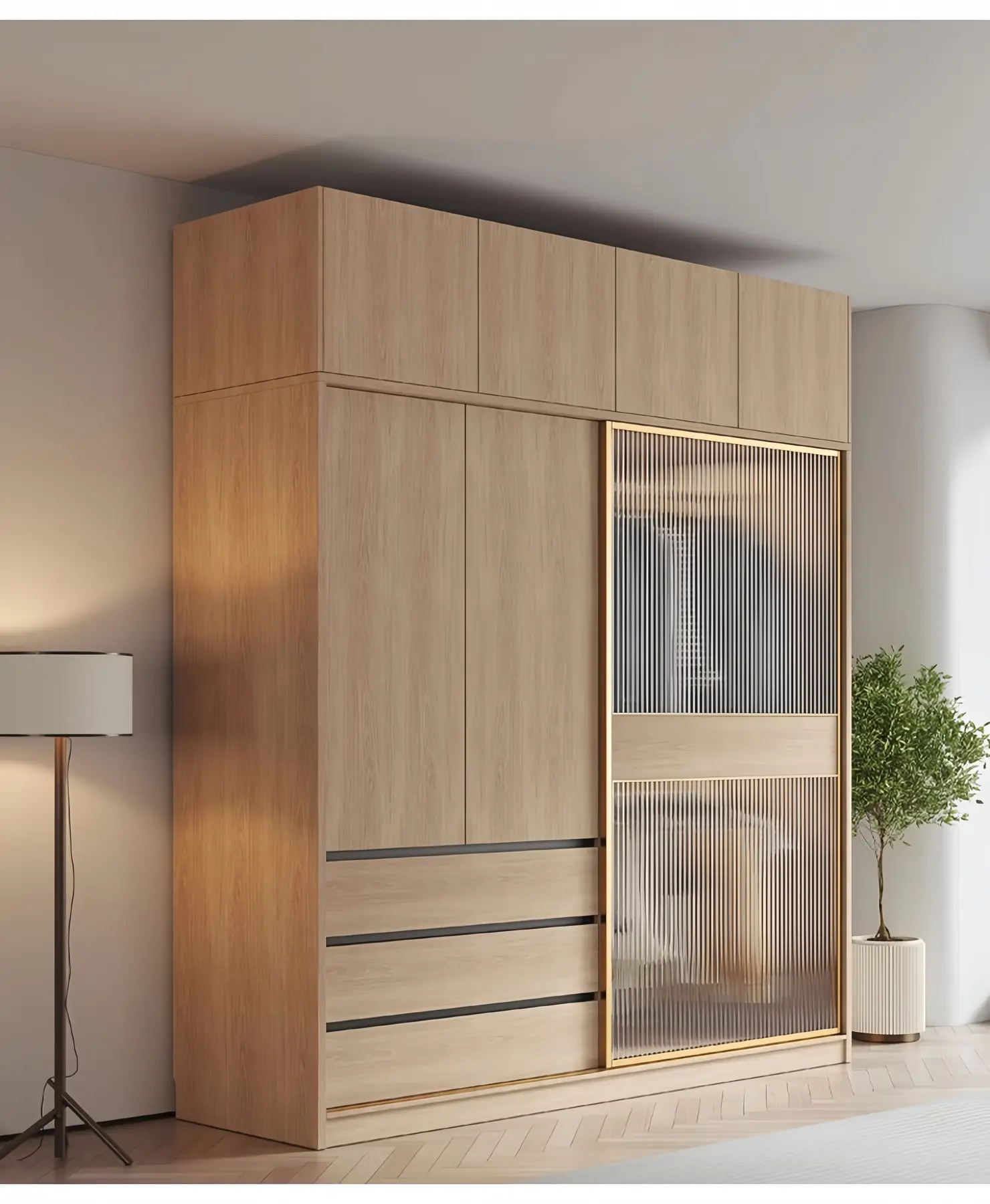
Cabinets here are built from particle board, MDF, plywood and solid wood. The useful decision is not which of the four is best, because none of them is best at everything. It is which one belongs on which component. A single wardrobe will often use three of them - a particle board carcase, an MDF door and a plywood shelf over a long span - and that mix is cheaper and better than specifying any one material throughout.
Particle Board
Particle board is wood chips bonded under pressure into a flat, dimensionally stable panel. It is the cheapest of the four and the most consistent in thickness, which is exactly what a hidden carcase side wants. Its weaknesses are edges and water: a raw particle board edge is fragile, which is why edge banding is not decorative, and a panel that sits wet will swell irreversibly. Specify it for carcase sides, backs and short-span shelving in dry rooms, and make sure every exposed edge is banded.
MDF
MDF is a finer fibre panel with no grain direction and a dense, uniform edge. That edge is the reason the shaker door exists in MDF: the profile can be machined into the panel and painted without the joints of a framed timber door telegraphing through the finish over time. MDF is heavier than particle board and holds paint better than any of the other three. It is not a structural material for long unsupported spans, and like particle board it does not tolerate standing water.
Plywood
Plywood is thin veneers glued in alternating grain directions, which is what gives it strength in both axes and its resistance to sagging. It holds screws far better than either chip or fibre panel, which matters at hinge plates and wall fixings that get loaded and re-loaded. It is the usual answer for heavy-duty carcases, long shelf spans, and rooms where humidity moves - a kitchen run beside a dishwasher, or a wardrobe in a coastal apartment.
Solid Wood
Solid timber moves with humidity across its width and effectively not at all along its length, which is why traditional joinery is built as frames and panels rather than as slabs. It is the only one of the four that can be sanded back and refinished repeatedly, and the only one where a damaged surface can be repaired invisibly. In modern cabinet work it is usually kept for visible fronts, frames and worktops rather than carcases, where its movement is a liability and its cost is invisible.
How To Specify The Mix
Work outward from what each component has to do. Carcase sides carry compression and are never seen, so particle board is adequate. Doors are seen constantly and must stay flat, so MDF for paint and veneered panel or solid wood for grain. Shelves are about span - under 800 mm almost anything works, over that plywood or a thicker panel. Anything near water goes to plywood. Anything that will be refinished later goes to solid wood.
Common Specification Mistakes
Three recur. Specifying plywood throughout, which adds cost to panels nobody sees or loads. Specifying particle board for a long open shelf, which sags within a year under media equipment or books. And specifying solid wood for a wide flat carcase panel, where seasonal movement will eventually show at every fixed joint. All three are avoided by quoting the cabinet component by component, which is how our drawings are built.
Have a specific case? Send the dimensions, the drawer schedule or the floor plan and you will get an answer about your project rather than the general rule.
Ask Our Export Team