
- Home
- Knowledge Center
- How Wood Slat Acoustic Panels Actually Reduce Noise
How Wood Slat Acoustic Panels Actually Reduce Noise
The felt does the work, not the timber. What the construction is, where it helps and what it will not fix.
The mechanism in one paragraph
Sound waves hit the panel and part of the energy passes through the gaps between the slats. Behind the slats is a felt made of recycled plastic. Inside that felt the air and the fibres move against each other, and friction and vibration turn sound energy into a small amount of heat. Energy consumed there is energy that does not come back into the room as echo.
What the panel is made of
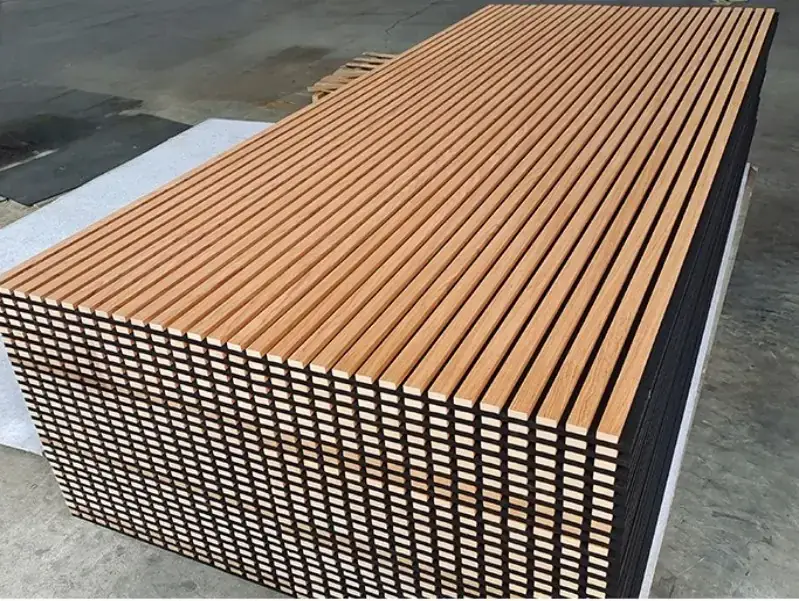
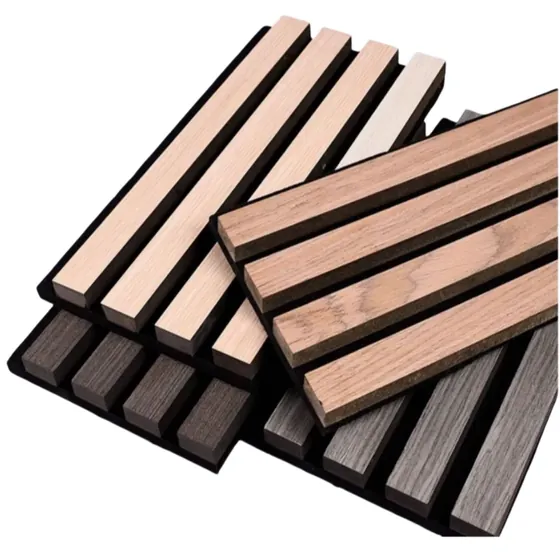
An engineered veneer face over MDF slats, bonded to the recycled plastic felt. Modules are 400x21mm and 600x21mm at 2.4m length or customized. That construction is why the panel reads as a timber wall while behaving as an absorber.
Where it helps most
Rooms with hard parallel surfaces: meeting rooms, restaurants, home theatres, open plan offices and hotel lobbies. The symptom to listen for is speech that is hard to follow even though it is loud enough. That is reverberation, and surface absorption is the fix.
What it will not do
Absorption is not insulation. A slat panel reduces echo inside a room; it does not stop sound passing through the wall into the next room. Sound transmission is a construction problem, solved by mass and separation in the wall build up, not by a surface finish.
Installing without a specialist trade
The panels fix with screws or adhesive. Keep the felt continuous behind the slats, butt the panels so the slat rhythm carries across the joint, and cut to room height before installation. Clean by vacuuming the felt gently.
What to ask a supplier
Ask what the backing is, because a printed fluted panel with no felt absorbs nothing. Ask for the module and the slat depth. If a laboratory absorption coefficient is required for a specification, ask what test data is on file rather than accepting a general claim.
Products Referenced In This Guide
Product Families Covered
Questions About This Guide
Do you publish an absorption coefficient?
Will it soundproof a room?
How much wall area do I need to cover?
Can the panels go on a ceiling?
Put This Into Practice
Send the room, the area and the finish you are working to and a recommendation with the matching published specification comes back.