
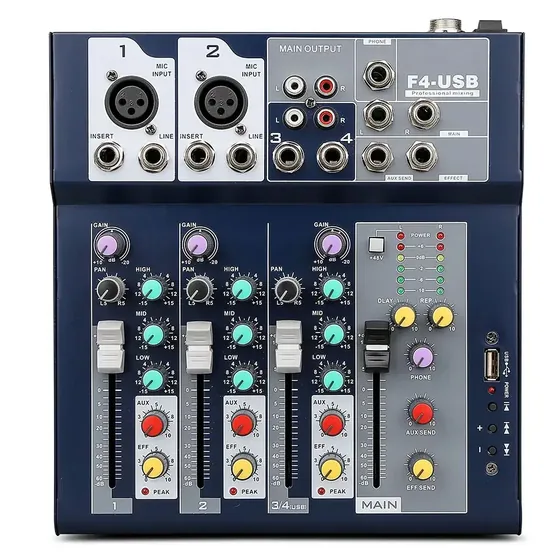
F4-USB
F4-USB 4-Channel Ultra Compact Mixer
The entry model at 21 USD, carrying the same published bench specification as desks costing twice as much.
View specificationThe choice between a dynamic and a condenser microphone decides more about your recordings than the price does. Here is how the two differ and which sources each one suits.
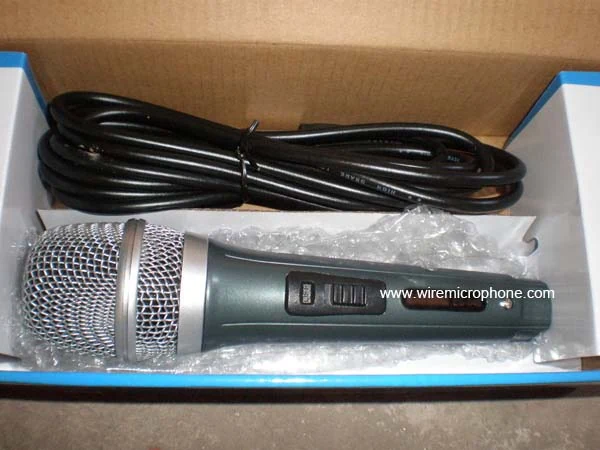
A dynamic microphone works on the moving-coil principle — effectively a loudspeaker running in reverse. The coil has mass, so the diaphragm resists being moved quickly, and high-frequency response suffers as a result. Most dynamics stay useful to somewhere around 15 to 16 kHz and then fall away sharply.
What you get in exchange is durability, a low price and a solid, punchy character that suits loud sources: guitar cabinets, bass, drums and brass. Dynamics need no phantom power, which is why they dominate live use.
A condenser microphone uses a very thin diaphragm, often metal-coated, forming part of an electrical capacitor. With no heavy coil attached, it tracks high frequencies far more accurately. It needs phantom power to polarise the capsule and run its internal preamp. Every mixer in our range supplies 48V phantom power, so this is not a constraint on the desk side.
Sensitivity determines how much gain you must add at the mixer to reach a working level. Dynamics are relatively insensitive. Close-miked vocals and loud instruments are fine, but quiet acoustic sources recorded at a distance force you to wind the gain up, and gain brings hiss with it.
This is where a published noise figure earns its place. Our F4-USB, F7-USB and CT-80S all specify 120 dB E.I.N. on the microphone inputs, so the preamp is not the weak link when you need that gain.
A back-electret capsule carries a permanent charge in an insulating film on its backplate, so no external polarising voltage is needed. A voltage is still required for the onboard preamp, supplied by phantom power, a battery or both.
Models designed to run on batteries for live work are usually less sensitive than phantom-only studio versions. That is a design decision to suit close-miking on stage, not a defect.
Cardioid is the most useful pattern in a project studio because it rejects more of the room and more spill from other sources. Omnidirectional microphones sound more open and natural but pick up equally in all directions, so they only make sense in a room that genuinely sounds good.
Cardioid and figure-of-eight microphones both show proximity effect — a bass lift as you move close to the source. Omnidirectional microphones do not, which can be an advantage for close work where you do not want the low end building up.
If you are recording loud sources, or the room is untreated, or the microphone will be handled by other people, start with a dynamic. Our dynamic microphone series is held in stock in metal and moulded bodies, in cabled, switched and USB variants.
If you are recording voice or acoustic instruments in a controlled room, a cardioid condenser will capture detail a dynamic cannot. Add a shock mount so floor vibration never reaches the capsule, and budget for a desk with phantom power and clean gain.
The entry model at 21 USD, carrying the same published bench specification as desks costing twice as much.
View specification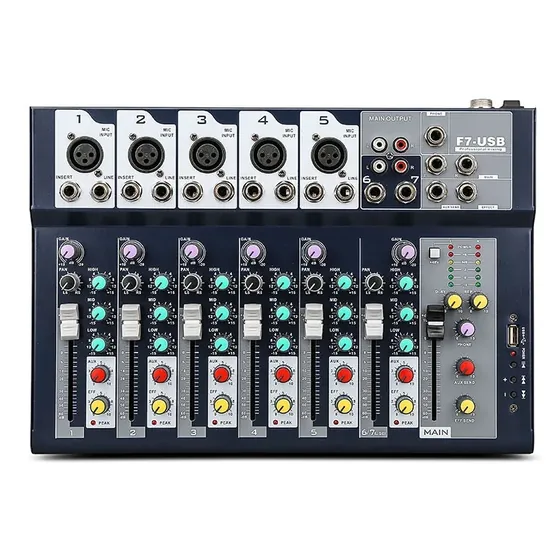
Seven inputs with effects and published bench figures at 29 USD — the value point of the range.
View specificationNo. A moving-coil dynamic microphone generates its own signal and works from any standard microphone input. Leaving 48V phantom power switched on does not normally harm a balanced dynamic microphone, but there is no reason to enable it.
Cardioid, in almost all cases. It rejects more room sound and more spill from other sources than an omnidirectional pattern, which matters most in an untreated room.
That is proximity effect, a bass lift that cardioid and figure-of-eight microphones show at close range. Back off slightly, or cut the 80 Hz EQ band on the mixer — all three of our F-series and CT-series desks have their low shelf centred there.
Tell us the application and quantity and we will translate it into models, minimums and a landed price.