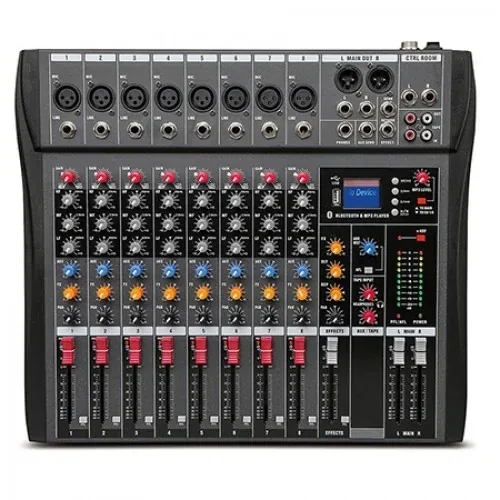
CT-80S
CT-80S 8-Channel Audio Effects Mixer With USB
The fully specified desk in the range, with published output levels, headphone loading and mains versions for five markets.
View specificationBuyers assume more RF power means more range. Field testing repeatedly shows otherwise. Here is how to test a system against the conditions it will really face.
There are thousands of wireless microphone manufacturers and, at the level of published technical indices, remarkably little difference between their products. Plenty of systems with good numbers on paper disappoint in use.
Part of the problem is that most buyers cannot test. A proper radio laboratory with a full set of measuring instruments is not something a distributor or an AV integrator has, so the choice defaults to imitation: this brand is what everyone else uses, so it must be right. That works until the room changes.
Higher transmitter RF power in particular is a poor predictor of working distance. In practical tests, a 100 mW system has repeatedly outperformed a 250 mW system over the same route, because reception quality is governed by the receiver, the antenna arrangement and the building — not by transmit power alone.
In a fixed installation with a settled channel plan, a mediocre system usually gets by. The risk concentrates in non-fixed installations: outside broadcast, mobile production, event work. The receiver position changes constantly, the environment cannot be predicted, and conditions can deteriorate badly while still nominally inside the system's published range.
When that happens on location, the crew stops to re-adjust, reconsiders the pickup plan, or replaces the equipment. All three are expensive.
Place both receivers being compared at the same point. Have two people each carry a different transmitter — one a lavalier head, one a handheld — and walk the same defined route, speaking continuously and calling out their position as they go.
Feed each receiver into a separate mixer input and record both to separate tracks on a digital audio workstation. Recording is the point: it lets you compare waveforms afterwards instead of arguing about what someone thought they heard.
Walk the route to a known end point — a doorway, a corner, the far wall. Note where dropouts, frequency loss or complete signal loss begin for each system. Shielded structures such as doorways and stairwells are where differences appear first.
Range is only one variable. Distortion, noise, interference and stability all matter, and the recorded waveform shows interruptions that a listener standing in the room may not consciously register.
One practical note on levels: if you take a receiver's microphone-level output into a mixer's microphone input, a high-sensitivity input stage can be overloaded. Use the line output and a line input where the receiver offers it, and compare like with like across the systems you are testing.
Weymic's own RF work is done on instruments rather than by ear: Motorola high-frequency wireless testing instruments, an HP high-frequency signal source, Fourier analysers and frequency sweep instruments, alongside surface-mount assembly equipment.
If you are evaluating our VHF range for a specific venue, send the channel count and the country and we will tell you what the frequency plan allows before you commit.
The fully specified desk in the range, with published output levels, headphone loading and mains versions for five markets.
View specificationNot reliably. Field comparisons repeatedly show a 100 mW system outperforming a 250 mW system over the same route. Receiver design, antenna arrangement and the building itself matter more than transmit power.
Yes. Place the receivers at one point, walk a fixed route with the transmitters while speaking continuously, and record each receiver to its own track. Comparing recordings shows dropouts that listening in the room will miss.
Use the line output into a line input where the receiver offers both. Feeding a mic-level output into a high-sensitivity mixer microphone input can overload the input stage and misrepresent the system.
Tell us the application and quantity and we will translate it into models, minimums and a landed price.