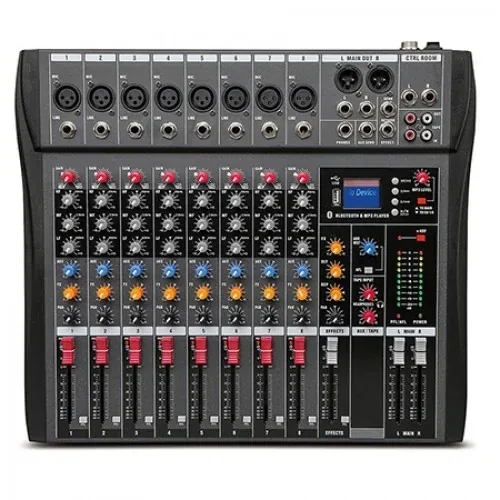
CT-80S
CT-80S 8-Channel Audio Effects Mixer With USB
The fully specified desk in the range, with published output levels, headphone loading and mains versions for five markets.
View specificationA mixer combines, routes and shapes audio signals. Choosing one comes down to input count, what the desk must do on its own, and whether you need published figures.
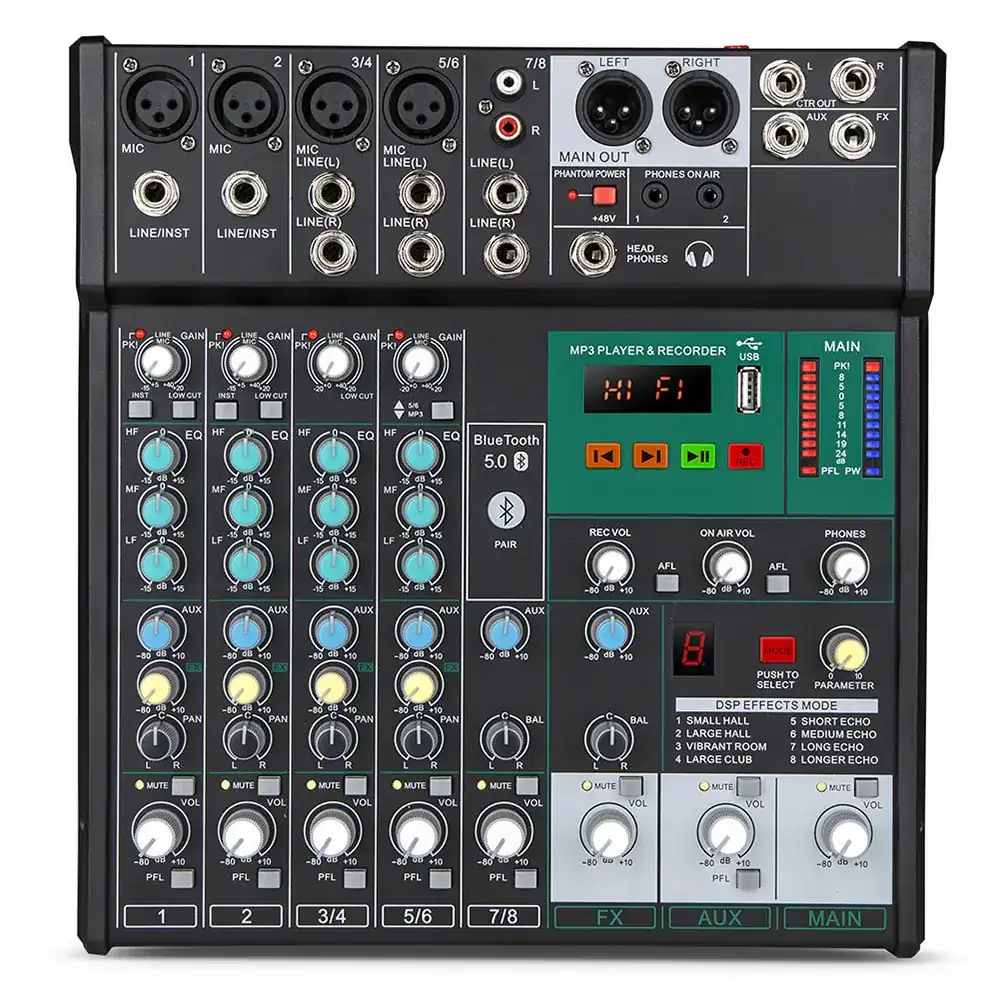
A mixing console — also called an audio mixer, sound board or mixing desk — is an electronic device for combining, routing and changing the level, timbre and dynamics of audio signals. The modified signals are summed to produce the combined output.
The simplest example: two vocalists singing a duet into two microphones, heard through one set of speakers. Beyond that, mixers appear in recording studios, public address, sound reinforcement, broadcast, television and film post-production.
In live use the mixer output usually feeds an amplifier, unless the mixer is powered or it is driving powered speakers directly.
Count the sources you will actually connect, then add two. Running out of inputs mid-installation forces a second desk, which costs a channel of gain and adds another power supply and another failure point.
Our range runs 4, 5, 6, 7, 8 and 12 channels: F4-USB, AR8, CT-60S, F7-USB, CT-80S and RX12 respectively. Every one of them provides 48V phantom power, so condenser microphones are never the constraint.
This is the question that decides the model. If the room has no separate player and no technician, the CT-60S puts an MP3 player, a U-disk slot, Bluetooth and USB recording inside the desk.
If the desk travels with a DJ or sits on a streaming desk, the AR8 is the mini DJ format with Bluetooth, USB and MP3 playback and a stereo output. If it needs twelve inputs and reverb, the RX12.
Three of our models publish full bench figures: the F4-USB and F7-USB at 20 Hz to 25 kHz within +/-1 dB, and the CT-80S tighter at +/-0.5 dB on mic and stereo channels. All three specify 0 to +40 dB of microphone gain and 120 dB E.I.N.
The CT-80S goes further, publishing main, AUX, effects and tape output levels, headphone loading of 350 mW into 30 to 600 ohms, maximum input and output levels, and five mains versions. If you have to defend the specification to your own customer, that is the model to quote.
The RX12, CT-60S and AR8 carry TBC on bench figures in the current catalogue. Email the model number and the factory will send the specification sheet.
We manufacture these desks in Enping, Guangdong and sell direct to importers, distributors and brand owners. Minimum orders run from fifty pieces on the RX12 and one hundred on the rest, samples are available in ones and twos, and stocked lines despatch within a week of the proforma invoice being settled.
The fully specified desk in the range, with published output levels, headphone loading and mains versions for five markets.
View specification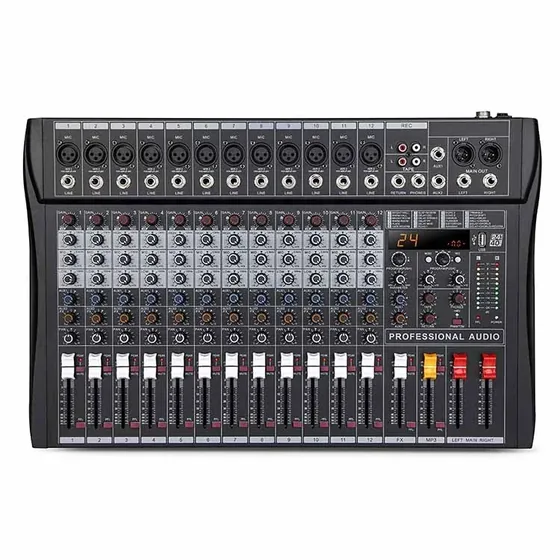
The largest desk in the range: twelve channels, 48V phantom power, reverb, and USB and Bluetooth playback in one analogue chassis.
View specification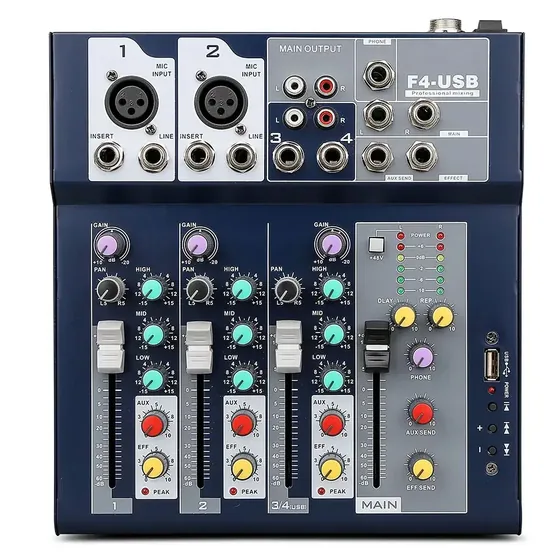
The entry model at 21 USD, carrying the same published bench specification as desks costing twice as much.
View specificationCount the sources you will actually connect and add two for headroom. Our range covers 4, 5, 6, 7, 8 and 12 channels, so most requirements land on a model without over-buying.
The CT-80S. It is the only model with full published figures for output levels, headphone loading, maximum input and output levels and mains versions, and it holds +/-0.5 dB across 20 Hz to 25 kHz on mic and stereo channels.
Yes, all six models supply 48V phantom power for condenser microphones.
The F4-USB at 21.00 USD per piece, minimum order one hundred pieces. It publishes the same bench specification as the F7-USB.
Tell us the application and quantity and we will translate it into models, minimums and a landed price.