
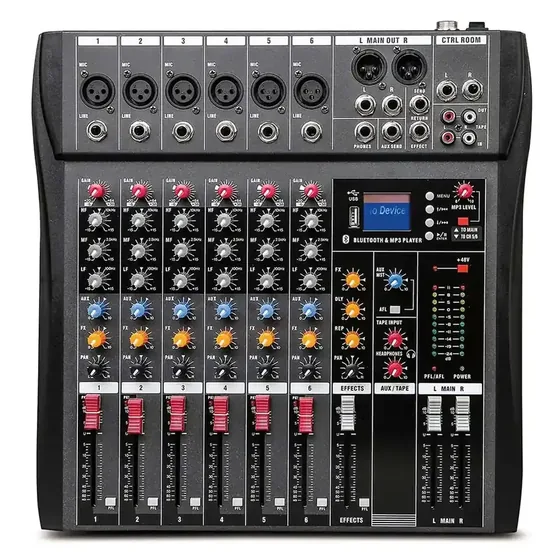
CT-60S
CT-60S 6-Channel Mixer With MP3 Player and Bluetooth
Six channels with an on-board MP3 player, U-disk slot, Bluetooth and USB recording — a self-contained desk for rooms with no separate source equipment.
View specificationA wireless microphone replaces the cable with a radio link. Understanding which part of that link is fragile tells you which system to specify.
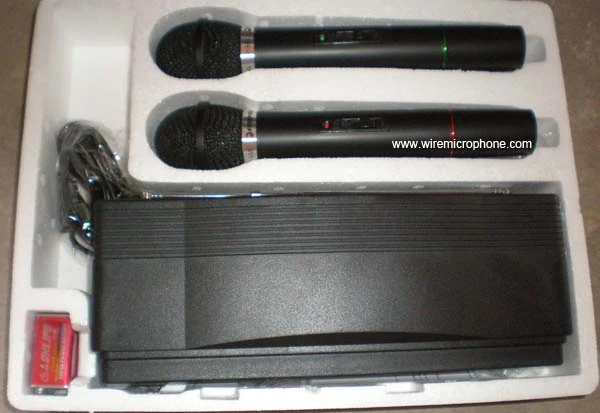
A wireless microphone has a small battery-powered radio transmitter inside the microphone body. It sends the audio by radio to a nearby receiver, which recovers the signal and passes it on by cable to the mixer or amplifier. Everything downstream of the receiver is conventional wired audio.
Our VHF systems are supplied as matched kits — receiver, handheld transmitters and leads packed together — so the dealer and the end user are not left matching components.
Many older systems operate in the VHF part of the spectrum. These are often crystal-controlled and therefore run on a single fixed frequency. That sounds like a limitation, and in a crowded environment it is. In a fixed installation where the frequency has been chosen properly, it is the opposite: the system works for years without anyone re-scanning anything.
Most modern products operate in the UHF television band. Band limits vary by country, and regulators have repeatedly changed what is permitted there, so a UHF system specified for one market may not be legal in another.
The practical rule: permanent installations with a stable channel plan suit VHF. Touring rigs, multi-channel productions and anywhere the plan changes often suit UHF.
As a planning figure, there is room for roughly one to two microphones per megahertz of available spectrum. The limit is not the number of channels on the receiver — it is interference between the transmitters themselves.
Intermodulation occurs when two or more radio signals mix in a non-linear circuit. Predictable combinations of the original frequencies appear as new signals. If one of those combinations lands close to another system's operating frequency, that channel picks up interference.
This is arithmetic, not guesswork. The combinations have to be calculated for the specific set of frequencies in use, either by hand or with software written for the purpose. Tell us the channel count and the country and we will confirm what is workable before you order.
Beyond VHF and UHF radio, systems exist using FM, AM and various digital modulation schemes, and some low-cost or specialist models use infrared light instead of radio. Infrared requires a clear line of sight between microphone and receiver; radio does not, which is why radio dominates outside specialist applications.
Six channels with an on-board MP3 player, U-disk slot, Bluetooth and USB recording — a self-contained desk for rooms with no separate source equipment.
View specificationNeither is better in the abstract. VHF systems are usually crystal-controlled on a single frequency, which makes them reliable for years in a fixed installation with a good channel plan. UHF is the better answer where many systems share a space or the frequency plan changes often.
Plan on roughly one to two microphones per megahertz of usable spectrum, and calculate intermodulation between the transmitters rather than assuming the channels are independent. Send us the channel count and country and we will confirm.
Seventeen: VHF-E200, VHF2000W, VHF2100W, VHF2300, VHF2400, VHF242, VHF2500, VHF3000W, VHF3100W, VHF311, VHF3200W, VHF330, VHF3300W, VHF332, VHF335, VHF4200W and VHF60. Per-model frequency specifications are available from the factory on request.
Tell us the application and quantity and we will translate it into models, minimums and a landed price.