
Knowledge Center
Silicon Carbide Material Guide
How pressureless sintered silicon carbide and reaction bonded sintered silicon carbide are made, what each grade resists, and how to choose between them.
Why Silicon Carbide
One of the Most Popular High Performance Tribo-Materials
Silicon carbide has been commercially available for more than twenty-five years. Its features include:
- Excellent abrasion and wear resistance
- Excellent corrosion resistance
- Low coefficient of friction
- Low coefficient of thermal expansion
- High thermal conductivity
Grades
Different Grades of Silicon Carbide
Reaction Bonded Silicon Carbide (RB SiC)
A very economical material which gives excellent wear characteristics, as well as good chemical resistance.
Sintered Silicon Carbide (SSiC)
The absence of free silicon makes it most resistant to chemically-aggressive fluids, and ideal for high temperature applications.
SSiC
Pressureless Sintered Silicon Carbide
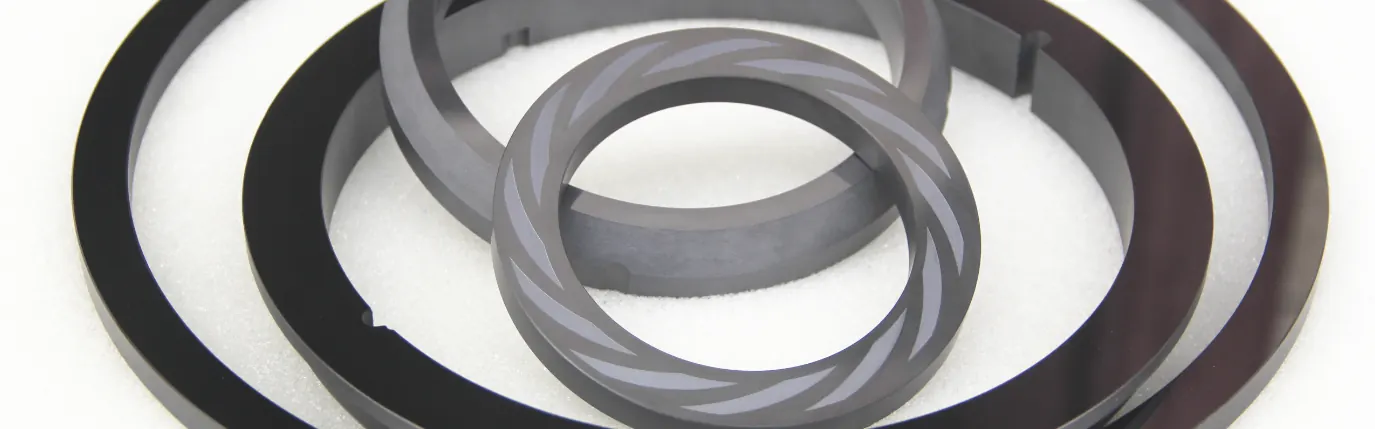
Pressureless sintered of silicon carbide in high purity and ultrafine silicon carbide powder as raw material, add a small amount of sintering additives at 2100 °C high temperature sintering vacuum environment, the products obtained almost entirely density, excellent mechanical properties of ceramic materials. It can be used in the high concentrations of acid or alkali medium. This material is widely application in mechanical seal face, valve bearing and oil, chemical industry, aerospace, automotive and other fields.
They have the property of excellent resistant-corrosion, high mechanical strength, high thermal conductivity, good self-lubrication, used as seal faces, bearings and tubes in spacecraft, machinery, metallurgy, printing and dyeing, food stuff, pharmaceutical, auto industry and so on. When the SiC faces are combined with graphite faces the friction is the smallest and they can be made into mechanical seals which are able to work in highest working requirements.
RBSiC
Reaction Bonded Sintered Silicon Carbide
Reaction bonded sintered silicon carbide is made from fine particles of silicon carbide and additive compressed into billet, at 1500 °C to 1800 °C high temperature vacuum contact with liquid silicone, free silicon filling the pores, and high density of ceramic material is obtained. It can be used in medium acid or mild alkaline medium. It can be at medium concentration of acid or used in mild alkaline medium, it is widely used in bearing and oil, chemical, automobile and ship, pump valve and other fields.
Comparison
SSiC Compared With RBSiC
| Operating Limits | Units | SSiC | RBSiC |
|---|---|---|---|
| Volume Density | g/cm³ | 3.08~3.15 | ≥3.03 |
| Hardness | HRA | ≥92 | ≥90 |
| Indicated Porosity | % | <0.2 | <0.2 |
| Compressive Strength | Mpa | ≥2400 | ≥2000 |
| Flexural Strength | Mpa | >400 | >350 |
| Free-Si content | % | <0.1 | <12 |
| Purity (SIC Percentage) | % | ≥99 | ≥98 |
| Elastic Modulus | GPa | ≥400 | 350 |
| Thermal Conductivity | w/m.k | 90-110 | 50-100 |
| Coefficient of Thermal | 10⁶.1/°C | 4.0 | 4.0 |
| Maximum Service Temp Air | °C | 1600 | 1000 |
| Operating Limits | Units | RBSiC |
|---|---|---|
| Volume Density | g/cm³ | 3.02-3.05 |
| Hardness | HRA | ≥90 |
| Indicated Porosity | % | <0.3 |
| Compressive Strength | Mpa | ≥2000 |
| Flexural Strength | Mpa | >350 |
| Free-Si content | % | <8-12 |
| Purity (SIC Percentage) | % | ≥90 |
| Elastic Modulus | GPa | ≥350 |
| Poisson Ratio | --- | 0.14 |
| Thermal Conductivity | w/m.k | 50-100 |
| Coefficient of Thermal expansion | 10⁶.1/°C | 4.0 |
| Maximum Service Temp Air | °C | 1000 |
FAQ
Material Questions
How Is SSiC Made
How Is RBSiC Made
Which Grade Resists Acid Better
Which Grade Is More Economical
Why Pair Silicon Carbide With Graphite
Not Sure Which Grade You Need
Send us the medium the concentration the temperature and the shaft speed and our team will recommend the grade.