
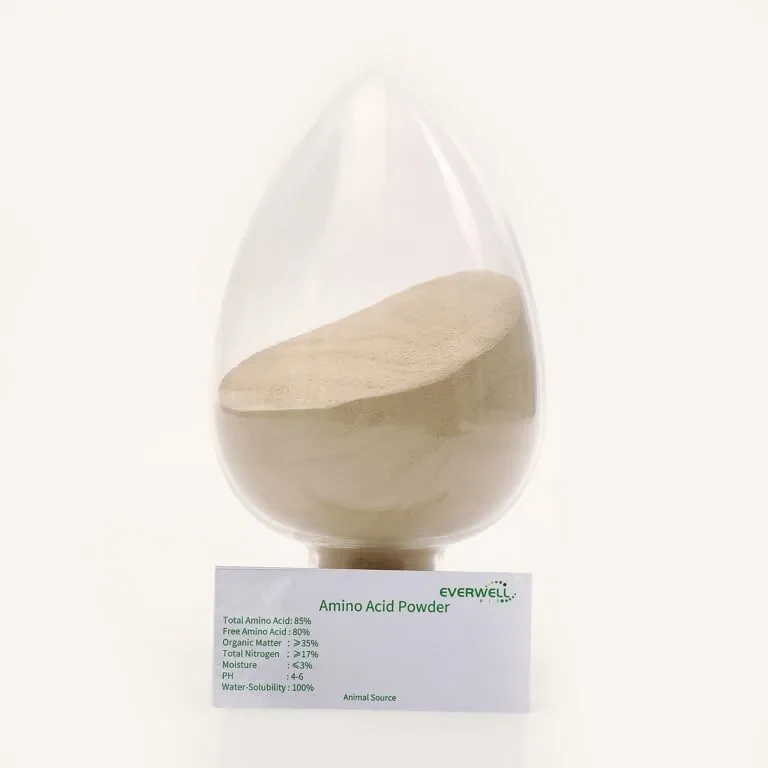
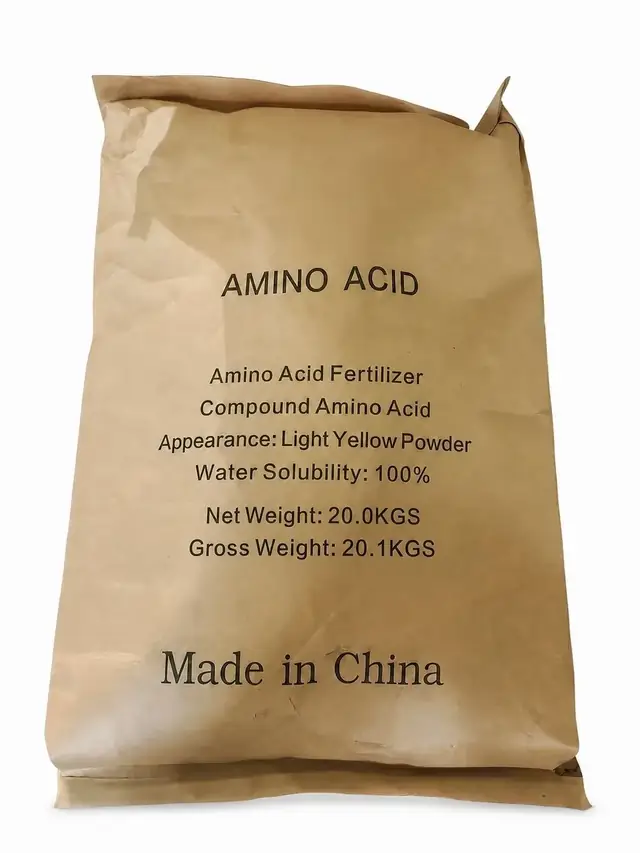

Amino Acids 80 — Maximum Concentration, 75.37% Free Amino Acids Verified
The density grade: ≥ 80% total amino acids, ≥ 80% organic matter, and 75.37% free amino acids measured by Eurofins. Glycine and proline rich, for concentrates where actives per kilogram decide the economics.
- Total Amino Acids≥ 80%
- Total Nitrogen≥ 12%
- Organic Matter≥ 80%
- Moisture≤ 5%
- pH (1% solution)4 – 6
What This Product Is
Amino Acids 80 is the top of the range: at least 80% total amino acids and at least 80% organic matter, from the same hydrolysed duck feather protein as the rest of the line.
Eurofins (Chengdu) measured free amino acids in this grade at 75.37% under GB/T 18246-2019, certificate AR-26-Y3-008791-02, issued 29 April 2026. Free amino acids are the immediately plant-available fraction, and at three quarters of the powder by weight this grade is close to being that fraction outright.
The measured profile is led by glutamic acid 12.13%, glycine 11.56%, serine 10.04%, aspartic acid 7.97% and proline 7.92%. Glycine is the smallest amino acid and acts as a natural chelating agent for micronutrients; proline is associated with osmotic stress response. That combination is why this grade is specified into high-strength biostimulants rather than into volume blends.
What You Get
- More actives per kilogram: lower inclusion rates, lower freight per unit of active, higher formulation value
- 75.37% free amino acids, independently measured by Eurofins
- Glycine at 11.56% free content — the smallest amino acid and a natural micronutrient chelator
- Proline at 7.92% free content, associated with osmotic stress tolerance
- ≥ 80% organic matter, the highest in the range
Who Buys It
- Biostimulant manufacturers at 20 to 50% inclusion in finished concentrate
- Specialty liquid concentrate formulators working to a target active concentration
- Tea and high-value cash crop programmes spraying at low dilution
- Nurseries running concentrated drenches at small volumes
What It Fixes
- Freight cost per unit of active on long ocean routes
- Concentrates that cannot reach the target active level without exceeding the volume budget
- Micronutrients precipitating out of a blend for want of a chelating agent
- Flagship products whose analysis has to stand up in front of a technical buyer
How It Is Made And Supplied
- Source: hydrolysed duck feather protein
- Controlled hydrolysis, purification, concentration and spray drying
- Free amino acids verified by Eurofins (Chengdu), certificate AR-26-Y3-008791-02, 29 April 2026
- Total nitrogen ≥ 12% — lower than the 35 and 45 grades because the powder is amino acid rather than protein dominated
- pH 4 to 6 in 1% solution; moisture ≤ 5%; 100% water solubility
- Same packaging options as the rest of the range, including OEM artwork
Technical Data
Typical specifications. Every shipment is verified against the agreed values and supplied with a batch-specific COA; where a value is not published it is left out rather than estimated.
| Total Amino Acids | ≥ 80% |
|---|---|
| Total Nitrogen | ≥ 12% |
| Organic Matter | ≥ 80% |
| Moisture | ≤ 5% |
| pH (1% solution) | 4 – 6 |
| Water Solubility | 100% |
| Appearance | Light yellow to brown powder |
| Source | Hydrolysed duck feather protein |
| Free Amino Acids (Eurofins) | 75.37% |
| Amino Acid | Free Content (Eurofins) |
|---|---|
| Glutamic Acid | 12.13% |
| Glycine | 11.56% |
| Serine | 10.04% |
| Aspartic Acid | 7.97% |
| Proline | 7.92% |
Free amino acid values from Eurofins (Chengdu) certificate AR-26-Y3-008791-02, method GB/T 18246-2019, issued 29 April 2026. Total free amino acids 75.37%.
Typical Use Rates
Rates vary by crop, growth stage and formulation target. Our team provides crop-specific recommendations on request.
- Foliar spray at 50 – 150 g per 100 L of water (0.05 – 0.15%)
- Fertigation and drip at 1 – 2 kg per hectare per application
- High-strength biostimulants at 20 – 50% of finished concentrate
- Specialty liquid formulations dosed to a target active concentration
- Seed treatment at a 0.05 – 0.1% solution
- Tea foliar programmes 7 – 10 days before each plucking round at 0.1 – 0.15%
How It Compares With The Alternatives
| Against Amino Acids 45 | 75.37% free amino acids against 41.93%, so roughly half the inclusion reaches the same active load — at a higher price per ton. |
|---|---|
| Against Amino Acids 35 | 80 carries more than double the total amino acids and organic matter; 35 carries more total nitrogen and suits hectare-scale budgets. |
| Against a synthetic chelate | Glycine chelation is part of the amino acid input itself rather than a separate chelating agent added to the blend. |
| Against buying volume and concentrating it | The concentration step is already done, and the result is verified on a named Eurofins certificate. |
From Sample To Production Batch
Step 1
Work out the target active concentration first; at this grade the inclusion rate falls out of that number.
Step 2
Halve the rate you would use for a 45 grade as a starting point, then confirm against the free amino acid figures.
Step 3
Pre-dissolve with agitation into a partly filled tank; the powder reaches full solution without extra mixing time.
Step 4
Reconcile the pH 4 to 6 window with the rest of the concentrate before scaling up.
Step 5
Jar test with all tank partners at field concentration before the first commercial batch.
Step 6
Keep the batch COA with the production record; at this inclusion level the analysis is the product claim.
Product, Packaging And Application
Questions About Amino Acids 80
Why is total nitrogen lower than in the 35 grade?
Total nitrogen counts all nitrogen present. The 80 grade is dominated by free amino acids rather than by residual protein, so its specified total nitrogen is ≥ 12% while the 35 grade is ≥ 17%.
What does the glycine content actually do?
Glycine is the smallest amino acid and acts as a natural chelating agent, complexing micronutrients in a blend. This grade carries glycine at 11.56% free content.
Is it worth the price difference over the 45?
It depends on freight and packaging. At 75.37% against 41.93% free amino acids, roughly half the mass reaches the same active load, which matters most on long ocean routes and in concentrated products.
Which certificate covers this grade?
Eurofins (Chengdu) AR-26-Y3-008791-02, method GB/T 18246-2019, issued 29 April 2026.
What foliar rate should we start with?
50 to 150 g per 100 L of water, which is 0.05 to 0.15%. Tea programmes typically run at 0.1 to 0.15%.
Do you supply samples of this grade?
Yes — 200 to 500 g free of charge with the batch COA.
Other Grades In The Range
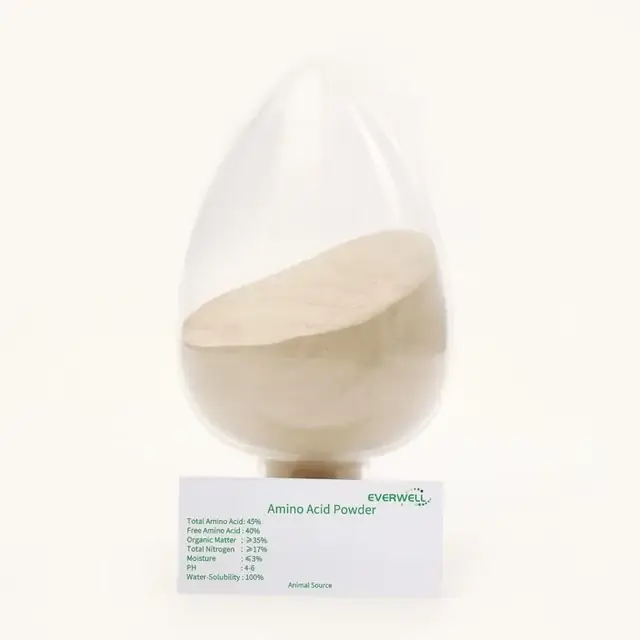
Amino Acids 45
The benchmark grade: ≥ 45% total amino acids, ≥ 60% organic matter, and 41.93% free amino acids measured by Eurofins under GB/T 18246-2019. The grade
View specification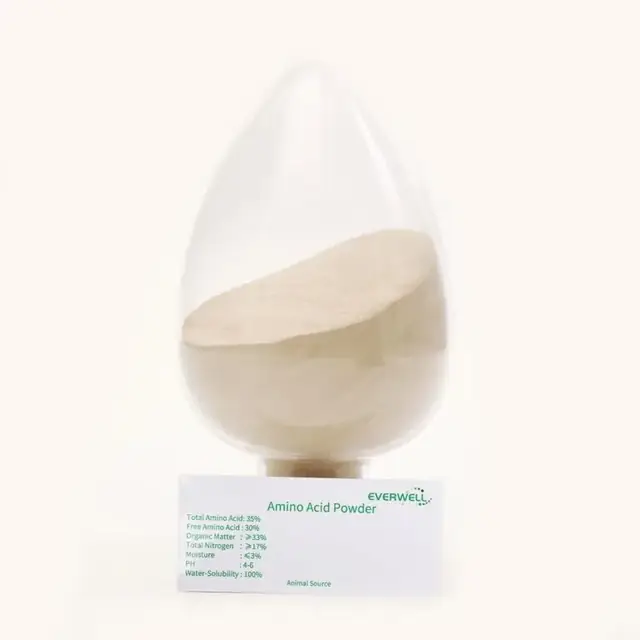
Amino Acids 35
The volume grade. A fully water-soluble hydrolysed feather protein powder carrying ≥ 17% total nitrogen, priced for foliar and fertigation programmes
View specification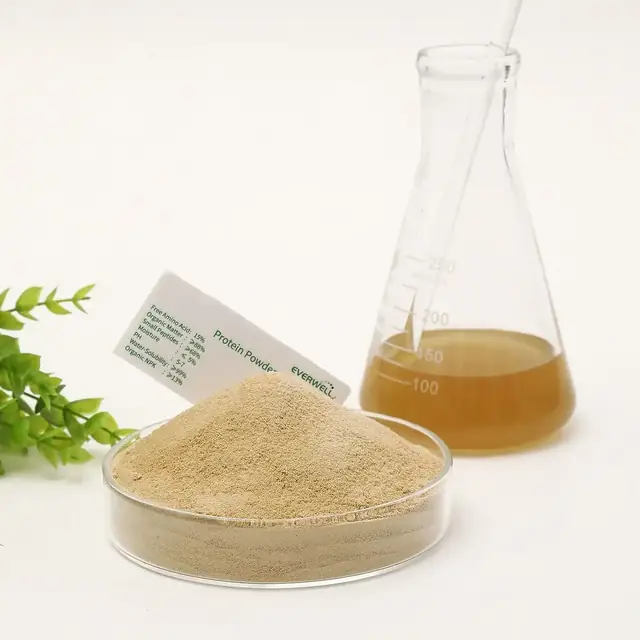
Protein Powder
A collagen-derived protein input at ≥ 90% crude protein and ≥ 80% total amino acids, glycine and proline rich, dissolving at 99% for animal feed, pet
View specificationWhere This Grade Is Used
Tea And Cash Crops
Crop Programme
Greenhouse And Open-Field Vegetables
Crop Programme
Biostimulant Concentrates
Application Solution
Foliar Fertilizer Programmes
Application Solution
Amino Acid 80 Explained: Composition and Formulation Use
Knowledge
Choosing an Amino Acid Powder Grade for Fertilizer Formulation
Knowledge
Get A Quotation For Amino Acids 80
Send the monthly volume, the destination port and the documents you need. A 200 to 500 g sample with its batch COA can ship in parallel.