
Choosing an Amino Acid Powder Grade for Fertilizer Formulation
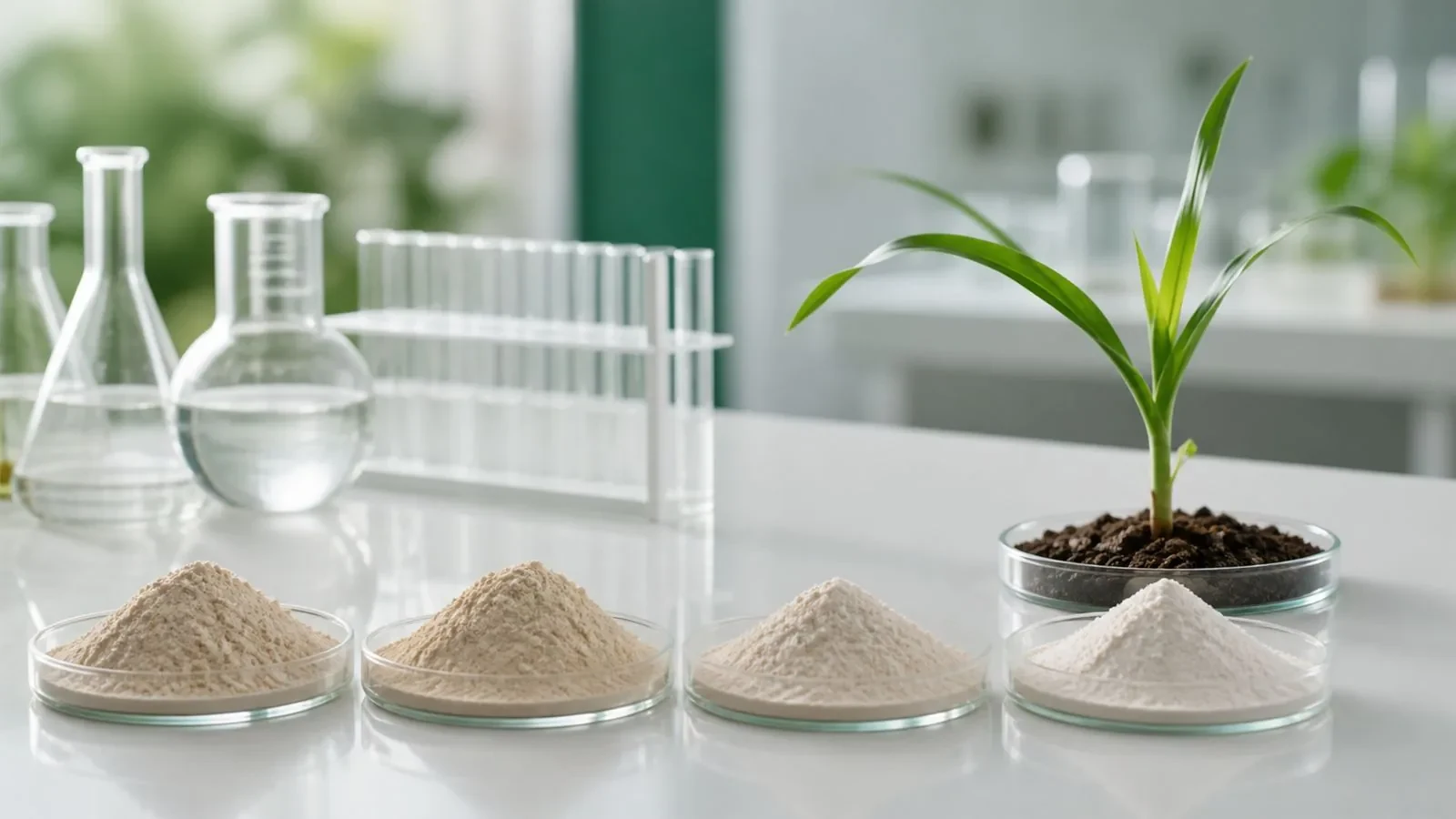
Water-soluble amino acid powders go into foliar fertilizers, fertigation products and compound nutrient formulations, and the grade that suits one of those rarely suits all three. This guide positions the AA35, AA45, AA50 and AA80 grades against formulation objectives and sets out the specification lines and bench tests that should settle the decision before volume is committed.
Three Variables Decide the Grade
The appropriate grade follows from three things: the amino acid concentration the formulation requires, the nitrogen contribution it needs, and the cost structure it has to live inside. Everything else is detail attached to those three.
Framed that way, the grade ladder stops being a quality ranking and becomes a set of positions. Higher concentration lets a formulator deliver more amino acids with less material, which frees blend space and reduces freight per unit of active. Lower grades offer greater cost flexibility and are easier to accommodate where the formulation has room. Neither direction is automatically better; they answer different constraints.
What Separates AA35, AA45, AA50 and AA80
AA35 sits at 35 percent total amino acids and is positioned for cost-efficient general crop nutrition. AA45 at 45 percent offers a balanced concentration for foliar and soil application. AA50 at not less than 50 percent suits concentrated fertilizer formulations, and AA80 at not less than 80 percent is aimed at high-strength professional formulations where blend space is tight.
All four are designed as water-soluble powders, which is the precondition for use in a spray tank or a drip line. Across the published Everwell Bio specifications the three main compound grades share a moisture limit of 5 percent or below, pH 4 to 6 in a 1 percent solution, and 100 percent water solubility, while organic matter rises with concentration: not less than 35 percent for Amino Acids 35, not less than 60 percent for Amino Acids 45, and not less than 80 percent for Amino Acids 80.
Nitrogen Does Not Follow the Grade Name
One specification line runs against the grain and catches formulators out. Total nitrogen is published at not less than 17 percent for Amino Acids 35, not less than 16 percent for Amino Acids 45, and not less than 12 percent for Amino Acids 80. Nitrogen therefore falls as the amino acid percentage climbs.
If your formulation is built around a declared nitrogen figure, that relationship changes the calculation entirely, and moving up the grade ladder to save blend space can cost you nitrogen you then have to replace from another source. Take the nitrogen value from the specification and confirm whether it is reported as total nitrogen or organic nitrogen before finalising the recipe.
Key Selection Factors Beyond the Grade Name
Buyers should compare more than the grade name, and the list of what to compare is short enough to work through for every candidate material. Where a supplier can only answer some of these, that itself is information about how the product is controlled.
Independent data helps anchor the free-amino-acid question in particular. Eurofins in Chengdu, a CNAS-accredited laboratory, using method GB/T 18246-2019 and issuing on 29 April 2026, reported free amino acids of 41.93 percent on an Amino Acids 45 sample, 48.22 percent on an Amino Acids 50 sample, and 75.37 percent on an Amino Acids 80 sample. Those results describe the tested samples and sit alongside, not in place of, the assigned batch COA.
- Total and free amino acid content, with the method stated for each
- Total nitrogen and organic matter
- Moisture, pH and water solubility
- Raw-material origin and hydrolysis method
- Compatibility with the other ingredients in the formulation
Bench Testing Before Large-Scale Use
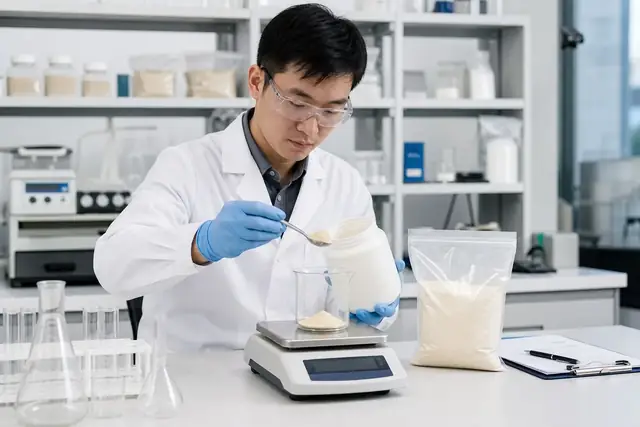
For a foliar spray or a drip irrigation product, a dissolution and compatibility test should be completed before any large-scale use. This is not a formality. A powder that meets its own specification can still behave differently in hard water, at an unusual concentration, or after a second input has been introduced to the tank.
Run the test at the concentration you actually intend to apply, in the water the customer actually has, at the temperature they will realistically be working at, and with the tank partners added in the real mixing order. Record dissolution time, sediment, filterability, solution pH and any change after standing. The final dosage in the field should then reflect crop type, growth stage, climate and local agronomic practice rather than a single recommended figure carried across markets.
Matching a Grade to a Product Type
In a general crop-nutrition blend with room to work in, the cost-efficient position usually wins, and AA35 is the natural starting point. In water-soluble foliar and fertigation products, where both concentration and formulation cost matter, AA45 tends to be the balanced answer and carries the higher organic matter figure that soil-applied uses often need.
Where the product is a concentrate, AA50 addresses concentrated fertilizer formulations and AA80 the high-strength professional end, delivering the amino acid contribution with the least material in the bag. Alongside the duck-feather compound grades, a hydrolyzed protein powder from cattle bone at not less than 90 percent crude protein and not less than 80 percent amino acids, with 99 percent solubility and pH 5 to 7.5, serves formulations specified on protein rather than on an amino acid grade.
What to Have in Hand Before You Commit
Product specifications and batch documentation are available for qualified enquiries, and it is worth assembling them before the formulation is locked rather than after. A batch-specific COA accompanies every shipment, and the TDS and SDS are available on request.
Everwell Bio manufactures at a 20,000 square metre facility in Suzhou, Jiangsu, with more than 80 workers and capacity of 4,000 tons per month, shipping around 50 forty-foot high-cube containers monthly to more than 20 countries. Regular orders run a 30-day lead time on FOB Shanghai or Qingdao terms, with payment by T/T, L/C, D/P or O/A. Free samples of 200 to 500 g are supplied with the batch COA so that the dissolution and compatibility work described above can be completed before an order is placed.
Grade positioning by total amino acid content
| Grade | Total amino acids | Typical positioning |
|---|---|---|
| AA35 | 35% | Cost-efficient general crop nutrition |
| AA45 | 45% | Balanced concentration for foliar and soil application |
| AA50 | at least 50% | Concentrated fertilizer formulations |
| AA80 | at least 80% | High-strength professional formulations |
Conclusion
Fix the amino acid concentration, nitrogen contribution and cost position your formulation needs, then choose the grade that satisfies all three and prove it on the bench with the customer's own water before scaling. Send your formulation type, target amino acid and nitrogen figures, application method and destination market to [email protected], or call +86 134 0579 7951 or +86 186 5277 5865. We reply within 24 hours, Monday to Saturday, and can supply specifications, batch documentation and a free sample for testing.
Products Discussed In This Article
Amino Acids 45
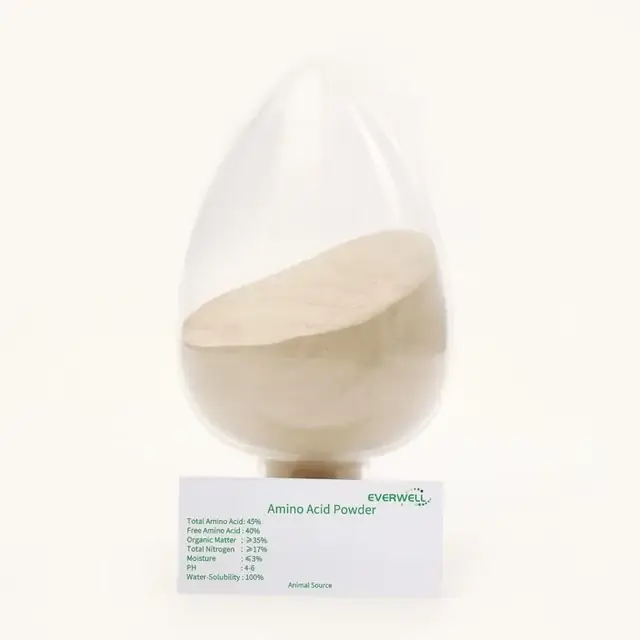
The benchmark grade: ≥ 45% total amino acids, ≥ 60% organic matter, and 41.93% free amino acids measured by Eurofins under GB/T 18246-2019. The grade
View specification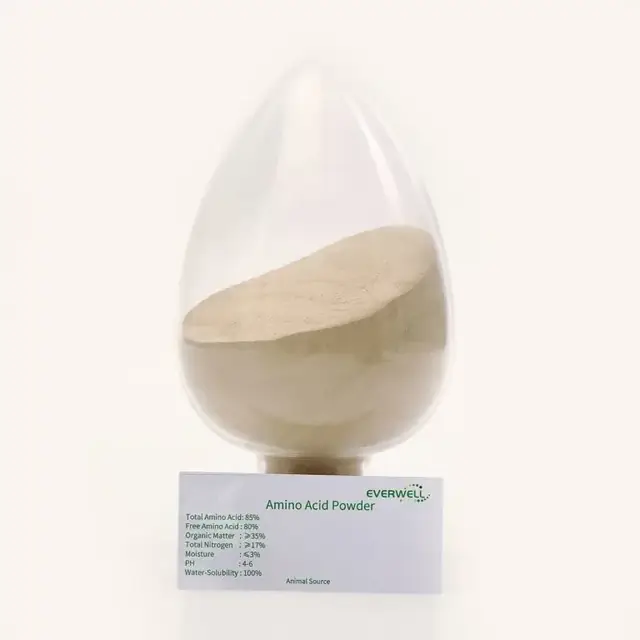
Amino Acids 80
The density grade: ≥ 80% total amino acids, ≥ 80% organic matter, and 75.37% free amino acids measured by Eurofins. Glycine and proline rich, for conc
View specification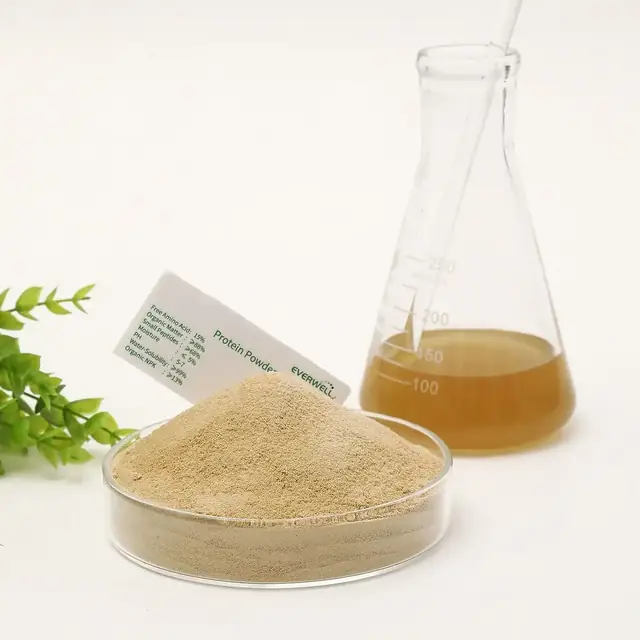
Protein Powder
A collagen-derived protein input at ≥ 90% crude protein and ≥ 80% total amino acids, glycine and proline rich, dissolving at 99% for animal feed, pet
View specificationRelated Articles
Documents to Request Before Buying Amino Acid Powder
The document set a buyer should collect before ordering compound amino acid powder, and what each one actually proves.
Read more
Environmental Considerations for Amino Acid Powder Use
How to account for nitrogen loading, runoff, salts and manufacturing footprint before making an environmental claim about amino acid powder.
Read more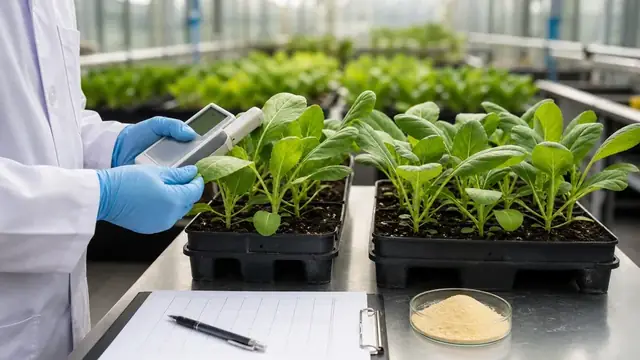
How Long Does Amino Acid Fertilizer Take to Work?
A staged monitoring timeline for judging whether an amino acid fertilizer has delivered a useful response, from application day to harvest.
Read moreQuestions On This Topic
Which grade suits a foliar fertilizer?
AA45 is positioned as a balanced concentration for foliar and soil application, but confirm it against your required amino acid and nitrogen figures and test dissolution in the target water first.
Does moving to AA80 also increase nitrogen?
No. Published total nitrogen is not less than 12% for Amino Acids 80 against not less than 17% for Amino Acids 35, so nitrogen falls as the grade rises.
Are all four grades water-soluble?
Yes, all four are designed as water-soluble powders. The three published compound grades are specified at 100% water solubility.
What independent free-amino-acid data is available?
Eurofins in Chengdu, CNAS-accredited, reported 41.93% on an AA45 sample, 48.22% on an AA50 sample and 75.37% on an AA80 sample by method GB/T 18246-2019, issued 29 April 2026.
Is there a recommended dosage?
The final dosage should reflect crop type, growth stage, climate and local agronomic practice, so it is set per market rather than published as a single figure.
How do I get specifications and documentation?
Product specifications and batch documentation are available for qualified enquiries by email to [email protected], with a reply within 24 hours, Monday to Saturday.
Ask Us About This Directly
Technical questions are answered by the export and production team, normally within 24 hours.