
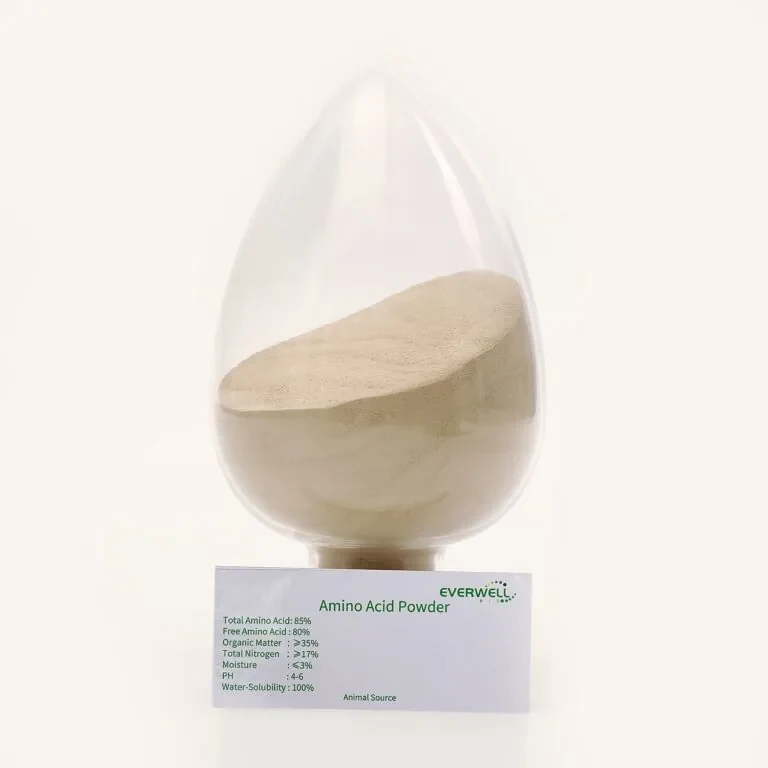
Amino Acid 80 Explained: Composition and Formulation Use
Amino Acid 80 is a high-concentration protein hydrolysate specified at a minimum of 80% total amino acids, aimed at formulations where amino acid concentration, available formulation space or freight per unit of amino acid decides the economics. This note sets out what the 80 does and does not promise, so you can judge whether the concentration premium is worth paying in your product.
What the Number Describes
The 80 refers to total amino acids in the specification. It does not mean that every batch contains 80% free amino acids, and it does not guarantee a stronger crop response than every lower-concentration product on the market.
The table below gives the current published specification together with an independent result. The 75.37% free-amino-acid value was reported by Eurofins (Chengdu), a CNAS-accredited laboratory, using method GB/T 18246-2019 under certificate AR-26-Y3-008791-02 issued on 29 April 2026, and it describes the tested sample. Use the current specification for contractual requirements and the assigned batch COA for shipment release.
Why Total and Free Values Differ
A protein hydrolysate contains free amino acids, small peptides and other soluble protein-derived components. A total-amino-acid test generally releases amino acids from peptide-bound forms during the laboratory analysis itself, while a free-amino-acid test measures only what is already unbound under the stated method.
Method name, sample preparation, moisture basis and calculation basis all move the result. Ask both the supplier and the laboratory to identify each of them before treating two numbers as equivalent.
Where a High-Concentration Grade Fits
Concentration buys formulation space and reduces the mass moved per unit of amino acid delivered. That matters most in concentrates and in export products where freight is a visible line in the cost model.
- Concentrated water-soluble fertilizer formulations
- Foliar or fertigation products requiring a high amino acid contribution
- Liquid concentrates, after stability testing
- Low-inclusion-rate formulations
- Export products where freight per kilogram of total amino acids matters
The Freight Calculation and Its Limits
On a theoretical total-amino-acid basis, one kilogram of an 80% product carries the same quantity of total amino acids as roughly 1.78 kilograms of a 45% product. In a container of 4,000 tons-per-month scale production shipped FOB Shanghai or Qingdao, that ratio is a real cost argument.
The calculation does not prove equivalent field performance. The free-amino-acid fraction, peptide profile, salts, pH and the final application rate all have to be considered alongside it.
The same ratio works against the grade in a low-value blend. If the finished product only needs a modest amino acid declaration and the bag has space for filler anyway, paying a concentration premium buys nothing but a smaller inclusion rate and a tighter dosing tolerance on the blending line. Concentration earns its price where freight, drum size or formulation space is the binding constraint, and it should be justified on that basis rather than on the assumption that a bigger number sells better.
Higher Concentration Is Not Automatically Better
A higher grade reduces the amount of powder needed to hit a formulation target, but it can also change solution behaviour, osmotic load, cost and crop-safety margins. Some lower-concentration products carry components that happen to be useful in a particular formulation.
The comparison worth running is not simply 45 against 80. It is the following set of parameters, evaluated on the same basis for each candidate.
- Cost per kilogram of the required component
- Verified total and free amino acids
- Nitrogen and salt contribution
- Solubility at the intended concentration
- Compatibility with the full formula
- Crop performance at the intended dose
Agronomic Claims and Application Testing
Protein hydrolysates may support nutrient-use efficiency and crop responses to abiotic stress, but the published evidence shows substantial variation between products and application conditions, and high free-amino-acid concentrations can be inhibitory in some circumstances. Do not assume that twice the amino acid concentration produces twice the agronomic effect, and do not publish a fixed response time or a guaranteed benefit without trials on the exact product and formulation.
Because the grade is concentrated, application rates copied from a 35% or 45% product may be inappropriate. Start from the current TDS or the locally approved label, then work through a defined sequence before scale-up. Avoid blanket statements about compatibility with NPK fertilizers, calcium, phosphate, copper products or pesticides; compatibility is concentration- and formulation-dependent.
- Confirm water quality and the target solution pH
- Run dissolution and filtration tests
- Conduct jar tests with every planned ingredient
- Test crop safety at several concentrations
- Compare performance against an untreated control under the intended conditions
Organic Status and the Buyer's Document Request
Amino Acid 80 is not automatically eligible for organic farming because it is a protein hydrolysate. Acceptance depends on the exact source, process, formulation, intended use and certification program, and buyers have to verify current documentation for the exact product and destination market.
Before approving the grade, request the full package so that every marketing statement can be traced back to a document. Everwell Bio issues a batch-specific COA with each shipment and supplies the TDS and SDS on request, with regular orders running on a 30-day lead time FOB Shanghai or Qingdao.
- Current product specification
- Representative and batch-specific COA
- Total- and free-amino-acid methods
- Total and organic nitrogen values
- Sodium, chloride or other relevant salts
- pH, solubility and insoluble matter
- Raw-material and hydrolysis-process statement
- SDS and storage guidance
- A sample for bench and crop testing
Everwell Bio Amino Acids 80: published specification and tested-sample result
| Parameter | Current published specification or result |
|---|---|
| Total amino acids | at least 80% |
| Total nitrogen | at least 12% |
| Organic matter | at least 80% |
| Moisture | 5% maximum |
| pH, 1% solution | 4-6 |
| Water solubility | 100% |
| Source | Hydrolyzed duck feather protein |
| Free amino acids | 75.37% in an independently tested sample |
Conclusion
Amino Acid 80 is a high-concentration formulation input whose advantage is the quantity of total amino acids delivered per kilogram, not a guaranteed field response. Qualify it through comparable analytical data and application-specific trials. Send your formulation target and destination market to [email protected] for the current specification, the Eurofins-verified certificate, pricing and a free 200-500 g sample with its batch COA; replies go out within 24 hours, Monday to Saturday.
Products Discussed In This Article
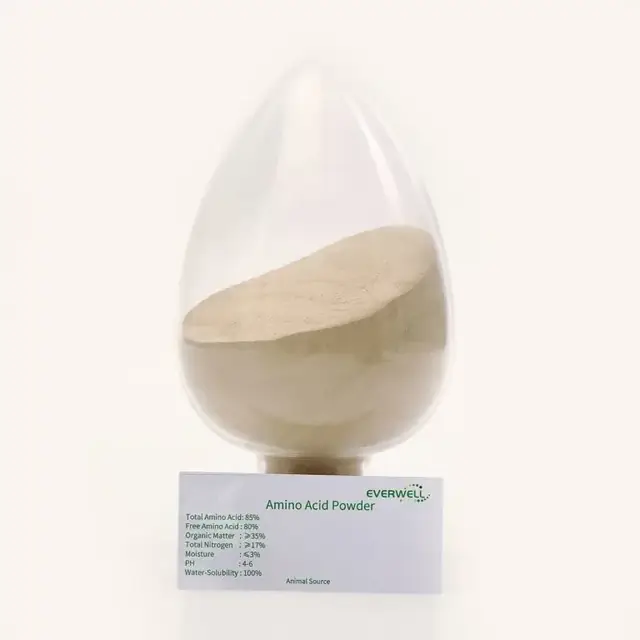
Amino Acids 80
The density grade: ≥ 80% total amino acids, ≥ 80% organic matter, and 75.37% free amino acids measured by Eurofins. Glycine and proline rich, for conc
View specification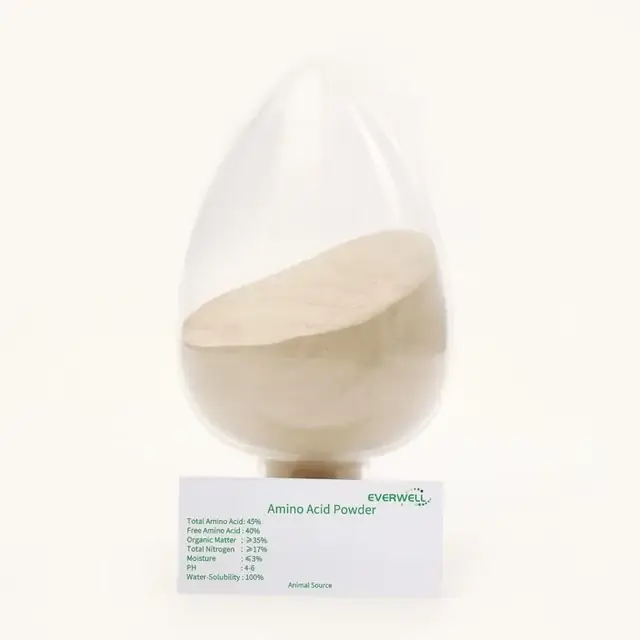
Amino Acids 45
The benchmark grade: ≥ 45% total amino acids, ≥ 60% organic matter, and 41.93% free amino acids measured by Eurofins under GB/T 18246-2019. The grade
View specificationRelated Articles
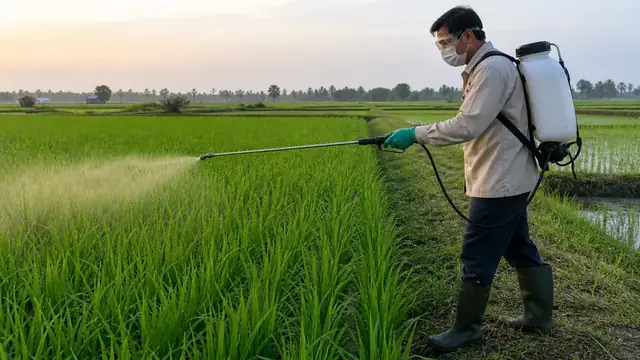
Amino Acid Fertilizer for Rice: A Practical Foliar Guide
How to evaluate an amino acid powder in rice by growth stage, set a safe starting rate and calibrate the spray without over-claiming.
Read more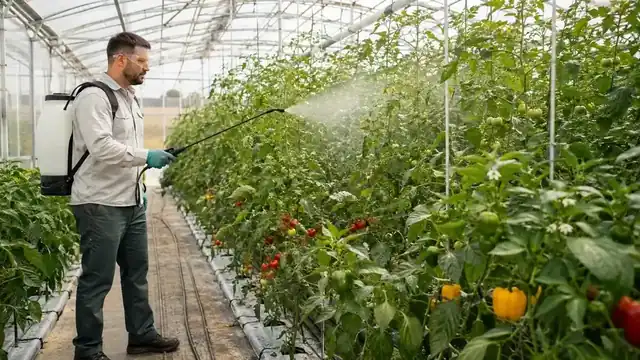
Amino Acid Fertilizer for Vegetables: Foliar Guide by Crop
Evaluation windows, rate calculation and spray practice for protein hydrolysates across fruiting, leafy, cucurbit, root and legume vegetables.
Read more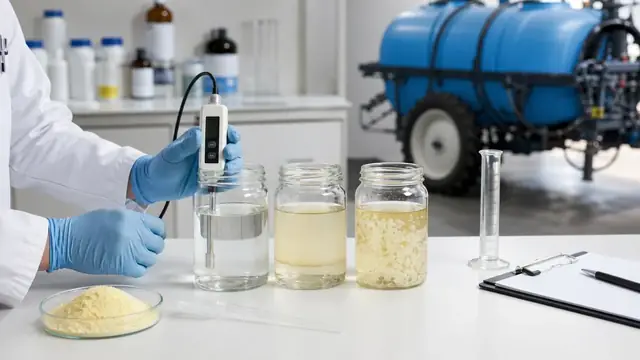
Mixing Amino Acid Powder: A Safer Compatibility Guide
Why category-level compatibility claims fail, how labels and water quality govern the answer, and how to run a jar test that means something.
Read moreQuestions On This Topic
Does Amino Acid 80 contain 80% free amino acids?
No. The 80% refers to total amino acids in the specification. An independently tested sample reported 75.37% free amino acids under certificate AR-26-Y3-008791-02.
How much 45% material does one kilogram of the 80% grade replace on paper?
About 1.78 kilograms, on a theoretical total-amino-acid basis. The calculation converts quantities only and does not demonstrate equivalent field performance.
Can I reuse my 45% product's application rate?
No. The grade is concentrated, so rates copied from a 35% or 45% product may be unsafe. Start from the current TDS or approved label and test crop safety at several concentrations.
What is the nitrogen content?
The specification states at least 12% total nitrogen, alongside at least 80% organic matter and 5% maximum moisture.
Is the grade suitable for liquid concentrates?
It can be evaluated for them, but only after stability testing at the intended concentration, since solution behaviour and osmotic load change with concentration.
What documentation accompanies a shipment?
A batch-specific COA is supplied with every shipment; the TDS and SDS, including storage guidance, are available on request.
Ask Us About This Directly
Technical questions are answered by the export and production team, normally within 24 hours.