

When to Apply Amino Acid Fertilizer: A Timing Guide
There is no single best date or growth stage for every amino acid fertilizer. The right timing depends on the exact product, the crop, the purpose, the application method, the plant's condition, the weather and local experience. After reading this you will be able to choose a defensible application window for your own crop, and to recognise the timing claims that a supplier cannot support.
Decide What the Application Is Supposed to Do
Timing should answer a specific agronomic question, not simply mark that a fixed number of days has passed. Before choosing a date, define the objective. Amino acid fertilizers and protein-hydrolysate biostimulants can be useful supplements in a crop programme, but they do not replace balanced soil fertility, irrigation, pest management or correction of whatever is actually causing a problem.
Use the product label or technical data as the starting point, then confirm the programme with a small local trial. One further caution before any of the windows below: do not treat total amino acid percentage as a universal application-rate guide. Two powders with the same total amino acid value may differ in free amino acids, peptides, nitrogen, chloride, sodium, ash, pH and other ingredients, and those differences affect solubility, crop safety and how much can be applied.
Foliar nutrition is normally supplemental in any case. Penn State Extension notes that leaves can absorb nutrients but that foliar delivery generally cannot satisfy the full nutrient demand of a crop, and can injure foliage if a fertilizer is too concentrated. Soil, substrate, water or tissue information should continue to guide the main fertility programme.
- Supplement a verified nutrient program
- Evaluate a biostimulant response during establishment or active growth
- Support a crop through a predictable period of abiotic stress
- Test a product at a reproductive or grain and fruit-development stage
- Correct a diagnosed nutrient shortage where foliar delivery is appropriate
Timing After Transplanting
Zero to seven days after transplanting is not a universal rule, although it appears on a great many labels. A transplanted crop may be actively recovering, or it may still be wilted, water-stressed or suffering root damage, and those two states call for opposite decisions.
A safer sequence is to restore appropriate root-zone moisture and temperature, confirm that the plants are upright and producing or maintaining functional foliage, inspect for disease, root injury, salinity or another cause of poor establishment, apply only a labelled or technically supported rate, and keep an untreated comparison area. If the crop has not stabilized, additional spray salts or tank-mix partners add stress rather than solve it.
Timing Around Flowering and Fruit Set
Pre-flowering and fruit-set applications are often promoted as the highest-impact timings. That statement is too broad to be useful. Flowering response depends on species, cultivar, temperature, water status, mineral nutrition, pollination and the composition of the exact product, and any of those can dominate the result.
If a product is being evaluated around flowering, use evidence from the same crop or a closely comparable production system. Avoid spraying open flowers where the label, pollinator protection measures or local crop guidance advises against it, and avoid combining an untested amino acid product with pesticides or adjuvants at this stage. Compare treated and untreated rows, and measure something meaningful such as marketable fruit set, yield or quality, rather than temporary leaf colour.
For continuously harvested greenhouse crops, stage-based monitoring is more useful than an automatic 10- or 14-day calendar, because the crop is carrying several stages at once and the calendar has no way to reflect that.
Timing Before and After Abiotic Stress
Protein hydrolysates have produced useful responses in some controlled and field studies, but the response can depend on crop genotype, formulation, dose and the stress conditions themselves. One positive trial does not establish a universal stress-rescue schedule.
Where a product has relevant evidence, a preventive application may be evaluated before a forecast heat, salinity or water-limitation period. It must accompany rather than replace appropriate irrigation, drainage, temperature management and fertility, because none of those can be substituted by a foliar input.
After stress, remove or correct the cause first. Rehydrate droughted plants gradually, drain waterlogged soil, protect frost-damaged tissue from further injury, and assess whether enough live leaf area remains to justify an application at all. Apply only once the crop is physiologically stable and the product instructions support the use. Do not claim that an application within 24 to 72 hours reverses frost, hail, herbicide or heat damage. Herbicide injury in particular requires correct diagnosis, and an additional foliar input or tank mix can complicate both the symptoms and crop safety, so consult the pesticide label and a qualified local adviser.
Weather Conditions for Foliar Application
There is no universal clock time, temperature band or rain-free interval that suits every product. Use the label and local spray guidance, and aim for conditions that let the spray deposit evenly and stay on the leaf long enough to be absorbed.
Early morning or late afternoon may offer favourable conditions, but neither is automatically correct. Heavy dew can dilute droplets and cause runoff, while long overnight leaf wetness may be undesirable where disease pressure is high. Midday application may increase evaporation and leaf-burn risk in hot, dry conditions, but the actual limit is product- and crop-specific.
Avoid the common claim that morning application is always superior because stomata are open. Foliar uptake also occurs through the cuticle and is influenced by formulation, droplet properties, leaf surface, humidity and drying time.
- A healthy, non-wilted crop
- Moderate temperature and humidity
- Low wind and manageable drift risk
- Leaves dry enough for even spray deposition
- No imminent rain or irrigation that would wash the product away
- Enough drying or absorption time for the product and any tank-mix partner
Foliar, Fertigation and Soil Application Follow Different Rules
The three delivery routes do not share a timing logic, and a programme written for one should not be copied to another. For foliar spraying, prioritise crop condition, coverage, concentration, water quality and weather; calibrate the sprayer and avoid runoff, and remember that a higher concentration is not automatically more effective.
For fertigation, timing is governed by the irrigation schedule and the root zone rather than by the leaf. Water quality, stock-tank concentration, mixing order and compatibility with the calcium, phosphate and micronutrients already in the programme determine what is possible, and a jar test with the complete ingredient list should precede the first commercial run.
For soil application, the material is a small nutrient or biostimulant input rather than a base dressing, and it should be positioned within an existing fertility plan rather than used to justify reducing one. Whichever route you use, keep an untreated comparison area so that a seasonal effect is not recorded as a product effect.
Application windows worth evaluating locally, with safeguards
| Crop stage or condition | Why it may be considered | Important safeguards |
|---|---|---|
| Seed or nursery stage | Some labelled products are used in seed treatment or nursery programs | Use only a product and rate specifically suitable for seed or young plants; check germination and phytotoxicity on a small batch first |
| After transplant establishment | A low-rate application may be evaluated once plants are hydrated and new growth has resumed | Do not spray wilted, heat-stressed or freshly damaged foliage merely because transplanting has occurred |
| Active vegetative growth | The crop has functioning leaf area and predictable growth | Confirm the application has a defined purpose; avoid repeat sprays when untreated plants perform equally well |
| Before a high-demand stage | A locally validated program may place an application before flowering, panicle initiation or rapid canopy development | Do not promise improved pollen viability, flower retention or yield without evidence for the exact product, crop and conditions |
| Fruit, tuber or grain development | Some product-specific trials evaluate quality or stress-related responses at this stage | Protect harvest quality, observe any preharvest restrictions, and avoid excessive salt loading on mature foliage |
| Before forecast abiotic stress | Preventive use may be more practical than rescuing severely injured tissue | Use only where the product is intended for that purpose and irrigation, shade or drainage are also addressed |
| Recovery after abiotic stress | An application may be tested once the crop is stable, rehydrated and capable of active growth | Do not spray frozen, desiccated, waterlogged or heat-injured plants automatically; correct the damaging condition first |
Conclusion
Build the timing around a defined objective, start from the product's own technical data, and validate the window with a small local trial that keeps an untreated comparison. If you are planning that trial, send your crop, production system and application method to [email protected]; we will recommend a grade and supply a free 200-500 g sample with its batch COA, and we reply within 24 hours, Monday to Saturday.
Products Discussed In This Article
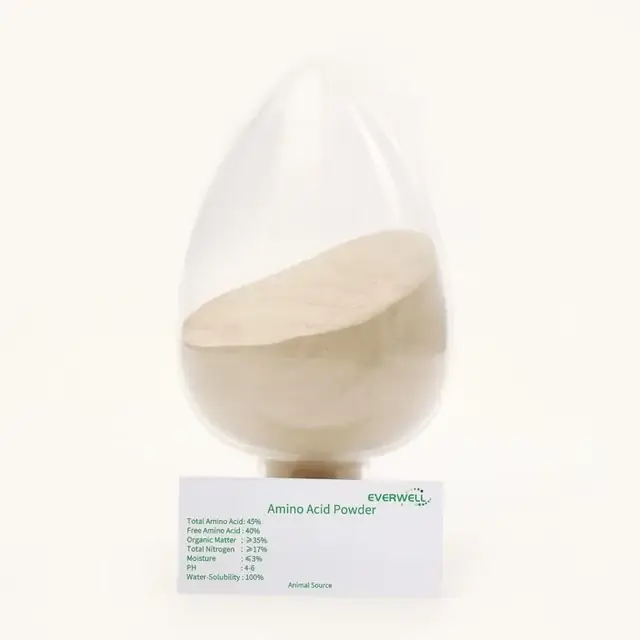
Amino Acids 45
The benchmark grade: ≥ 45% total amino acids, ≥ 60% organic matter, and 41.93% free amino acids measured by Eurofins under GB/T 18246-2019. The grade
View specification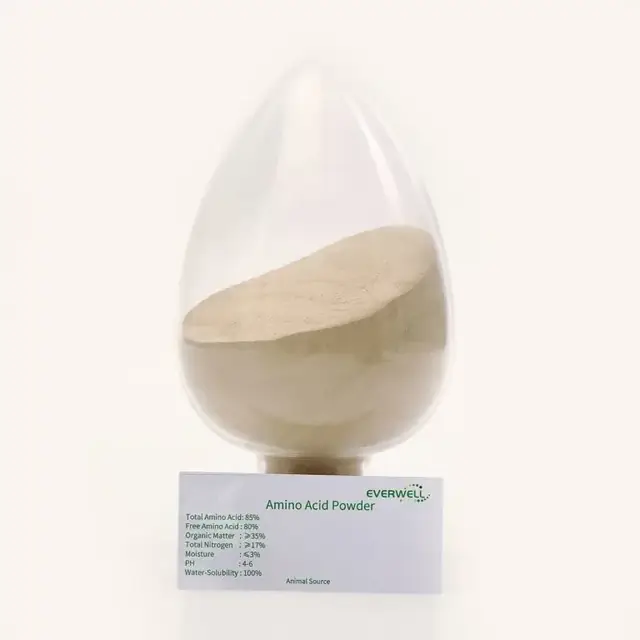
Amino Acids 80
The density grade: ≥ 80% total amino acids, ≥ 80% organic matter, and 75.37% free amino acids measured by Eurofins. Glycine and proline rich, for conc
View specification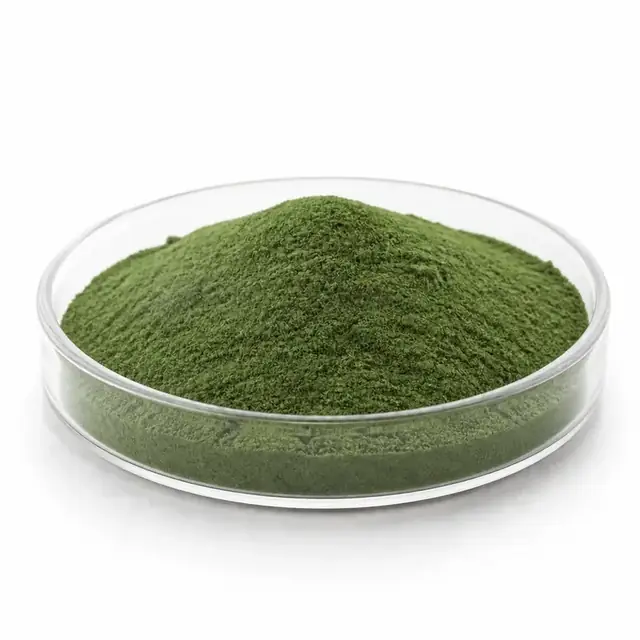
Seaweed Extract 30%
A cold-water extract of brown seaweed standardised to 30% alginic acid on a dry basis, carrying alginates, mannitol and betaines, supplied through the
View specificationRelated Articles
Which Crops Benefit Most From Amino Acid Fertilizer
The crop groups most often formulated for with compound amino acid powder, and how to qualify a grade for each of them.
Read more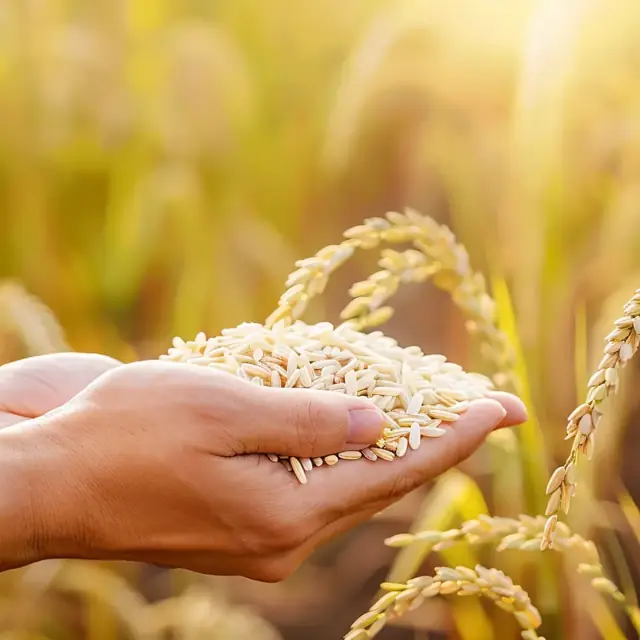
Amino Acid 45: Practical Advantages and Real Limits
What a 45% total amino acid grade actually offers a formulator, what it cannot do, and the specifications to verify first.
Read more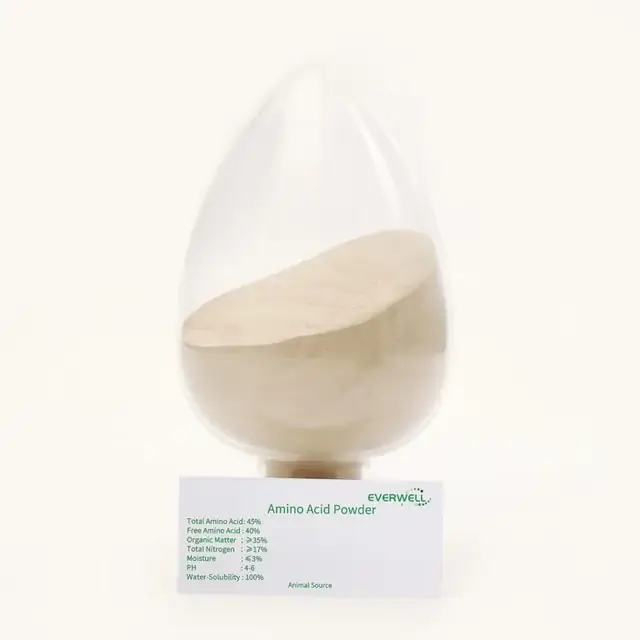
Amino Acid 45 Explained: Composition, Uses, Buyer Checks
How a 45% grade is defined and produced, where it fits in formulations, and the analytical checks that make two offers comparable.
Read moreQuestions On This Topic
Is there a best growth stage for amino acid fertilizer?
No. The right timing depends on the exact product, crop, purpose, application method, plant condition, weather and local experience, so start from the product's technical data and confirm with a local trial.
Should I apply within seven days of transplanting?
Not automatically. Restore root-zone moisture and temperature, confirm the plants are upright with functional foliage, and rule out disease, root injury or salinity before applying.
Can an application reverse frost or heat damage?
No. Correct the damaging condition first and apply only once the crop is physiologically stable and the product instructions support the use. Claims of reversal within 24 to 72 hours are not supportable.
Is early morning always the best time to spray?
No. Foliar uptake also occurs through the cuticle and depends on formulation, droplet properties, leaf surface, humidity and drying time. Heavy dew can cause runoff and overnight wetness can raise disease risk.
Can I use total amino acid percentage to set the application rate?
No. Two powders with the same total amino acid value may differ in free amino acids, peptides, nitrogen, chloride, sodium, ash and pH, all of which affect solubility, crop safety and how much can be applied.
Does foliar application replace the main fertility program?
No. Foliar delivery is supplemental and generally cannot meet a crop's full nutrient demand; soil, substrate, water or tissue data should continue to guide the main program.
Ask Us About This Directly
Technical questions are answered by the export and production team, normally within 24 hours.