
Amino Acid 45: Practical Advantages and Real Limits
Amino Acid 45 is a water-soluble protein hydrolysate specified at a minimum of 45% total amino acids, used in foliar products, fertigation blends and specialty crop-nutrition formulations. After reading this you should be able to decide whether a 45% grade fits your formulation space and cost target, and which documents you need before you commit to a supplier.
A Balanced Concentration for Formulation Work
A 45% total amino acid grade sits between lower-concentration powders and high-concentration grades. It contributes a meaningful quantity of amino acids without occupying as much of the formulation as a weaker powder, which matters when the remaining space has to carry NPK salts, micronutrients, carriers and anti-caking agents.
That middle position is an argument for evaluation, not an automatic answer. The correct grade for a given product also depends on free amino acids, nitrogen, salt content, moisture, pH, colour, odour, solubility, raw-material origin and, ultimately, cost per kilogram of the component you actually need in the finished product.
Water-Soluble Does Not Mean Universally Compatible
A properly manufactured and quality-controlled powder can be suitable for water-soluble formulations, but dissolution behaviour changes with temperature, water hardness, pH, concentration and the other ingredients in the tank. Test the material in your own water and your own finished formulation rather than relying on a solubility figure alone.
Calcium, phosphate, concentrated micronutrients, alkaline materials and some crop-protection products can all alter solution stability. Complete a bench-scale dissolution test and a jar test before either production blending or field application.
A Source of Amino Acids and Nitrogen
Protein hydrolysates contain amino acids and peptides that may support nutrient-use efficiency, plant metabolism and responses to abiotic stress. The published work also shows that the outcome depends on the specific hydrolysate, the concentration applied, the crop, its growth stage and the environment. A positive result in one trial is not a guaranteed response across a portfolio.
Amino Acid 45 also contributes nitrogen, and the way that nitrogen is reported decides whether two offers are comparable at all.
- Total amino acids, with the analytical method stated
- Free amino acids, with the analytical method stated
- Total nitrogen
- Organic nitrogen
- Nitrogen originating from any added inorganic salts
Use in Multi-Component Fertilizer Products
A 45% amino acid powder is normally evaluated alongside NPK fertilizers, micronutrients, fulvic materials or seaweed extracts, and each of those inputs performs a different role. The amino acid fraction does not supply the phosphorus and potassium a crop requires, so the finished product should only be presented as a complete fertilizer if it genuinely delivers those nutrients.
Compatibility has to be demonstrated in the final product at the intended concentration. Two materials that dissolve cleanly on their own can still destabilise each other when combined at high concentration in a concentrate.
This is also where the economics of the grade become visible. Formulation space is finite, and every kilogram of amino acid powder in a water-soluble blend displaces a kilogram of something else the label promises. A 45% grade lets a formulator declare a credible amino acid contribution while leaving room for the nitrogen, phosphorus, potassium and micronutrient salts that the crop programme actually requires, which is why it is frequently the grade chosen for general-purpose blends rather than for concentrates.
Support During Crop Stress: What Can Be Said
Published research on protein hydrolysates reports possible benefits under drought, salinity, temperature and transplant stress. Those effects are not uniform across products or conditions, and excessive concentrations of free amino acids can suppress growth or cause phytotoxicity in some circumstances.
Stress-support statements should therefore be tied to the exact formulation and, wherever possible, to crop-specific trials. A formulation should not claim to prevent drought, frost, disease or yield loss.
In practice this means designing the trial before writing the label copy. Choose the stress you expect the product to address, treat a defined area, keep an untreated or standard-practice comparison alongside it, and record a measurable outcome rather than a visual impression. A claim that survives that process is defensible in a registration dossier and in front of a distributor; a claim borrowed from a review paper is not.
What a 45% Grade Cannot Do
Being explicit about the limits protects both the formulator and the label. A 45% amino acid powder has the following boundaries.
- It does not replace a complete NPK program
- It does not guarantee higher yield, Brix, shelf life or root growth
- It is not automatically compatible with every fertilizer or pesticide
- It is not automatically approved for organic production
- It should not be promoted as residue-free or safe until harvest without product- and market-specific support
Everwell Bio Amino Acids 45 in Context
The current Everwell Bio Amino Acids 45 specification states at least 45% total amino acids, at least 16% total nitrogen and at least 60% organic matter, produced from hydrolyzed duck feather protein by controlled hydrolysis, purification, concentration and spray drying. An independent Eurofins (Chengdu) analysis, CNAS-accredited and run to GB/T 18246-2019, reported 41.93% free amino acids for the tested sample under certificate AR-26-Y3-008790-02, issued 29 April 2026.
That laboratory result describes the tested sample. It is not a substitute for the specification, and it does not pre-determine the result on the batch COA that accompanies a future shipment. Request the current technical package, then test the product inside your own formulation before commercial use.
Specifications to request for the exact grade before comparing suppliers
| Item | Why it matters |
|---|---|
| Total amino acids and test method | Confirms the grade definition |
| Free amino acids and test method | Separates free amino acids from peptide-bound amino acids |
| Total and organic nitrogen | Identifies the actual nitrogen contribution |
| Moisture and reporting basis | Allows fair comparison between samples |
| pH and solubility | Supports formulation screening |
| Sodium, chloride or other salts where relevant | Helps assess crop and formulation compatibility |
| Raw-material origin and hydrolysis process | Supports market, label and regulatory requirements |
| Batch COA, TDS and SDS | Connects marketing statements to quality documents |
Conclusion
The advantage of Amino Acid 45 is not a guaranteed field effect; it is the balance it can offer between amino acid concentration, formulation space and cost per kilogram of active component. Decide on comparable test methods, current batch documentation and trials in your own application. Email [email protected] with your formulation target and destination market to receive the current specification, a batch COA and a free 200-500 g sample; replies go out within 24 hours, Monday to Saturday.
Products Discussed In This Article
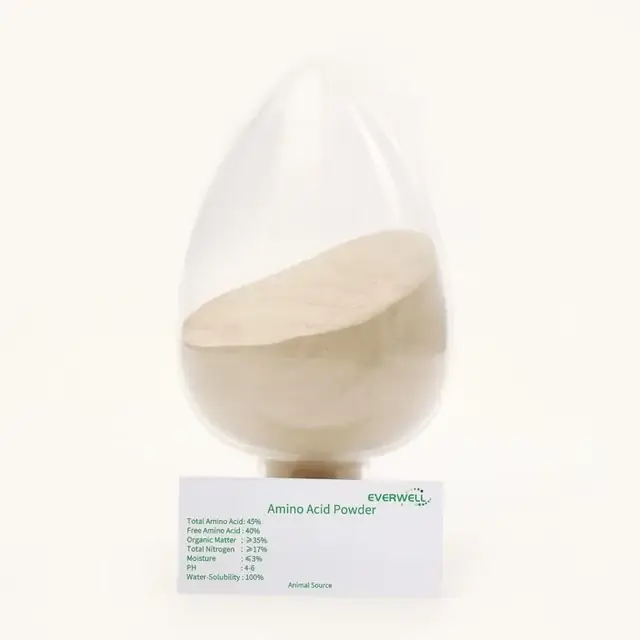
Amino Acids 45
The benchmark grade: ≥ 45% total amino acids, ≥ 60% organic matter, and 41.93% free amino acids measured by Eurofins under GB/T 18246-2019. The grade
View specification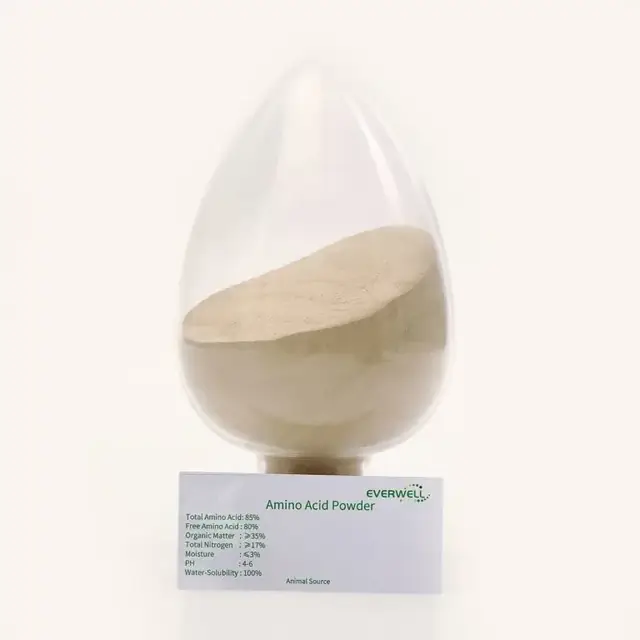
Amino Acids 80
The density grade: ≥ 80% total amino acids, ≥ 80% organic matter, and 75.37% free amino acids measured by Eurofins. Glycine and proline rich, for conc
View specification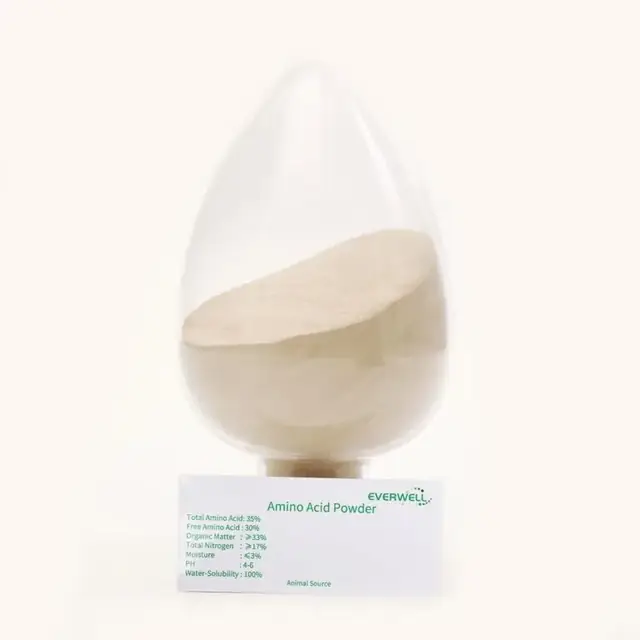
Amino Acids 35
The volume grade. A fully water-soluble hydrolysed feather protein powder carrying ≥ 17% total nitrogen, priced for foliar and fertigation programmes
View specificationRelated Articles
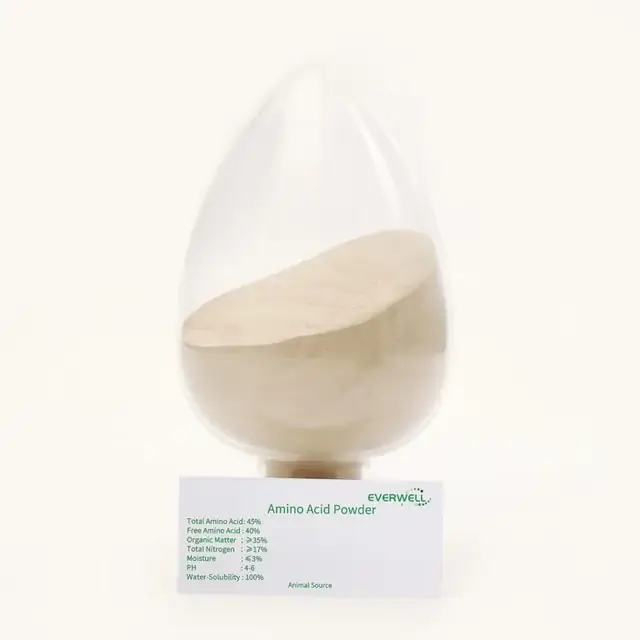
Amino Acid 45 Explained: Composition, Uses, Buyer Checks
How a 45% grade is defined and produced, where it fits in formulations, and the analytical checks that make two offers comparable.
Read more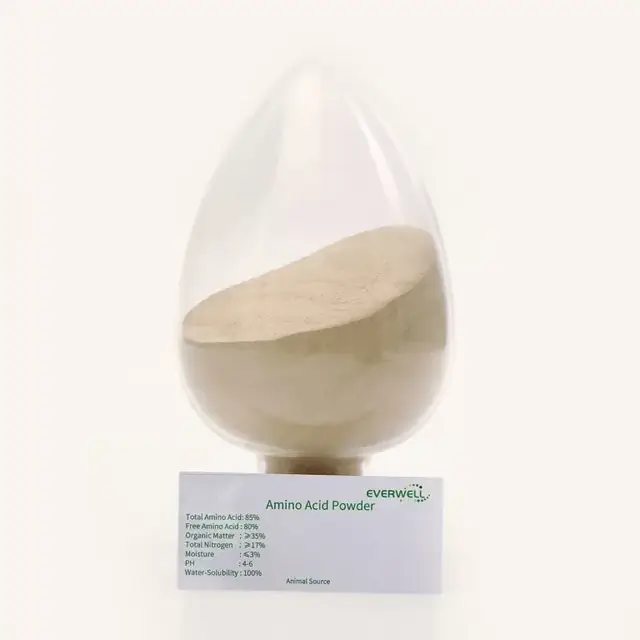
Amino Acid 80 Explained: Composition and Formulation Use
What an 80% total amino acid grade delivers per kilogram, where concentration helps, and why higher is not automatically better.
Read more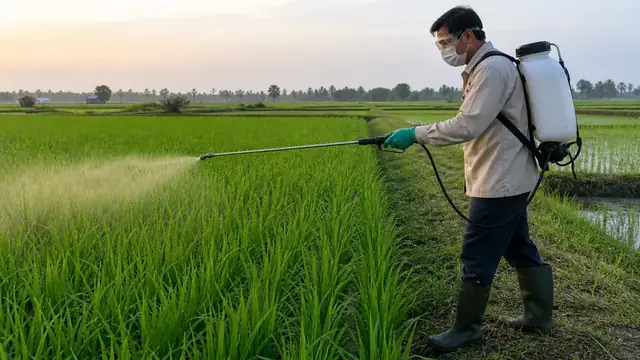
Amino Acid Fertilizer for Rice: A Practical Foliar Guide
How to evaluate an amino acid powder in rice by growth stage, set a safe starting rate and calibrate the spray without over-claiming.
Read moreQuestions On This Topic
Does the 45 in Amino Acid 45 mean 45% free amino acids?
No. The number refers to total amino acids in the specification. Free amino acids are measured by a separate method and reported separately; the Eurofins result for a tested Everwell Bio sample was 41.93%.
Can Amino Acid 45 replace part of an NPK program?
It can contribute amino acids and nitrogen, but it supplies little or no phosphorus and potassium. Any reduction in mineral fertilizer has to be tested locally against a normal-practice control.
Is the powder compatible with calcium and phosphate fertilizers?
Not automatically. Calcium, phosphate, concentrated micronutrients and alkaline materials can change solution stability, so run a jar test at the intended concentration before blending.
Is Amino Acid 45 approved for organic production?
It is not automatically approved. Eligibility depends on the raw material, process, intended use, country and certification program, and must be confirmed with the relevant certifier.
What documents come with a shipment?
A batch-specific COA is issued with every shipment, and the TDS and SDS are available on request for the exact grade.
How do I get material for a bench trial?
Email [email protected]. Free samples of 200-500 g are supplied with the batch COA, and regular production orders run on a 30-day lead time, FOB Shanghai or Qingdao.
Ask Us About This Directly
Technical questions are answered by the export and production team, normally within 24 hours.