
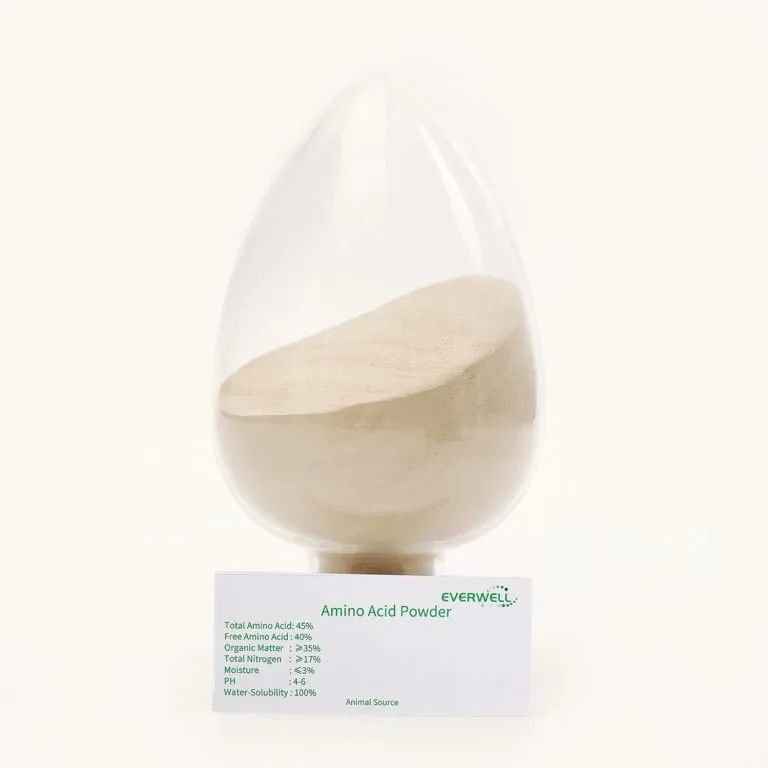
Amino Acid 45 Explained: Composition, Uses, Buyer Checks
Amino Acid 45 is a water-soluble protein hydrolysate specified at a minimum of 45% total amino acids and supplied as a raw material for foliar fertilizers, fertigation products and water-soluble blends. This note explains what the grade number does and does not describe, so that you can read two certificates side by side and know whether you are comparing the same thing.
Total Amino Acids and Free Amino Acids Are Different Values
Free amino acids are individual molecules that are not bound into peptides or proteins. Total amino acids are generally measured after a hydrolysis step in the laboratory, so the figure includes amino acids that were already free as well as amino acids released from peptides and protein fragments during the analysis itself.
Because the result depends on the analytical method, sample preparation and reporting basis, two certificates should not be placed side by side until the methods and units have been confirmed as comparable. A higher headline number obtained by a different method proves nothing about the material in the bag.
Current Everwell Bio Amino Acids 45 Values
The table below sets out the published specification for the grade together with the independent laboratory result on a tested sample. The 41.93% free-amino-acid figure was reported by Eurofins (Chengdu), a CNAS-accredited laboratory, using method GB/T 18246-2019 under certificate AR-26-Y3-008790-02 issued on 29 April 2026.
That value applies to the sample that was tested. For contractual purposes use the current specification, and for shipment release use the batch COA assigned to your order.
How the Grade Is Produced
Protein hydrolysis breaks large protein structures into a mixture of amino acids, peptides and other soluble components. At Everwell Bio the route is controlled hydrolysis, followed by purification, concentration and spray drying, with hydrolyzed duck feather protein as the starting material.
The distribution of amino acids and peptides in the finished powder depends on the raw material, the hydrolysis route, reaction control, purification and the final formulation. Process descriptions should match the actual grade, and terms such as enzymatic, chemical, physical or natural should not be used interchangeably. If the hydrolysis route or the salt profile matters in your destination market, have it confirmed in writing before purchase.
Where a 45% Grade May Be Used
The following are formulation categories to evaluate, not registration or label claims. The finished product still has to comply with the rules of the market where it is sold.
- Foliar fertilizer formulations
- Fertigation and drip-irrigation products
- Water-soluble NPK or micronutrient blends
- Liquid concentrates, after solubility and stability testing
- Multi-component biostimulant formulations where local rules permit
What the Research Supports, and What It Does Not
Research on protein hydrolysates reports possible improvements in nutrient-use efficiency, root development, crop quality and tolerance to abiotic stress. The same literature stresses that responses vary with composition, crop, concentration, growth stage and environmental conditions.
It is therefore reasonable to describe Amino Acid 45 as a candidate ingredient for crop-nutrition and biostimulant formulations. It is not reasonable to promise a fixed absorption time, a visible response within a set number of days, a guaranteed yield increase or a universal improvement in Brix or shelf life.
Does It Replace NPK? No
Amino Acid 45 contributes amino acids and nitrogen, but normally supplies little or no phosphorus and potassium unless those nutrients are added separately. A complete crop-nutrition program should still be built from crop demand, soil or substrate analysis, water quality and the nutrient contribution of every input in the program.
Any proposed reduction in mineral fertilizer has to be tested locally. A percentage saving that held up in one crop, soil or climate should not be published as a general recommendation.
The practical way to position the grade with a distributor is therefore additive rather than substitutive. Amino Acid 45 is sold into a programme as an amino acid and organic nitrogen contribution with a possible biostimulant function, while the phosphorus, potassium, calcium and micronutrients come from the rest of the formulation or from separate applications. That framing survives technical scrutiny in the destination market, whereas a replacement claim usually does not.
Application Trials, Organic Status and Supplier Checks
There is no single correct application rate for every 45% amino acid powder. Design a trial around the crop and growth stage, the route of use (foliar, root zone or in-formulation), water hardness, pH and temperature, the concentration of the final solution, the other fertilizers and crop-protection products involved, and local label requirements. Begin from the current TDS or the locally approved label, then run a dissolution test, a jar test, a small crop-safety test and a replicated field comparison before making any performance claim.
Protein hydrolysates are not automatically approved for organic production. Eligibility depends on the exact raw material, manufacturing process, intended use, country and certification program, and animal-source materials may carry additional restrictions. OMRI is a product-review organization rather than a blanket certification covering all hydrolyzed proteins, and EU or JAS acceptance has to be confirmed for the specific product and use. Ask for a current certificate or listing and verify it with the certifier before making an organic claim.
- Total amino acids and test method
- Free amino acids and test method
- Total nitrogen and organic nitrogen, reported separately
- Moisture and reporting basis
- pH, solubility and insoluble matter
- Sodium, chloride or other salts where relevant
- Raw-material origin and process statement
- Current COA, TDS and SDS
- Measured performance in your own formulation
Everwell Bio Amino Acids 45: published specification and tested-sample result
| Parameter | Current published specification or result |
|---|---|
| Total amino acids | at least 45% |
| Total nitrogen | at least 16% |
| Organic matter | at least 60% |
| Moisture | 5% maximum |
| pH, 1% solution | 4-6 |
| Water solubility | 100% |
| Source | Hydrolyzed duck feather protein |
| Free amino acids | 41.93% in an independently tested sample |
Conclusion
Treat Amino Acid 45 as a medium-concentration protein-hydrolysate raw material whose commercial value rests on verified composition, consistent production and fit with your own formulation rather than on the grade number. Send your crop, growth stage and target market to [email protected] and you will receive the COA, price and a free sample of 200-500 g for formulation testing, with a reply within 24 hours, Monday to Saturday.
Products Discussed In This Article
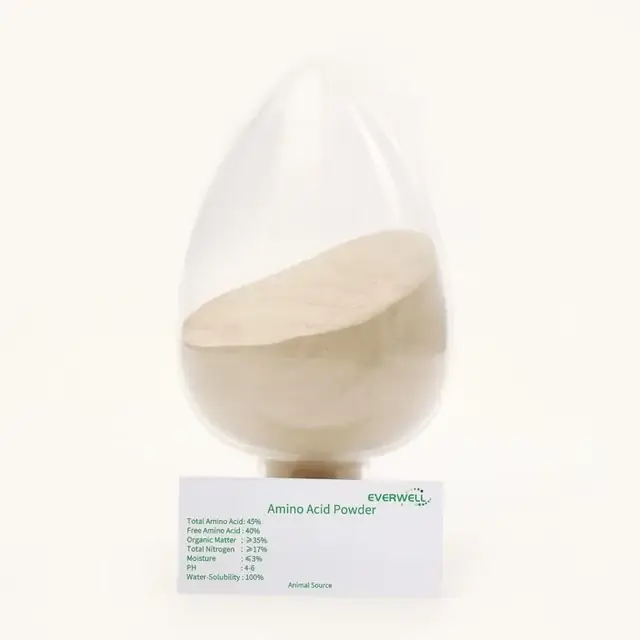
Amino Acids 45
The benchmark grade: ≥ 45% total amino acids, ≥ 60% organic matter, and 41.93% free amino acids measured by Eurofins under GB/T 18246-2019. The grade
View specification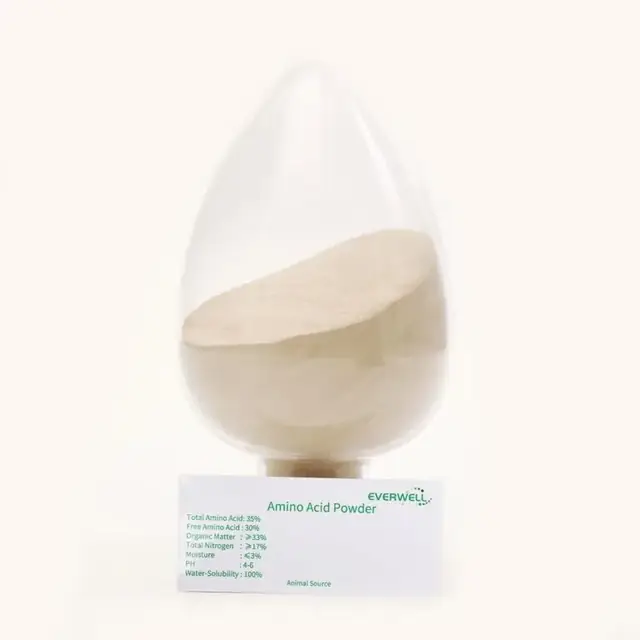
Amino Acids 35
The volume grade. A fully water-soluble hydrolysed feather protein powder carrying ≥ 17% total nitrogen, priced for foliar and fertigation programmes
View specificationRelated Articles
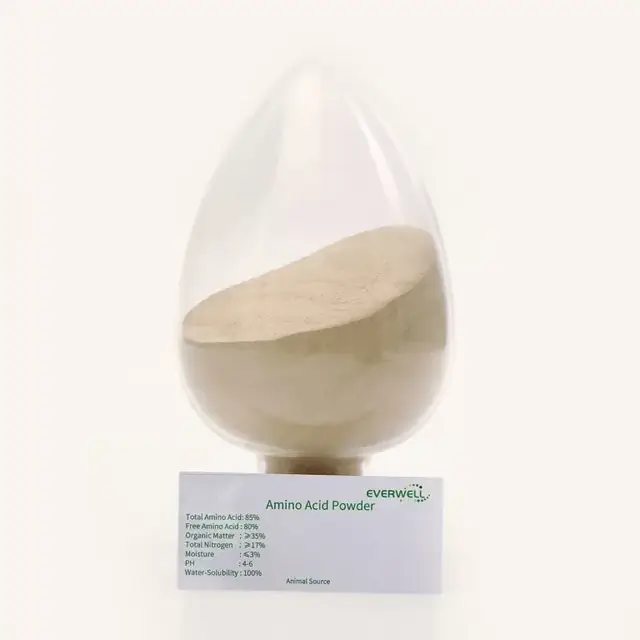
Amino Acid 80 Explained: Composition and Formulation Use
What an 80% total amino acid grade delivers per kilogram, where concentration helps, and why higher is not automatically better.
Read more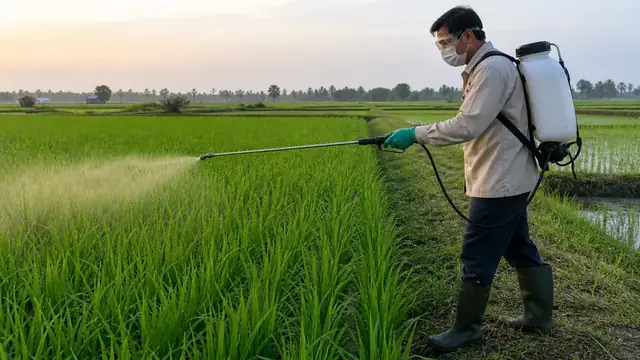
Amino Acid Fertilizer for Rice: A Practical Foliar Guide
How to evaluate an amino acid powder in rice by growth stage, set a safe starting rate and calibrate the spray without over-claiming.
Read more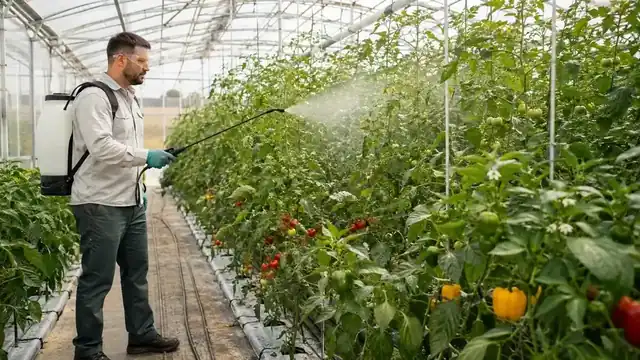
Amino Acid Fertilizer for Vegetables: Foliar Guide by Crop
Evaluation windows, rate calculation and spray practice for protein hydrolysates across fruiting, leafy, cucurbit, root and legume vegetables.
Read moreQuestions On This Topic
What does the number 45 actually refer to?
It refers to total amino acids in the product specification, measured after laboratory hydrolysis. It is not a statement that the powder contains 45% free amino acids.
Which laboratory produced the 41.93% figure?
Eurofins in Chengdu, a CNAS-accredited laboratory, using method GB/T 18246-2019 under certificate AR-26-Y3-008790-02 dated 29 April 2026, on a tested sample.
What is the raw material?
Hydrolyzed duck feather protein, processed by controlled hydrolysis, purification, concentration and spray drying.
How soluble is the powder and at what pH?
The specification states 100% water solubility and a pH of 4 to 6 in a 1% solution, with moisture at 5% maximum.
Can I use it in an organic-certified product?
Not without checking. Eligibility depends on the raw material, process, intended use, country and certification program, and must be verified with the relevant certifier for your specific product.
What are the commercial terms?
Regular orders ship on a 30-day lead time, FOB Shanghai or Qingdao, with payment terms of T/T, L/C, D/P or O/A.
Ask Us About This Directly
Technical questions are answered by the export and production team, normally within 24 hours.