
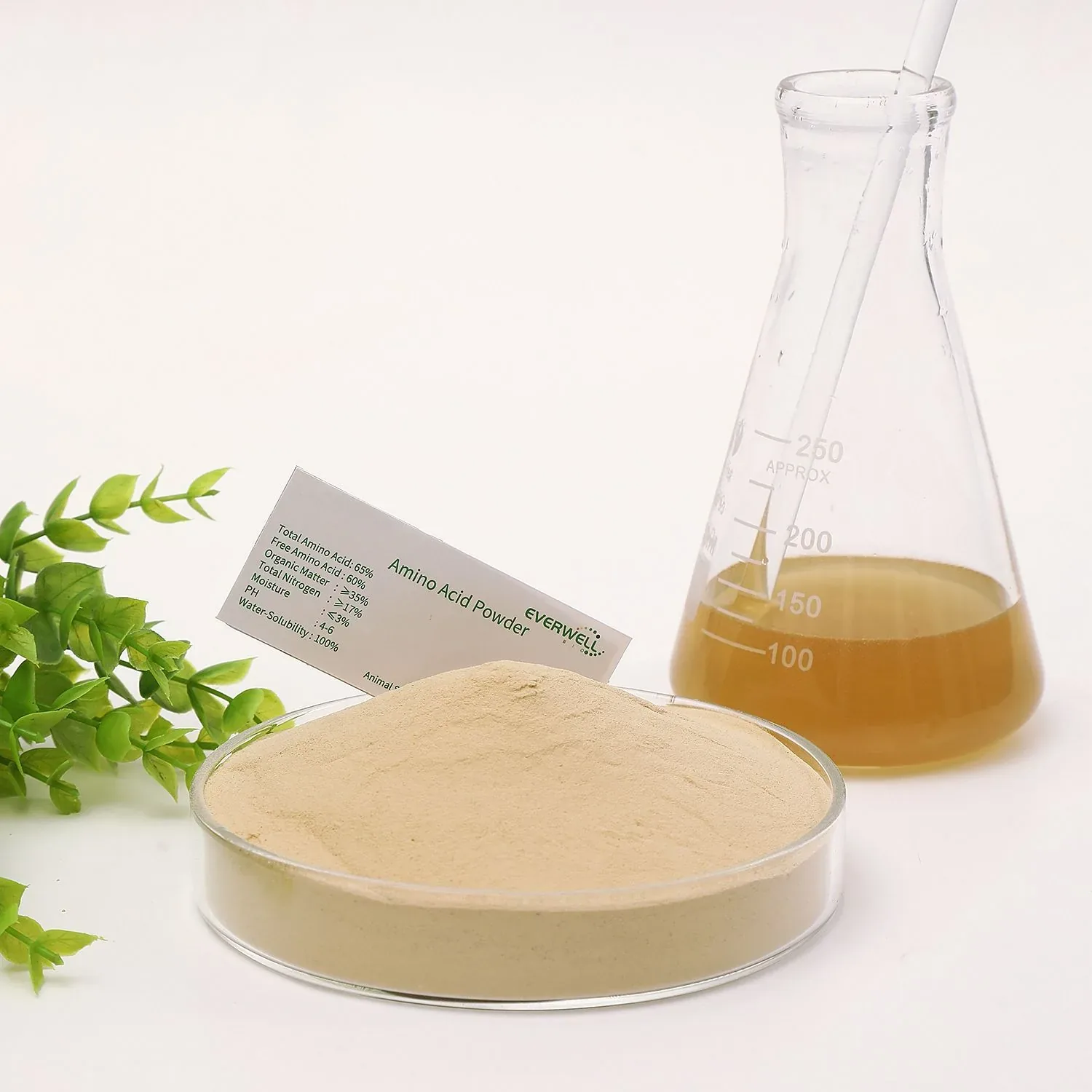
What Is Compound Amino Acid Powder? A Buyer's Guide
Compound amino acid powder is a water-soluble protein-hydrolysate material used in fertilizer and plant-nutrition formulations, and it is routinely bought on a single number such as 35, 45 or 80 percent. After reading this you will be able to decide which analytical values actually qualify a grade for your formulation, which claims to refuse, and exactly which documents to ask a supplier for before you place an order.
What the Material Is
Compound amino acid powder is produced by breaking a protein-rich raw material down into smaller, water-soluble components. Depending on the raw material and the process used, the finished powder may contain free amino acids, peptides, other nitrogen-containing compounds, minerals and salts. It is a mixture, not a single defined chemical.
Commercial grades are usually described by total amino acid content: 35%, 45% or 80%. That number is a useful shorthand for concentration, but it is only one part of qualification. Before a grade enters a formulation, verify free amino acids, total and organic nitrogen, organic matter, moisture, pH, water solubility, salt content, raw-material source and the test method behind every figure.
How Compound Amino Acid Powder Is Produced
Production begins with a protein-rich raw material. Plant sources may include soy or corn proteins; animal sources may include feathers, fish materials, hides or collagen-rich by-products. Hydrolysis then breaks the protein structures into smaller components, using acid, alkali, enzymes, heat or a controlled combination of these. The hydrolysate may afterwards be purified, concentrated and dried.
The process is not a marketing label. It changes measurable properties of the finished powder, which is why a process name on its own proves nothing about quality. The finished specification and the analytical results matter more than the word used to describe the reactor step.
- The proportion of free amino acids to peptides
- The amino acid profile
- pH and salt content
- Colour and odour
- Solubility and insoluble matter
- Batch-to-batch consistency
Total Amino Acids Versus Free Amino Acids
These two terms are not interchangeable, and confusing them is the most common costing error in this category. Free amino acids are individual amino acid molecules that are not bound in proteins or peptides. Total amino acids are generally measured after laboratory hydrolysis, so the result includes amino acids that were already present in free form together with those released from peptides and proteins during the analysis itself.
A product described as 45% amino acids should therefore never be restated as 45% free amino acids. If a specification sheet does not say which figure it reports, the method and the reporting basis have to be confirmed in writing before the value is used in a formulation calculation or a label claim.
Everwell Bio has free amino acid results determined by Eurofins in Chengdu, a CNAS-accredited laboratory, using method GB/T 18246-2019, issued 29 April 2026: 41.93% free amino acids on the 45 grade (certificate AR-26-Y3-008790-02), 48.22% on the 50 grade (AR-26-Y3-008792-02) and 75.37% on the 80 grade (AR-26-Y3-008791-02). Those are examples of the kind of third-party evidence a buyer should ask any supplier to produce.
What 35, 45 and 80 Actually Mean
The percentages normally identify the supplier's guaranteed minimum total amino acid grade. They set how much powder you need to reach a given amino acid target in a finished blend, and therefore how much formulation space remains for other ingredients.
A higher grade does not guarantee better field performance. The correct choice depends on the complete analytical profile and on the intended formulation, including crop safety and how the solution behaves at your working concentration.
Where It Is Used in Formulation
Compound amino acid powder may be evaluated in several formulation types, but none of these uses is an automatic label approval. The finished product still has to meet the destination market's registration, composition and claim requirements before it can be sold there.
- Foliar fertilizer formulations
- Fertigation and drip-irrigation products
- Water-soluble NPK and micronutrient blends
- Liquid concentrates, after stability testing
- Specialty biostimulant products where local regulations permit
Agronomic Roles and Honest Language
Research on protein hydrolysates reports possible effects on nutrient-use efficiency, root development, plant metabolism and tolerance to abiotic stress. The same body of evidence shows that results vary by source, process, concentration, crop, growth stage and environment. Defensible wording is therefore conditional: may support nutrient-use efficiency under tested conditions, may be evaluated in stress-management formulations, crop-specific trials are recommended.
Claims that a product is absorbed completely within hours, guarantees rapid greening, prevents drought, frost, pests or disease, always improves yield or Brix, or leaves no residue and is safe until harvest should not appear on your literature. They are not supportable and they create regulatory exposure in most import markets.
On the question that comes up in almost every enquiry: no, this material does not replace NPK fertilizer. It may contribute nitrogen, but it normally supplies little or no phosphorus and potassium unless those are added separately. Treat it as one component alongside a complete nutrient program, and calculate any proposed fertilizer reduction nutrient by nutrient under local conditions rather than copying a reduction percentage from another crop or trial.
Solubility, Compatibility and the Buyer Checklist
A product can meet a published solubility specification and still behave differently in a concentrated formulation. Water hardness, temperature, pH, concentration and the other ingredients in the tank all affect dissolution and stability, so the specification is a starting point for your own testing rather than a substitute for it.
Organic-production status deserves the same scepticism. Protein-derived materials are not automatically approved for organic farming; eligibility depends on the exact source, manufacturing process, formulation, use, country and certification program, and animal-source products may face additional restrictions. Request a current certificate or product listing for the exact grade and verify it with the relevant certifier rather than relying on a general statement that protein hydrolysates are organic.
- Test the powder in the actual process water before scale-up
- Record dissolution time and insoluble matter
- Run a jar test with the complete ingredient list
- Observe precipitation, foam, odour and pH change
- Complete short- and longer-term storage tests
- Test crop safety at the intended use rate
Documents and values to request before commercial approval
| Document or value | What to confirm |
|---|---|
| Product specification or TDS | Guaranteed parameters and intended use |
| Representative COA | Typical reporting format and recent production |
| Batch COA | Results for the material assigned to your order |
| SDS | Handling, storage and transport information |
| Total amino acids | Method and reporting basis |
| Free amino acids | Separate measurement and stated method |
| Total and organic nitrogen | Nitrogen form and contribution |
| Sodium, chloride or other salts | Formulation and crop relevance |
| Origin and process statement | Market and compliance requirements |
| Sample trial | Performance in your actual formulation |
Conclusion
Compound amino acid powder is not defined by one percentage alone. Everwell Bio currently supplies 35%, 45% and 80% total amino acid grades produced from hydrolyzed duck feather protein, and the published specifications are a starting point for evaluation rather than the end of it. Send your target specification, intended formulation and destination market to [email protected] and ask for the current technical package, the assigned batch COA and a 200-500 g free sample with its batch COA; we reply within 24 hours, Monday to Saturday.
Products Discussed In This Article
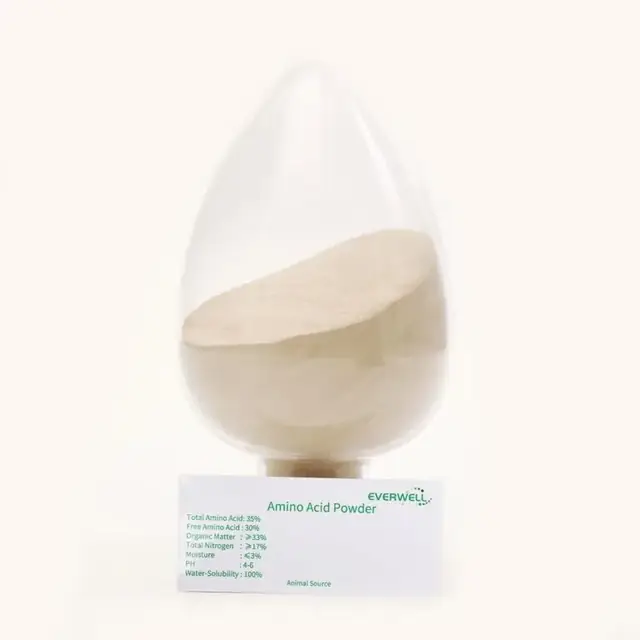
Amino Acids 35
The volume grade. A fully water-soluble hydrolysed feather protein powder carrying ≥ 17% total nitrogen, priced for foliar and fertigation programmes
View specification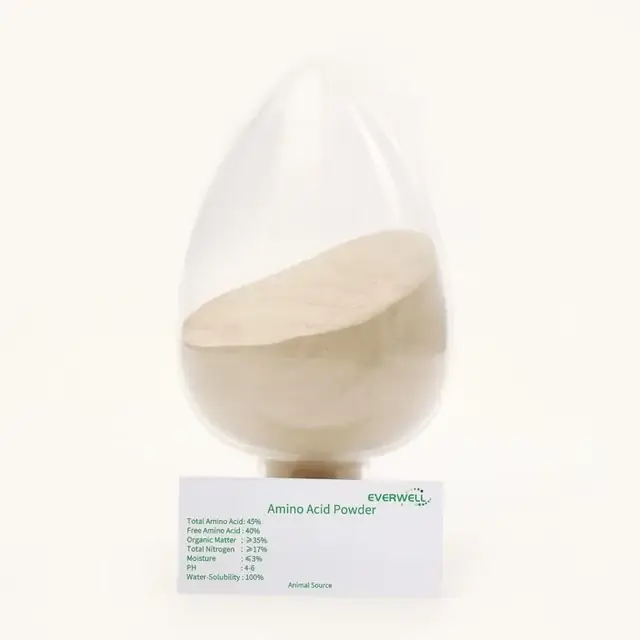
Amino Acids 45
The benchmark grade: ≥ 45% total amino acids, ≥ 60% organic matter, and 41.93% free amino acids measured by Eurofins under GB/T 18246-2019. The grade
View specification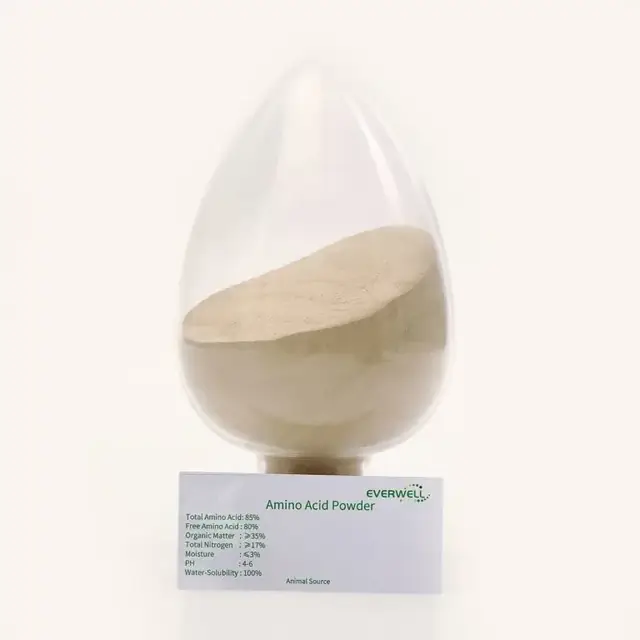
Amino Acids 80
The density grade: ≥ 80% total amino acids, ≥ 80% organic matter, and 75.37% free amino acids measured by Eurofins. Glycine and proline rich, for conc
View specificationRelated Articles

When to Apply Amino Acid Fertilizer: A Timing Guide
Why there is no universal application date, which windows are worth testing locally, and the safeguards that keep a timing decision crop-safe.
Read more
Which Crops Benefit Most From Amino Acid Fertilizer
The crop groups most often formulated for with compound amino acid powder, and how to qualify a grade for each of them.
Read more
Amino Acid 45: Practical Advantages and Real Limits
What a 45% total amino acid grade actually offers a formulator, what it cannot do, and the specifications to verify first.
Read moreQuestions On This Topic
Is a 45% amino acid powder the same as 45% free amino acids?
No. Total amino acids are measured after laboratory hydrolysis and include amino acids released from peptides and proteins during the analysis. Free amino acids require a separate measurement, and the method and reporting basis must be stated.
Which grade should I start with?
Choose by formulation space rather than by the highest number. The 35 grade suits cost-focused blends where more powder can be carried, the 45 grade balances concentration against cost, and the 80 grade is for high-concentration inputs where less powder is wanted.
What raw material does Everwell Bio use?
The 35, 45 and 80 grades are produced from hydrolyzed duck feather protein. A separate hydrolyzed protein powder is produced from cattle bone.
Can this material replace my NPK program?
No. It may contribute nitrogen but normally supplies little or no phosphorus and potassium unless they are added separately, so it is a component within a complete nutrient program.
Is compound amino acid powder approved for organic production?
Not automatically. Eligibility depends on the exact source, process, formulation, intended use, country and certification program, so request a current certificate for the exact grade and verify it with your certifier.
What can I get before committing to a commercial order?
A free sample of 200-500 g with its batch COA, plus the TDS and SDS. Regular orders run on a 30-day lead time, FOB Shanghai or Qingdao.
Ask Us About This Directly
Technical questions are answered by the export and production team, normally within 24 hours.