
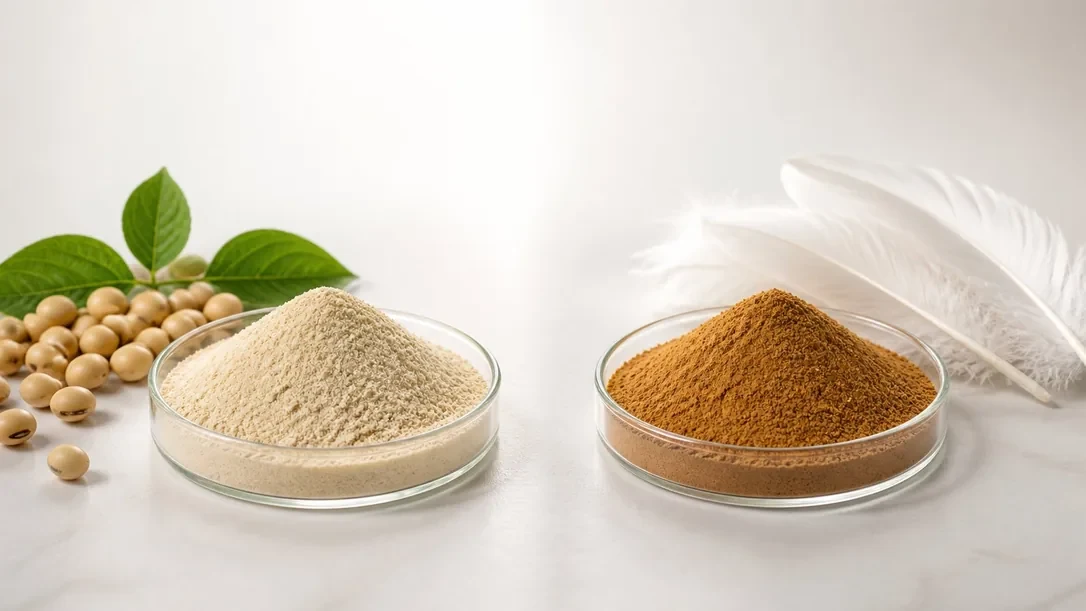
Plant vs Animal Source Amino Acid Powder for Fertilizer
Compound amino acid powder for fertilizer is made by hydrolyzing either plant protein such as soybean meal and corn gluten, or animal protein such as duck feathers, fish, cattle hide or bone. This note sets the two families side by side, walks through how a feather hydrolysate is actually made, and gives you a decision framework so you can choose a source on batch analysis and market rules rather than on category folklore.
The Five Protein Sources You Will Be Quoted
Almost every protein-hydrolysate amino acid powder on the market starts from one of five raw materials. Hydrolysis, whether enzymatic, acid or alkaline, breaks the long protein chains into short peptides and free amino acids. The concentration ranges below describe finished commercial powders, and they vary with grade, carrier and any added inorganic salts. They are not fixed properties of the protein itself.
That distinction matters commercially. Protein nitrogen generally falls near 13-19% for most proteins, and pure soy protein, using the 5.71 nitrogen-to-protein conversion factor, can itself approach roughly 17.5% N. So the gap between a finished powder at 3-8% N and one at 8-17% N is mostly explained by how much protein hydrolysate, carrier and salt is in the final product, not by the source category on the label.
How Feather Protein Becomes a Spray-Dried Powder
Everwell Bio's Amino 35, 45 and 80 grades are produced from hydrolyzed duck feather protein. Feather keratin is a widely available, relatively low-cost poultry by-product, and its amino acid spectrum suits many plant nutrition programs. The route from raw feather to finished powder runs through five controlled steps.
Keratin is the reason this process is more demanding than hydrolyzing a soluble plant protein. Degrading it generally requires disruption of its disulfide cross-links, usually through reducing agents, sulphites or disulfide-reductase enzymes, followed by proteolytic cleavage of the peptide bonds. The exact conditions depend on the keratinolytic enzyme system and the pretreatment used.
- Cleaning. Raw duck feathers are washed to remove dirt, oil and foreign matter, then dewatered and fed to the hydrolysis reactor.
- Hydrolysis. The feathers are treated at controlled temperature and pH with a keratin-degrading enzyme system or a chemical pretreatment, producing a liquor of peptides and free amino acids.
- Filtration. The hydrolysate passes through screens and centrifuges to remove undissolved residue such as ash and insoluble fibre, leaving a clear amber concentrate.
- Spray-drying. The concentrate is atomised into fine droplets and dried with hot air; the short residence time helps limit prolonged thermal exposure.
- Quality control. Each batch is tested and a Certificate of Analysis is issued.
What Is Actually Measured on Each Batch
Batch testing covers total amino acids by HPLC after acid hydrolysis, total nitrogen by Kjeldahl, moisture, pH, water solubility, heavy metals including lead, arsenic, cadmium and mercury, and microbial limits including total plate count, E. coli and Salmonella.
Read those method names carefully when you compare suppliers. Standard HPLC measures total amino acids; free amino acids require a separate assay, and confirming the L-form requires chiral L/D analysis. Kjeldahl measures total nitrogen, which is not automatically synonymous with organic nitrogen. A quotation that blurs these distinctions is quoting a different product from the one you think you are buying.
The finished material is a light-yellow to brown powder that meets its product-specific water-solubility specification under the stated test conditions. The grade number, 35, 45 or 80, is determined mainly by hydrolysate concentration, purification and final formulation. The degree of hydrolysis primarily affects the split between free amino acids and peptides, not the total amino acid percentage itself.
Amino Acid Profile: Where the Real Difference Lies
Different protein sources do have different inherent amino acid compositions. But the profile of a commercial powder is also shaped by raw-material variety, pretreatment, the enzyme system or chemical method, hydrolysis conditions and downstream processing. Two feather-derived powders from different plants can differ more than a feather powder and a soy powder from careful producers.
Individual amino acids do participate in multiple metabolic pathways inside the plant. Glycine is involved in photorespiration and nitrogen metabolism, proline acts as an osmolyte under stress, and glutamic acid participates in nitrogen transport. Those are descriptions of internal plant biochemistry. The effect of an exogenously applied amino acid depends on concentration, uptake, crop condition and environment, and cannot be predicted from a single amino acid's metabolic label.
The practical conclusion is not that plant-source powder is inferior. It is that the two families can have different profiles, and the choice should rest on batch-specific analysis, your formulation goals, certification requirements and crop trials rather than on source-category generalisations.
Soy Versus Feather on the Five Purchasing Dimensions
Once the profile question is settled by analysis, five practical dimensions decide the purchase. Note how many of them resolve to the same answer for both sources: compare the batch COA.
Cost is where the honest difference sits. Feathers are a widely available poultry by-product, which often makes feather hydrolysate cost-competitive per kilogram of amino acid, but delivered cost still depends on grade, purity, salt load, order volume and freight. Certification is the other genuine discriminator: it is product-specific in both cases, and animal-source material can face restrictions that plant-source material does not, such as EU rules on hydrolysed animal protein.
Response time is not a discriminator at all. For both sources it varies with crop condition, rate, formulation and environment, and it is product-specific. Any supplier offering a fixed response window by source category is selling a story.
- Amino acid spectrum: varies with variety and hydrolysis method on both sides; compare the batch COA.
- Nitrogen content of the finished powder: depends on grade, carrier and added salts, not on the source.
- Cost per kg of amino acid: varies with grade, processing, purity and order quantity; feather is often competitive.
- Organic certification: product-specific; verify the current certificate and any animal-source restrictions.
- Best fit: plant source for vegan or vegetarian-labelled products and markets restricting animal-origin imports; feather source for general foliar, fertigation and stress-recovery formulations.
Choosing a Source for Your Own Programme
Start from the market, not from the raw material. If your destination market restricts hydrolysed animal protein, or your finished product carries a vegan claim, the decision is made for you and the remaining work is qualifying a plant-source supplier. If neither constraint applies, the question becomes cost per kilogram of delivered amino acid at your required specification.
Then qualify by document. Request the current TDS and SDS, a representative COA and the assigned batch COA for the material allocated to your order, plus a raw-material origin and process statement. Run your own solubility and jar tests in the actual process water, because a published solubility figure describes the stated test conditions and not your stock tank.
Finally, trial before you commit volume. A 200-500 g sample with its batch COA is enough to run dissolution checks, a compatibility jar test and a small crop-safety trial at your intended rate. That sequence costs weeks; reversing an unsuitable container costs a season.
Common protein sources for amino acid powder, with finished-powder ranges
| Source | Type | Typical total AA (finished powder) | Typical total N (finished powder) | Relative cost per kg AA |
|---|---|---|---|---|
| Duck / chicken feathers | Animal (keratin) | 35-80% | 8-17% | Low (by-product) |
| Soybean meal | Plant (globulin) | 35-50% | 3-8% | Medium |
| Fish meal / fish solubles | Animal (myofibrillar) | 30-60% | 5-10% | Medium |
| Cattle hide / bone | Animal (collagen) | 40-80% | 8-14% | Low - medium |
| Corn gluten meal | Plant (zein) | 30-45% | 3-6% | Medium - high |
Conclusion
No protein source is universally superior. Decide on the basis of your destination market's rules on animal-origin material, your finished-product claims, the batch-specific analysis and your own formulation trials, and treat the source category only as a first filter. Send your target specification, intended formulation and destination market to [email protected] and ask for the current technical package and a free 200-500 g sample with its batch COA; we reply within 24 hours, Monday to Saturday.
Products Discussed In This Article
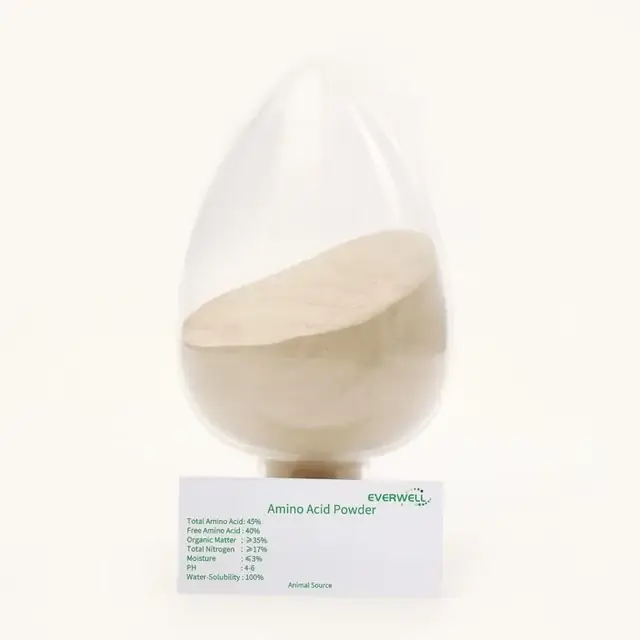
Amino Acids 45
The benchmark grade: ≥ 45% total amino acids, ≥ 60% organic matter, and 41.93% free amino acids measured by Eurofins under GB/T 18246-2019. The grade
View specification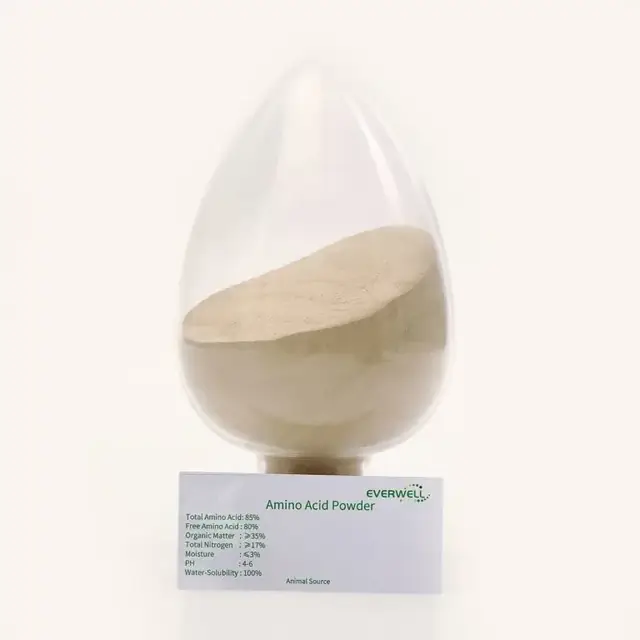
Amino Acids 80
The density grade: ≥ 80% total amino acids, ≥ 80% organic matter, and 75.37% free amino acids measured by Eurofins. Glycine and proline rich, for conc
View specification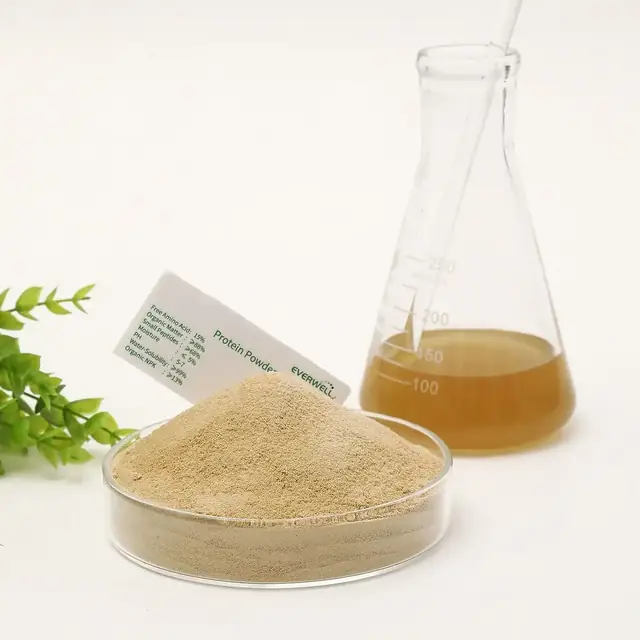
Protein Powder
A collagen-derived protein input at ≥ 90% crude protein and ≥ 80% total amino acids, glycine and proline rich, dissolving at 99% for animal feed, pet
View specificationRelated Articles
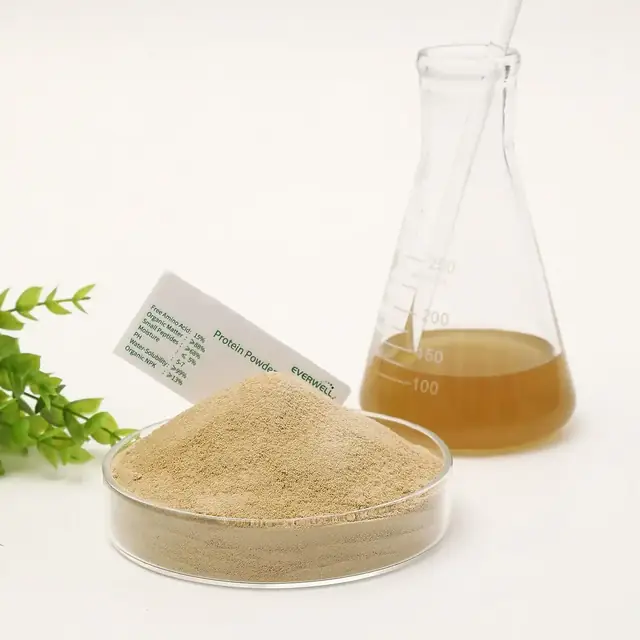
Hydrolyzed Protein Powder: Composition, Uses, Compliance
What a 90% crude protein cattle-bone hydrolysate is, how it differs from amino acid powder, and what each end use still requires you to prove.
Read more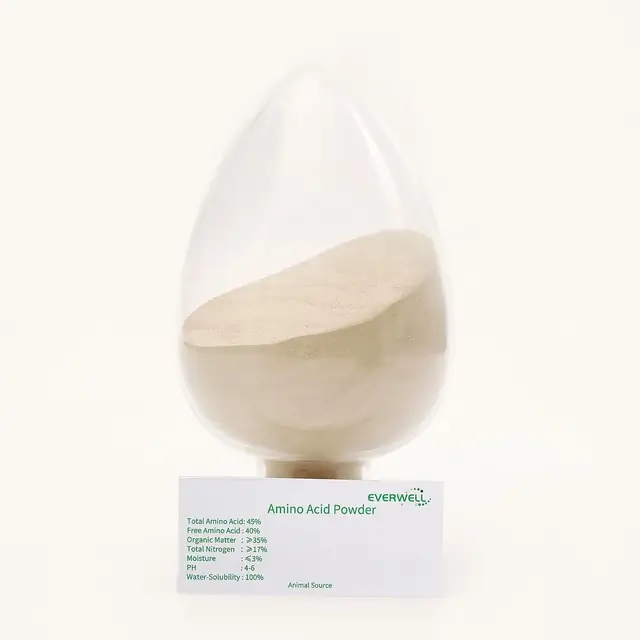
Recommended Dosage for Compound Amino Acid Powder
Starting foliar and soil rates for compound amino acid powder, how to convert them into a real programme, and why the grade changes the arithmetic.
Read more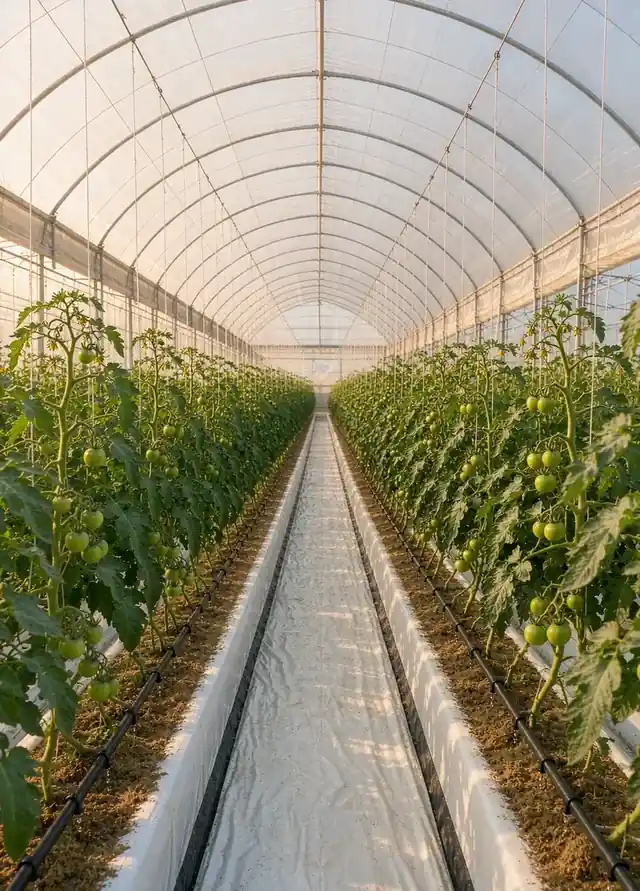
Sourcing Amino Acid Powder for Fertilizer in Turkiye
A procurement guide for Turkish importers and formulators: grade selection, drip-irrigation testing, documents, GTIP questions, HALAL and shipping terms.
Read moreQuestions On This Topic
Is animal-source amino acid powder better than plant-source?
Neither is universally superior. Performance depends on composition, processing method, crop and application conditions, so compare batch-specific analyses rather than source categories.
Why is feather-derived powder often cheaper?
Feathers are a widely available poultry by-product, which keeps the raw material cost low. Delivered cost still depends on grade, purity, salt content, order volume and freight.
Does a higher nitrogen figure mean a better protein source?
No. Total nitrogen in a finished powder depends mainly on hydrolysate concentration, carrier and added salts. Protein nitrogen itself generally falls near 13-19% for most proteins.
Can I assume the amino acids are in the L-form?
Not from a standard analysis. HPLC after hydrolysis reports total amino acids; confirming the L-form requires separate chiral L/D analysis.
Will animal-source material pass organic certification?
That is product-specific and market-specific. Verify the current certificate for the exact product and check restrictions on hydrolysed animal protein in your destination market, such as the EU rules.
What raw material do Everwell Bio's amino acid grades use?
Amino 35, 45 and 80 are produced from hydrolyzed duck feather protein. A separate hydrolyzed protein powder is produced from cattle bone.
Ask Us About This Directly
Technical questions are answered by the export and production team, normally within 24 hours.