
How Long Does Amino Acid Fertilizer Take to Work?
There is no universal number of days in which an amino acid fertilizer works, because absorption, physiological response and visible field results are three separate events. This guide gives you a defensible monitoring timeline, the factors that most often change response speed, and the comparison design you need before you can say the product did anything at all.
The Short Answer, and Why It Is a Range
After a foliar application, start checking the crop at around three to seven days, while accepting that a visible difference is not guaranteed at that point. A second assessment at seven to fourteen days is usually more informative. Root-zone applications generally need longer, because the response depends on root activity, soil or substrate conditions and irrigation distribution. Yield and quality effects can only be judged across the crop cycle and at harvest.
The distinction that matters is between uptake and result. A product may be absorbed well before any difference can be seen, and a greener leaf does not by itself prove a yield benefit. Everything below is about separating those two things in a way that survives scrutiny from a customer or an agronomist.
Why There Is No Universal Response Time
Amino acid fertilizer is a category, not a specification. Products within it differ in their proportions of free amino acids, peptides, nitrogen, salts and carriers, in any added nutrients, and in the raw material and manufacturing process behind them. Two products sharing a label description can behave quite differently in the same tank.
Published experiments show that protein hydrolysates can affect plant growth, nitrogen metabolism and stress responses. Those results, however, come from specific products, crops, rates and experimental conditions. They do not establish a guaranteed response time for every commercial amino acid fertilizer, and they should not be quoted as though they did.
- The finished product's verified composition
- Application rate and method
- Crop species, variety and growth stage
- Leaf condition and spray coverage
- Root-zone moisture, aeration, pH and salinity
- Temperature, light and humidity
- The adequacy of the existing nutrient program
- The type and severity of any plant stress
Absorption Is Not the Same as a Visible Result
Plants can take up some amino acids and small nitrogen-containing compounds through leaves and roots, so physiological and metabolic changes may begin before anything is visible in the field. Splitting the response into three stages keeps the evaluation honest.
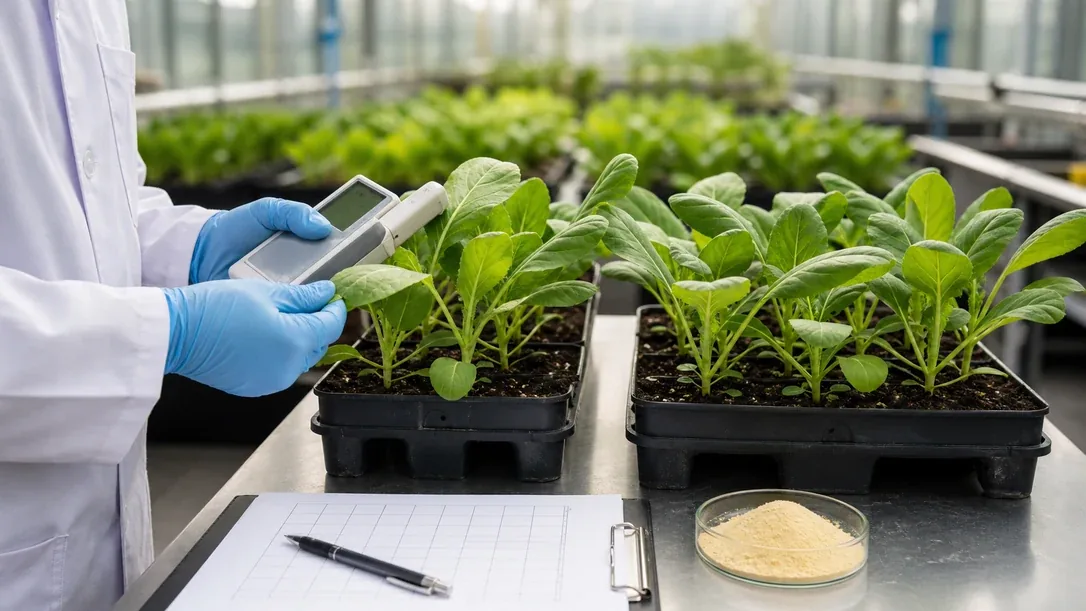
Early physiological response may begin within hours or days, but normally requires instruments or laboratory measurement to detect. Visible crop response, such as leaf posture, new growth, recovery or colour, may become noticeable over several days, provided the crop is responsive and nothing else is limiting it. Agronomic result, meaning biomass, flowering, fruit set, yield, Brix, uniformity or shelf life, requires measurement over weeks or at harvest.
A claim such as absorbed in two hours is therefore not evidence that a product will visibly improve a crop in two hours. Uptake speed does not determine the complete field response.
What a Useful Early Response Looks Like
Depending on the crop and the reason for application, early observations may include improved leaf posture or turgor after a reversible stress, more uniform new growth, a difference in chlorophyll-meter or SPAD readings, renewed shoot or root development, or a smaller decline in treated plants than untreated plants during a defined stress period.
Each of these needs context before it counts. Darker green leaves may reflect nitrogen or another added nutrient rather than a specific amino acid biostimulant effect, and recovery following irrigation is easily mistaken for a fertilizer response. Always compare treated plants against an untreated or standard-program control exposed to the same conditions on the same day.
Six Factors That Change Response Speed
Finished-product composition comes first. Total amino acids, free amino acids, peptides and total nitrogen are different measurements. A higher grade contains more declared material per kilogram, but that does not automatically mean a faster visible response. Compare products at appropriate rates using the current specification and the batch COA.
Crop condition and growth stage set the ceiling on what you can see. A healthy, well-fertilized crop may show little visible change even where a treatment is affecting plant metabolism, while a crop under severe drought, root disease, waterlogging, salinity or a major nutrient deficiency may not respond at all until the primary limitation is corrected. Actively expanding leaves and roots give a better evaluation window than dormant or senescing tissue.
Foliar coverage and weather decide how much product reaches the target. Poor coverage, rapid drying, rainfall soon after application, or unsuitable temperature and humidity all change foliar performance. Follow the finished-product label and local agronomic guidance, and do not assume that adding a surfactant is always helpful, since compatibility and crop safety must be checked first.
Root-zone conditions govern fertigation and soil applications, where response depends on irrigation distribution, root activity, oxygen, salinity, pH and microbial processes. No product corrects a damaged or inactive root system by itself. Finally, base nutrition frames everything: protein hydrolysates should normally complement a balanced nutrient program, and most standalone amino acid powders do not supply enough phosphorus or potassium to replace a complete NPK program. Calculate nutrient contributions from the verified analysis rather than from the product name.
Do Amino Acids Work Faster Than Urea or NPK?
There is no defensible universal ranking. Foliar urea, nitrate fertilizers and amino acid products have different compositions, uptake pathways and agronomic purposes, and mineral nitrogen can itself produce a rapid response where nitrogen is the limiting factor. An amino acid product may support stress management or plant metabolism, while NPK supplies the bulk nutrients growth requires.
So the useful question is not which one is faster. Ask instead what limitation you are trying to address, which nutrients or compounds each product actually supplies, what rate reaches the crop, and what a controlled comparison showed under local conditions. One thing follows from this directly: do not cut the base NPK program simply because a crop looks greener after an amino acid application.
Testing Whether the Product Worked
Keep a comparison. Leave an untreated strip, or run the new program against current practice, under the same conditions and the same management. Without that reference, every observation later in the season is an opinion.
Record the inputs on application day so the trial can be reconstructed: product, batch, rate, water volume, tank mix, weather and crop stage. Then hold to the observation schedule rather than judging early and stopping. Move from appearance to measurement at two to four weeks, and settle the commercial question at harvest by comparing marketable yield, quality and economics rather than colour.
Monitoring guide after application. This is an evaluation schedule, not a performance guarantee.
| Time after application | What to do | What the result can tell you |
|---|---|---|
| Application day | Record product, batch, rate, water volume, tank mix, weather and crop stage; retain an untreated comparison | Establishes a valid baseline |
| 1-3 days | Check crop safety, spray injury, precipitation or irrigation problems | Identifies application or compatibility problems; usually too early to judge value |
| 3-7 days | Make the first foliar-treatment comparison under the same light and time of day | May reveal differences in leaf posture, colour, stress recovery or new growth |
| 7-14 days | Repeat observations and measurements; begin evaluating root-zone treatments | Shows more reliably whether the response is persisting |
| 2-4 weeks | Measure growth rather than relying on appearance | Useful for shoot growth, root development, canopy measurements and treatment decisions |
| At harvest | Compare marketable yield, quality and economics | Determines whether the program created commercial value |
Conclusion
Set the evaluation up before the first application rather than after it: define the objective, keep an untreated comparison, record the batch and rate, and fix the observation dates in advance. Judge foliar treatments first at three to seven days and again at seven to fourteen, move to measurement at two to four weeks, and reserve the commercial verdict for harvest. To match a grade and a verified analysis to the response you are trying to produce, email [email protected] with your crop, application method and current nutrient program.
Products Discussed In This Article
Amino Acids 45
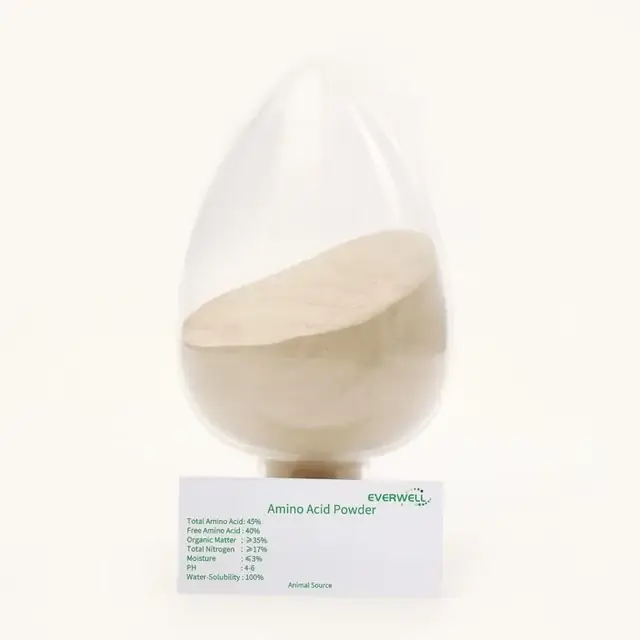
The benchmark grade: ≥ 45% total amino acids, ≥ 60% organic matter, and 41.93% free amino acids measured by Eurofins under GB/T 18246-2019. The grade
View specification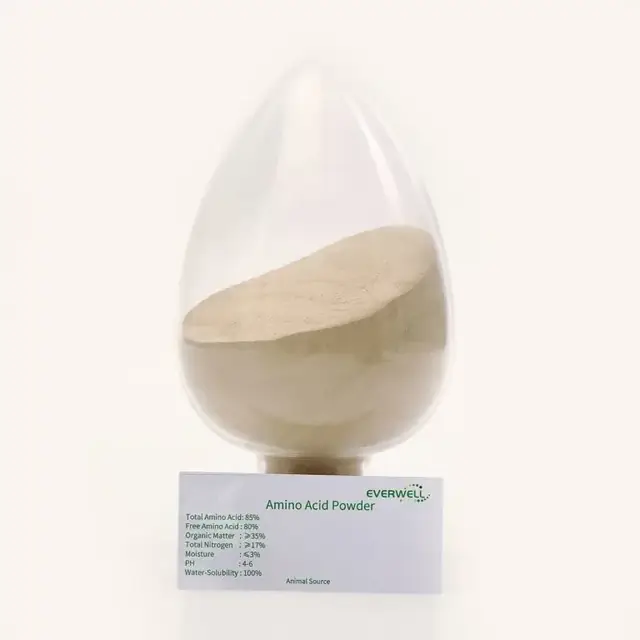
Amino Acids 80
The density grade: ≥ 80% total amino acids, ≥ 80% organic matter, and 75.37% free amino acids measured by Eurofins. Glycine and proline rich, for conc
View specificationRelated Articles
How to Apply Compound Amino Acid Powder Safely
A trial-based framework for foliar, fertigation and root-zone use, including jar testing, crop safety checks and dosage priority.
Read more
Is Amino Acid Powder Allowed in Organic Farming?
How NOP, OMRI, EU organic rules and JAS treat amino acid and protein-hydrolysate inputs, and which documents a buyer must request.
Read more
Mixed-SKU FCL Consolidation for Fertilizer Inputs
How several fertilizer raw materials can be loaded into one buyer-dedicated container at the Suzhou warehouse, with no consolidation fee.
Read moreQuestions On This Topic
How soon after a foliar spray should I look for a difference?
Begin checking at around three to seven days, but treat seven to fourteen days as the more informative assessment. A visible difference at the first check is not guaranteed.
Why do root-zone applications take longer to assess?
Because the response depends on root activity, soil or substrate conditions and irrigation distribution. Fertigation and soil applications should not be given a fixed days-to-effect figure without product- and crop-specific trial data.
Does a darker green leaf prove the product worked?
No. Darker green may reflect nitrogen or another added nutrient rather than a specific biostimulant effect, and recovery after irrigation can look the same. Compare against an untreated control under identical conditions.
Will a higher grade such as 80% give a faster visible response?
Not automatically. A higher grade contains more declared material per kilogram, but response speed depends on rate, crop condition, coverage and base nutrition. Compare grades at appropriate rates using the current specification and batch COA.
Can I reduce my NPK program if the crop looks better?
No. Most standalone amino acid powders do not supply enough phosphorus or potassium to replace a complete NPK program. Calculate nutrient contributions from the verified analysis before changing base nutrition.
What should I record on application day?
Product, batch, rate, water volume, tank mix, weather and crop stage, along with an untreated comparison area. Without this the later observations cannot be interpreted.
Ask Us About This Directly
Technical questions are answered by the export and production team, normally within 24 hours.