
How to Choose 35%, 45% or 80% Compound Amino Acid Powder
The best amino acid powder grade is rarely the one with the highest percentage on the bag. This guide compares the 35, 45 and 80 percent grades on verified composition, formulation space, cost, salts, solubility, application and destination-market requirements, so you can pick on arithmetic rather than on the headline number.
Read the Percentage Correctly First
The grade percentage normally refers to total amino acids. It should not be read as free-amino-acid content, and the two figures can differ substantially. Before comparing any two offers, confirm which quantity each supplier is reporting and by which test method, because a total figure and a free figure placed side by side is not a comparison at all.
Everwell Bio has published representative independent free-amino-acid results of 41.93 percent on a tested Amino Acids 45 sample and 75.37 percent on a tested Amino Acids 80 sample. Those results relate to the samples that were tested and do not replace the assigned batch COA for the material you buy.
The Grade Comparison, and What the Nitrogen Column Shows
All three grades come from hydrolyzed duck feather protein, all three are specified at moisture of 5 percent or below, pH 4 to 6 in a 1 percent solution, and 100 percent water solubility. What changes across the range is total amino acids, organic matter and, in the opposite direction, nitrogen.
That last point deserves attention because it is counter-intuitive. Total nitrogen is specified at not less than 17 percent for the 35 grade, not less than 16 percent for the 45 grade, and not less than 12 percent for the 80 grade. Nitrogen therefore falls as the amino acid percentage rises, which means a buyer who infers nitrogen contribution from the grade name will get it backwards. Ask whether the reported value is total nitrogen or organic nitrogen, and confirm whether any of it comes from inorganic salts.
When a 35% Grade May Be Suitable
The 35 percent grade earns its place when the formulation has room and cost per finished unit is the governing constraint. It is not a lesser product; it is a different position on the same curve, and in a blend with available space it can deliver the same total amino acid contribution as a higher grade at a different cost structure.
The warning that goes with it is the nitrogen point again. Do not assume that a lower amino acid percentage means lower nitrogen, because in this range the opposite is specified. Work from the actual specification rather than from an assumption about ranking.
- Formulation space is available in the blend
- The target amino acid contribution is moderate
- Cost per finished unit is a priority
- The remaining composition is compatible with the formula
When a 45% Grade May Be Suitable
The 45 percent grade occupies a middle position between concentration and formulation cost. It tends to be the relevant choice for water-soluble blends, foliar products and fertigation formulations where the buyer wants more amino acids per kilogram than the 35 grade delivers but does not need to move to the highest concentration available.
Its suitability is still decided downstream of the grade name. Free amino acids, salt contribution and stability in the final formulation all have to be confirmed on the specific material, and the organic matter specification of not less than 60 percent is worth checking against soil-applied applications where that line matters.
When an 80% Grade May Be Suitable
The 80 percent grade is the answer to a space or freight problem. It is worth considering where formulation space is limited, where a high total-amino-acid contribution is required, where lower powder inclusion is desirable in the blend, or where freight per kilogram of total amino acids drives the landed cost.
The arithmetic is straightforward on a theoretical total-amino-acid basis: 1 kg of an 80 percent product provides the same total amino acids as approximately 1.78 kg of a 45 percent product, or 2.29 kg of a 35 percent product. Those ratios are composition mathematics only. They do not demonstrate equivalent field performance, and they say nothing about solubility behaviour or salt load in a concentrated solution.
Compare Cost Correctly, and Test Solubility Under Real Conditions
Price per kilogram decides very little on its own. A defensible comparison covers the delivered cost per kilogram of the required component, total and free amino acids measured by comparable methods, nitrogen and salt contribution, losses from insoluble matter or filtration, formulation and packaging efficiency, and performance in the intended formula rather than in general.
All three grades are sold as water-soluble powders, but behaviour in concentrated solution can differ. Test with the actual water, temperature, concentration and co-ingredients you will use. For foliar or fertigation products the list to review is short and specific: dissolution time; sediment and filterability; solution pH; compatibility with calcium, phosphate and micronutrients; storage stability; and crop safety at the intended use rate.
- Delivered cost per kilogram of the required component
- Total and free amino acids by comparable methods
- Nitrogen and salt contribution
- Losses from insoluble matter or filtration
- Formulation and packaging efficiency
- Performance in the intended formula
Documents to Request and Questions for the RFQ
Before selecting a grade, assemble the paperwork. Request the current specification or TDS, a representative COA, and the assigned batch COA before shipment; the methods used for total and free amino acids; total nitrogen and organic nitrogen reported separately; sodium, chloride or other salt data where relevant; the SDS; a raw-material and process statement; and a sample for bench testing. Everwell Bio supplies free samples of 200 to 500 g with the batch COA and issues a batch-specific COA with every shipment.
Then put the commercial questions in writing. Which grade and minimum total-amino-acid value are offered? What is the current free-amino-acid result and by which method? Is nitrogen reported as total or organic? What are the source and hydrolysis route? What are the pH, solubility and relevant salt values? Which documents are available for the destination market? What are the packaging, quantity and current lead time? Can the representative sample be linked to the offered grade? Regular orders run on a 30-day lead time, FOB Shanghai or Qingdao, with T/T, L/C, D/P or O/A terms, and we reply within 24 hours, Monday to Saturday.
Current Everwell Bio grade comparison
| Parameter | Amino Acids 35 | Amino Acids 45 | Amino Acids 80 |
|---|---|---|---|
| Total amino acids | at least 35% | at least 45% | at least 80% |
| Published total nitrogen | at least 17% | at least 16% | at least 12% |
| Organic matter | at least 35% | at least 60% | at least 80% |
| Moisture | 5% or below | 5% or below | 5% or below |
| pH, 1% solution | 4-6 | 4-6 | 4-6 |
| Water solubility | 100% | 100% | 100% |
| Source | Hydrolyzed duck feather protein | Hydrolyzed duck feather protein | Hydrolyzed duck feather protein |
Conclusion
Choose between 35, 45 and 80 percent by the formulation target and by verified product data. Higher concentration can improve formulation and freight efficiency, but it does not automatically deliver better crop performance or an easier regulatory path. Send your formulation type, target amino acid contribution, destination market and required volume to [email protected], or call +86 134 0579 7951 or +86 186 5277 5865, and we will reply within 24 hours with specifications, documentation and a free bench sample.
Products Discussed In This Article
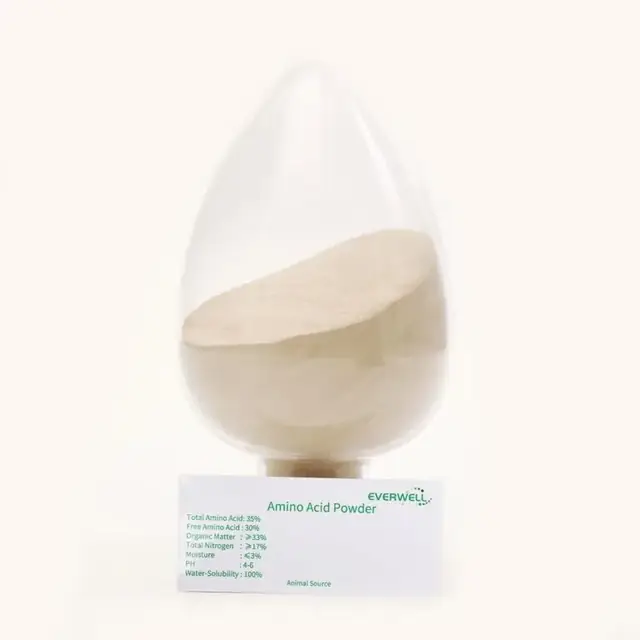
Amino Acids 35
The volume grade. A fully water-soluble hydrolysed feather protein powder carrying ≥ 17% total nitrogen, priced for foliar and fertigation programmes
View specification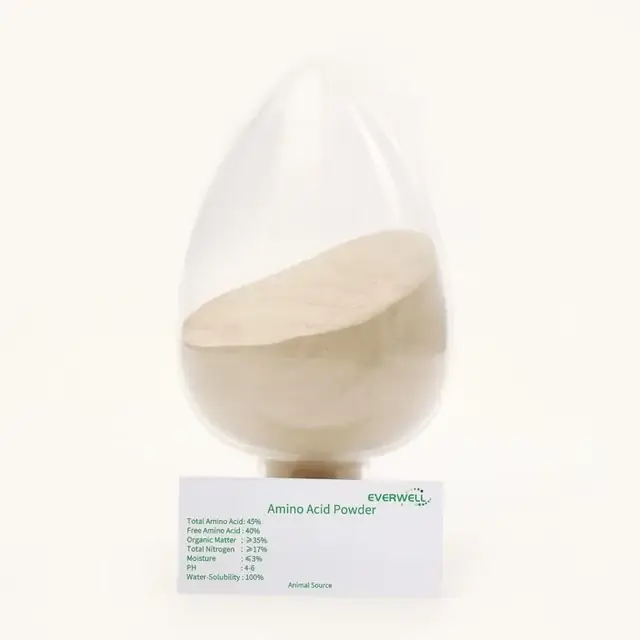
Amino Acids 45
The benchmark grade: ≥ 45% total amino acids, ≥ 60% organic matter, and 41.93% free amino acids measured by Eurofins under GB/T 18246-2019. The grade
View specification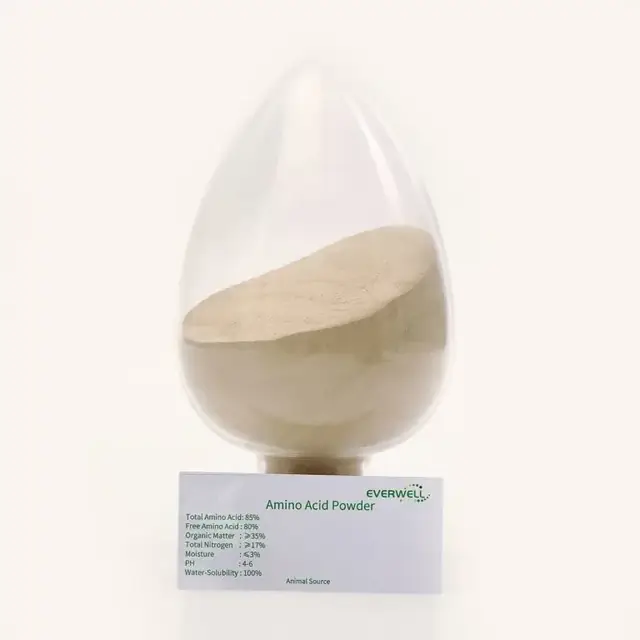
Amino Acids 80
The density grade: ≥ 80% total amino acids, ≥ 80% organic matter, and 75.37% free amino acids measured by Eurofins. Glycine and proline rich, for conc
View specificationRelated Articles
Choosing an Amino Acid Powder Grade for Fertilizer Formulation
AA35, AA45, AA50 and AA80 positioned against formulation objectives, with the specification lines and bench tests that should decide the choice.
Read more
Documents to Request Before Buying Amino Acid Powder
The document set a buyer should collect before ordering compound amino acid powder, and what each one actually proves.
Read more
Environmental Considerations for Amino Acid Powder Use
How to account for nitrogen loading, runoff, salts and manufacturing footprint before making an environmental claim about amino acid powder.
Read moreQuestions On This Topic
Does the grade percentage mean free amino acids?
Normally no. It refers to total amino acids, so confirm which quantity a supplier is reporting and by which method before comparing offers.
Why does nitrogen fall as the grade rises?
That is what the published specifications state: not less than 17% total nitrogen for the 35 grade, not less than 16% for the 45, and not less than 12% for the 80. Nitrogen has to be read from the specification rather than inferred.
How much 45% product equals 1 kg of 80% product?
On a theoretical total-amino-acid basis, approximately 1.78 kg, and approximately 2.29 kg of the 35% product. These ratios are composition arithmetic, not proof of equivalent field performance.
Are all three grades from the same raw material?
Yes. All three are produced from hydrolyzed duck feather protein.
Is the highest grade the most soluble?
All three are specified at 100% water solubility, but concentrated solution behaviour can differ, so test at your actual water, temperature, concentration and ingredient list.
What documents come with a shipment?
A batch-specific COA accompanies every shipment, with TDS and SDS available and the assigned batch COA issued before shipment on request.
Ask Us About This Directly
Technical questions are answered by the export and production team, normally within 24 hours.