
Can Amino Acid Fertilizer Replace NPK? An Evaluation Framework
The short answer is no: an amino acid fertilizer or protein hydrolysate does not replace a complete NPK programme. The useful answer is a process. After reading this you will be able to calculate what an amino acid product actually contributes, decide nutrient by nutrient whether any adjustment is justified, and design a trial that tests it rather than a strip that flatters it.
Asking a Better Question
Nitrogen, phosphorus and potassium are primary nutrients required in large quantities. An amino acid powder may contribute amino acids and nitrogen, but it normally supplies little or no phosphorus and potassium unless those nutrients have been deliberately built into the finished formulation. That asymmetry is the whole argument, and it does not go away with a better grade.
So the question worth asking is not what percentage of NPK amino acids can replace. It is how an amino acid product should be evaluated alongside a crop's nutrient programme. There is no universal reduction percentage that is safe across crops, soils and climates, and any reduction has to rest on nutrient analysis and local validation.
What NPK Supplies
Each of the three primary nutrients underwrites functions that no biostimulant contribution substitutes for. Nitrogen is required for proteins, nucleic acids and chlorophyll. Phosphorus is involved in energy transfer, root development and reproductive growth. Potassium supports water regulation, enzyme activity and assimilate transport.
Crop demand for these nutrients can reach tens or hundreds of kilograms per hectare across a season. A sound nutrient programme accounts for soil supply, nutrients delivered in irrigation water, organic amendments, the previous crop, and a realistic yield target. Any conversation about reduction starts from that budget, not from a product label.
- Nitrogen: proteins, nucleic acids, chlorophyll
- Phosphorus: energy transfer, root development, reproductive growth
- Potassium: water regulation, enzyme activity, assimilate transport
What an Amino Acid Product May Contribute
Protein hydrolysates contain varying proportions of free amino acids, peptides and nitrogen-containing compounds. Research reports possible effects on nutrient-use efficiency, root development and abiotic-stress responses, which is a genuine reason to include one in a programme. It is not a reason to treat it as a nutrient source it is not.
These products are best treated as complements to mineral or organic nutrition rather than as substitutes for nutrients they do not supply. The size of the contribution depends on total and free amino acids, on total and organic nitrogen, on the application rate, on any salts or added nutrients in the formulation, on the crop and its growth stage, and on environmental and management conditions. Everwell Bio's published grades illustrate why the nitrogen figure has to be read from the specification: Amino Acids 35 is specified at not less than 17 percent total nitrogen, Amino Acids 45 at not less than 16 percent, and Amino Acids 80 at not less than 12 percent, so nitrogen runs opposite to the amino acid grade.
Why a Blanket 20 to 30 Percent Reduction Is Unsafe
A percentage lifted out of one trial cannot be transferred to another field. A successful treatment may reflect the starting fertility, the crop, the climate, the fertilizer source, the timing of application, or a biostimulant effect specific to the exact product that was tested. None of those travel automatically.
Reducing all three nutrients by the same percentage is particularly hard to justify. If the amino acid product contributes nitrogen but supplies no phosphorus or potassium, then a uniform cut takes out nutrients nothing has replaced. Whatever adjustment is made has to be calculated one nutrient at a time.
A Safer Evaluation Process
Establish the nutrient baseline first. Use soil, substrate, water and, where appropriate, tissue analysis, and record the existing fertilizer programme together with expected nutrient removal at the target yield. Without that baseline every later number floats.
Then calculate the nutrient contribution of the amino acid product from the current batch COA and the intended application rate. Do not treat total amino acids as nitrogen. Calculate nitrogen from the verified nitrogen value, and establish whether that value is total nitrogen, organic nitrogen, or nitrogen arising from added inorganic salts. Keep phosphorus and potassium decisions entirely separate: unless the formulation contains verified P or K, it replaces neither, and those nutrients should be adjusted only when soil, tissue and crop-demand data support it.
Run a replicated comparison rather than a single strip. A practical trial includes the current full nutrient programme, the current programme plus the amino acid product, a modest nutrient adjustment plus the amino acid product, and an untreated or locally appropriate reference where that is feasible. Use replicated plots and record yield, quality, crop safety and economic return; do not draw conclusions from one visually greener strip. Finally, review results across more than one condition, because amino acid responses shift with stress, season, variety and soil, and a treatment that performs during a stress event may not repeat in a normal season.
- Establish the nutrient baseline from soil, substrate, water and tissue analysis
- Calculate the product's contribution from the batch COA and intended rate
- Keep phosphorus and potassium decisions separate from nitrogen
- Run replicated plots with a full-programme control
- Repeat across seasons and conditions before generalising
Nutrient-Use Efficiency and Tank-Mixing
Some studies report improved nutrient uptake or use efficiency after applying protein hydrolysates. Proposed mechanisms include changes in root architecture, nutrient availability, plant metabolism and interactions with soil microorganisms. What the evidence does not support is a universal percentage improvement applicable to every commercial product; claims should be tied to the exact formulation and to relevant trials.
On tank-mixing with NPK, assume nothing. Solubility and stability depend on concentration, water chemistry, pH and the full ingredient list. Everwell Bio grades are specified as 100 percent water soluble at pH 4 to 6 in a 1 percent solution, but that describes the powder, not the mixture you are about to make with it.
- Check both labels and the technical documents for each product
- Confirm the combination is permitted in the destination market
- Run a jar test at the intended concentration and mixing order
- Observe pH, precipitation, heat, foam and sediment
- Test crop safety on a small area before broad application
Organic Production Is a Separate Question
An amino acid product does not become an approved organic input because it is protein-derived. The exact source, manufacturing process, formulation, intended use and a current certificate or listing all have to be verified against the specific programme in the destination market.
It is also worth remembering that organic status changes what you may use, not what the crop needs. An organic nutrient programme still has to supply the crop's full nutrient requirement within the applicable rules, so the phosphorus and potassium question is no easier there than in a conventional programme.
Conclusion
Amino acid products are useful components of crop-nutrition and biostimulant programmes, but they do not replace the nutrient budget. Build the case from verified composition, nutrient-by-nutrient calculation and replicated trials rather than from a fertilizer-reduction promise. Send your crop, soil type, current NPK schedule and target market to [email protected] and we will reply within 24 hours, Monday to Saturday, with grade specifications, the batch documentation you need for the calculation, and a free sample of 200 to 500 g with its COA.
Products Discussed In This Article
Amino Acids 45
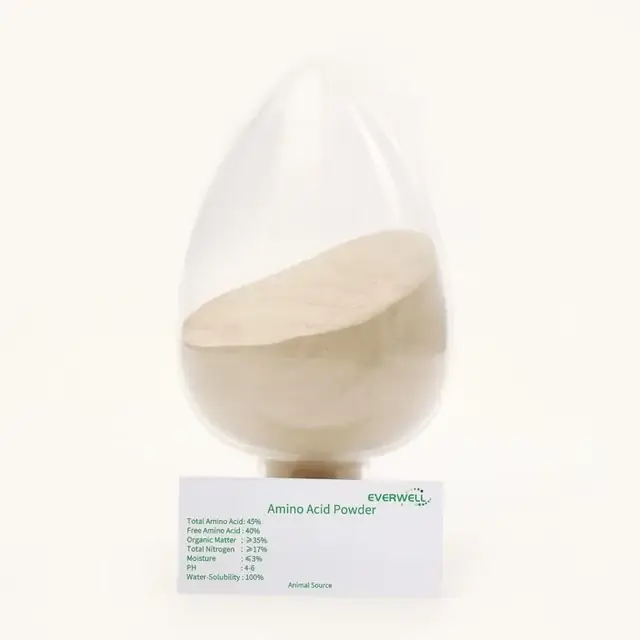
The benchmark grade: ≥ 45% total amino acids, ≥ 60% organic matter, and 41.93% free amino acids measured by Eurofins under GB/T 18246-2019. The grade
View specification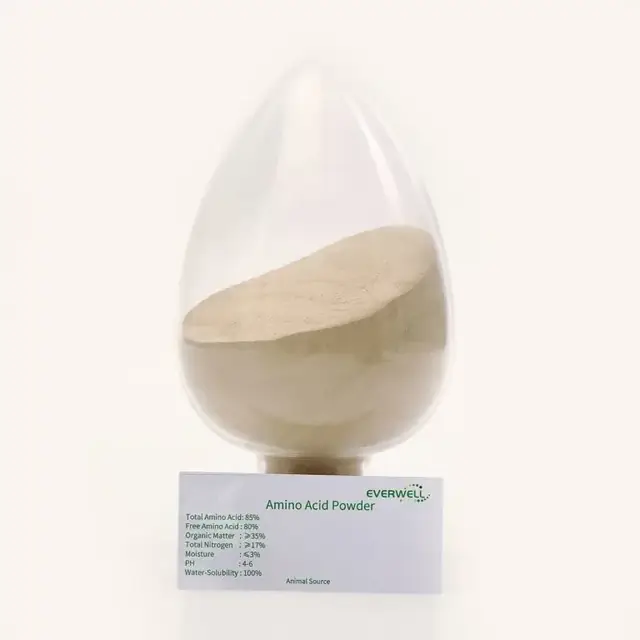
Amino Acids 80
The density grade: ≥ 80% total amino acids, ≥ 80% organic matter, and 75.37% free amino acids measured by Eurofins. Glycine and proline rich, for conc
View specification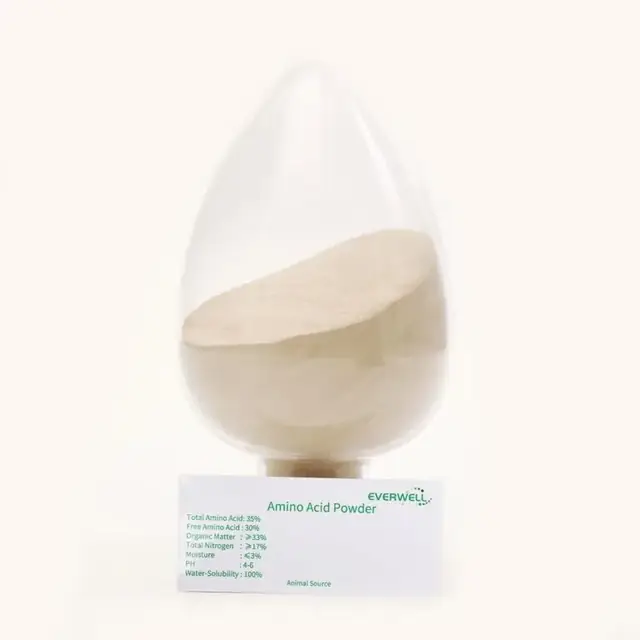
Amino Acids 35
The volume grade. A fully water-soluble hydrolysed feather protein powder carrying ≥ 17% total nitrogen, priced for foliar and fertigation programmes
View specificationRelated Articles

How to Choose 35%, 45% or 80% Compound Amino Acid Powder
A grade-by-grade comparison of Amino Acids 35, 45 and 80, with the cost, nitrogen and solubility checks that should decide the purchase.
Read more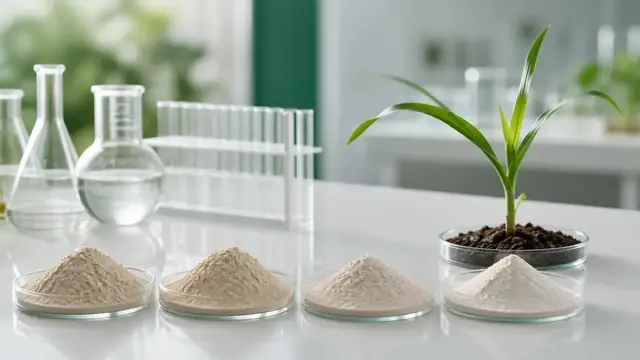
Choosing an Amino Acid Powder Grade for Fertilizer Formulation
AA35, AA45, AA50 and AA80 positioned against formulation objectives, with the specification lines and bench tests that should decide the choice.
Read more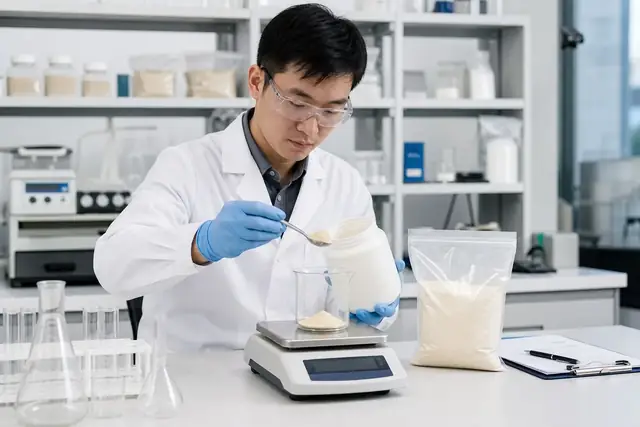
Documents to Request Before Buying Amino Acid Powder
The document set a buyer should collect before ordering compound amino acid powder, and what each one actually proves.
Read moreQuestions On This Topic
Can amino acid fertilizer replace nitrogen fertilizer?
It can contribute some nitrogen, but the amount must be calculated from the verified nitrogen content and the application rate. It should not be assumed to cover the crop's total nitrogen requirement.
Can it replace phosphorus or potassium?
Not unless the finished product contains verified quantities of those nutrients. Most stand-alone amino acid powders contribute little or none.
How much NPK should I reduce?
There is no universal answer. Make nutrient-by-nutrient adjustments only after analysis and local trials.
Will adding amino acids always increase yield?
No. The response depends on product composition, crop, dose, timing, environment and whether the base nutrient programme is already adequate.
Can I treat total amino acid percentage as nitrogen?
No. Read nitrogen from the verified nitrogen figure and establish whether it is total nitrogen, organic nitrogen, or nitrogen from added inorganic salts.
Does a protein origin make the product organic-approved?
No. Source, process, formulation, intended use and a current certificate or listing must all be verified for the destination market.
Ask Us About This Directly
Technical questions are answered by the export and production team, normally within 24 hours.