
Amino Acid Fertilizer for Rice: A Practical Foliar Guide
An amino acid powder can be evaluated as a supplemental foliar or soil-applied input in rice, but it does not replace a site-specific NPK program and there is no universal rate that applies to every product. This guide shows how to pick the stages worth testing, how to arrive at a starting rate from the product documents rather than from a category average, and how to run the application so the result is interpretable.
Start From the Stage, Not the Calendar
Rice management is stage-sensitive. The International Rice Research Institute separates the crop into vegetative, reproductive and ripening phases, with panicle initiation marking the transition from vegetative to reproductive growth. That framework is a sound basis for testing a supplemental input, but it does not demonstrate that any given amino acid formulation will be effective at each stage.
Calendar dates after sowing or transplanting shift with variety, temperature, planting method and season, so identify the actual stage by scouting the field. IRRI's rice nutrient tools themselves emphasise site- and stage-specific management rather than a fixed fertilizer schedule.
What an Amino Acid Product Can and Cannot Do in Rice
An amino acid powder supplies amino acids, peptides and some nitrogen, with the actual composition depending on the protein source, the hydrolysis process and the finishing method. Two products carrying the same total amino acids value can still differ substantially, and those differences matter more than the category name.
A foliar application delivers a small supplemental quantity directly to the leaves. It cannot meet the full nitrogen, phosphorus and potassium demand of a rice crop, so base nutrition must stay tied to the yield target, soil and water conditions, variety, season and local nutrient-management guidance.
- Free amino acids and peptide distribution
- Total and organic nitrogen
- Sodium, chloride and ash
- pH and solubility
- Moisture and insoluble matter
- Added nutrients, carriers or processing aids
Which Stages to Prioritise in a First Evaluation
For a first commercial evaluation it is more informative to test one or two well-defined stages than to spray repeatedly through the season. Active tillering is easy to identify and is already a monitoring point in rice nutrient management, so a treatment there can be compared against an untreated strip for productive tiller number, canopy condition and final yield. What cannot be claimed is that the spray automatically creates more productive tillers, since tiller formation and survival are driven strongly by variety, plant density, nitrogen management, light, temperature and water.
Panicle initiation is the other stage worth careful testing, because potential panicle development is underway and management decisions there carry through to yield formation. Identify it by scouting rather than assuming it falls a fixed interval before heading; variety and temperature move that interval. After heading, management increasingly affects grain set, filling and canopy retention, but flowering is a sensitive period and late foliar applications interact with temperature, disease management, tank partners and harvest restrictions. Apply then only where the label supports the crop and timing, and avoid promising higher thousand-grain weight or improved grain set without field evidence for the exact product and program.
Determining a Safe Rate
Publishing one fixed rate for an 80% powder and another for a 45% powder is not reliable enough to stand behind. Total amino-acid percentage says nothing about salt load, chloride, sodium, free-amino-acid content or the other ingredients that determine leaf safety.
Work through the sequence below instead, and keep any rice recommendation grade-specific and tied to the current product specification rather than presented as a worldwide standard.
- Review the current product label, technical data sheet and certificate of analysis
- Confirm that rice and the intended application route are supported
- Use the supplier's minimum supported rate as the starting treatment
- Calculate the final concentration from product mass and actual spray volume
- Test on a small representative area, including a normal-practice control
- Inspect for leaf spotting, tip burn, abnormal colour or delayed growth
- Evaluate yield and grain quality before expanding the program
Spray Volume, Coverage and Equipment
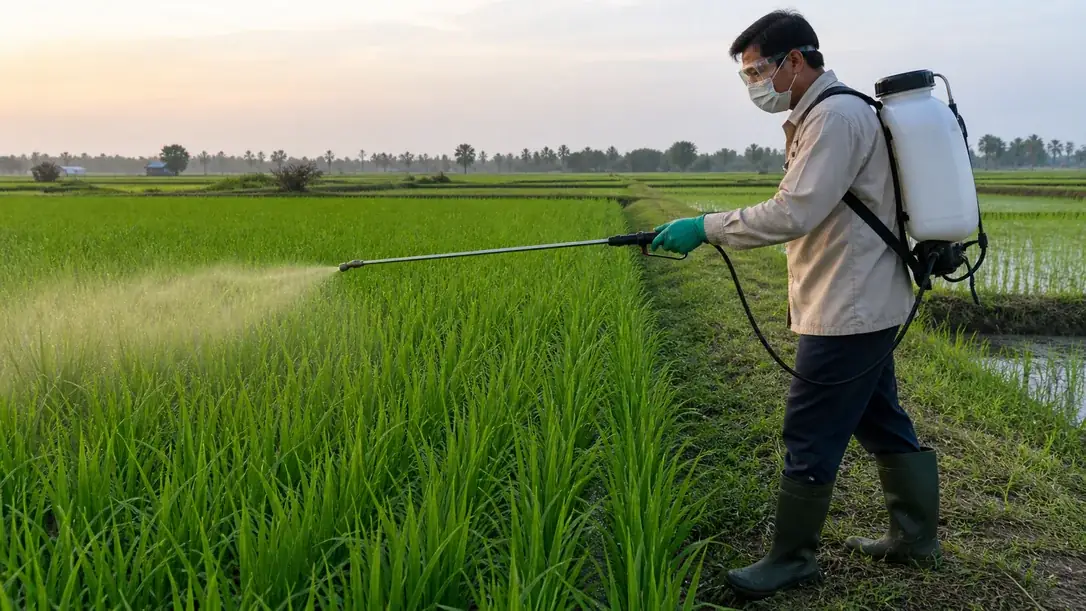
Use enough carrier water and a droplet spectrum that covers the target leaves evenly without runoff. The correct volume depends on canopy size, nozzle, pressure, travel speed, application platform and local rules, so it has to be set in the field rather than copied from a guide.
For ground or backpack application, calibrate the sprayer with clean water before mixing, verify nozzle output and uniformity, keep agitation running where the finished formulation requires it, spray in low-wind conditions and follow the product and equipment directions for personal protective equipment.
For drone or other low-volume application, do not assume that cutting water volume and raising concentration proportionally is crop-safe. Low-volume and aerial work changes droplet size, deposition, drift and the concentration that lands on the leaf. Use those methods only where the product directions and local aviation or pesticide requirements permit them and local validation supports the result. No single maximum concentration can be assigned across all amino acid powders.
Weather and Paddy-Specific Precautions
Standing water does not stop a properly directed foliar spray from reaching rice leaves, but paddy conditions still affect application quality and environmental loss. Spray only when wind and thermal conditions allow droplets to stay on the target canopy.
Avoid imminent rainfall or irrigation that would wash material off the leaves, and respect the rainfast period stated for the product and for every tank partner. Keep unnecessary spray out of canals, drains and non-target water, and coordinate the application with field access and water-level management.
Which Grade to Trial
Everwell Bio supplies Amino Acids 35, Amino Acids 45 and Amino Acids 80 from hydrolyzed duck feather protein, all specified as 100% water soluble at pH 4 to 6 in a 1% solution. The higher grades concentrate more total amino acids into less powder, which changes the mass handled per hectare but not the need for a stage-specific trial.
Whichever grade is trialled, request the batch COA, TDS and SDS for the exact lot before designing the program. A free sample of 200 to 500 g with its batch COA is enough material for a dissolution check and a small replicated strip.
Rice growth stages and how to approach an amino acid evaluation at each
| Rice stage | What to observe | How to approach an amino acid evaluation |
|---|---|---|
| Nursery or early seedling | Healthy leaves, root condition and uniform growth | Use only a product and rate intended for seedlings; test a small nursery area for phytotoxicity |
| Post-transplant establishment | Plants upright, rehydrated and resuming new leaf or root growth | Consider treatment only after establishment; do not automatically spray severely wilted or damaged seedlings |
| Active tillering | Rapid formation of new tillers before panicle initiation | A practical stage for a local comparison where the product has relevant support; maintain the normal nutrient program |
| Panicle initiation | Reproductive development has begun inside the stem | A high-value stage to evaluate carefully because crop demand is changing, but response and rate remain product-specific |
| Booting, heading and flowering | Panicle development, panicle emergence and flowering | Treat as a sensitive period; follow crop, pesticide and pollinator-related instructions and avoid unsupported tank mixes |
| Early grain filling | Green functional flag leaf and developing grain | Consider only if the canopy is healthy, the product permits late use and local evidence supports the objective |
| Stress recovery | Crop stabilized after cold, heat, salinity, water deficit or flooding | Correct water and field conditions first; apply only when live foliage is capable of recovery |
Conclusion
Choose one or two stages, take the starting rate from the supplier's documents, calibrate the sprayer, keep an untreated control and judge the result on yield and grain quality rather than on canopy colour. Email [email protected] with your variety, target stage and spray volume to receive the grade-specific specification, batch COA and a free 200-500 g sample for a strip trial; replies are sent within 24 hours, Monday to Saturday.
Products Discussed In This Article
Amino Acids 45
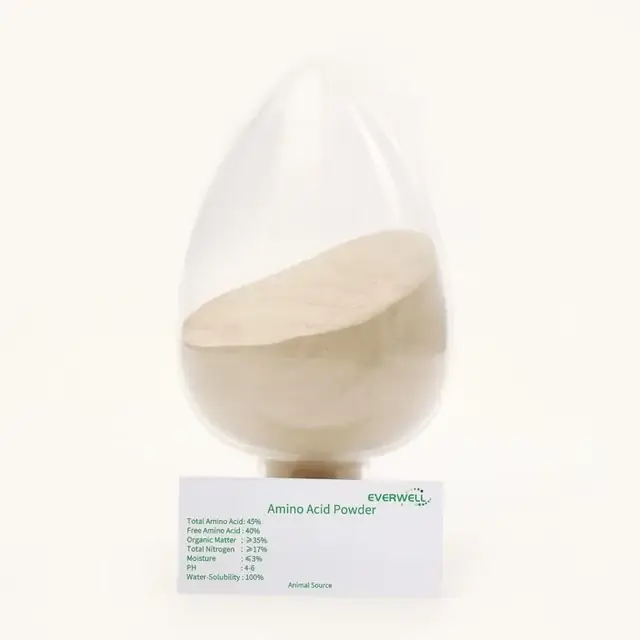
The benchmark grade: ≥ 45% total amino acids, ≥ 60% organic matter, and 41.93% free amino acids measured by Eurofins under GB/T 18246-2019. The grade
View specification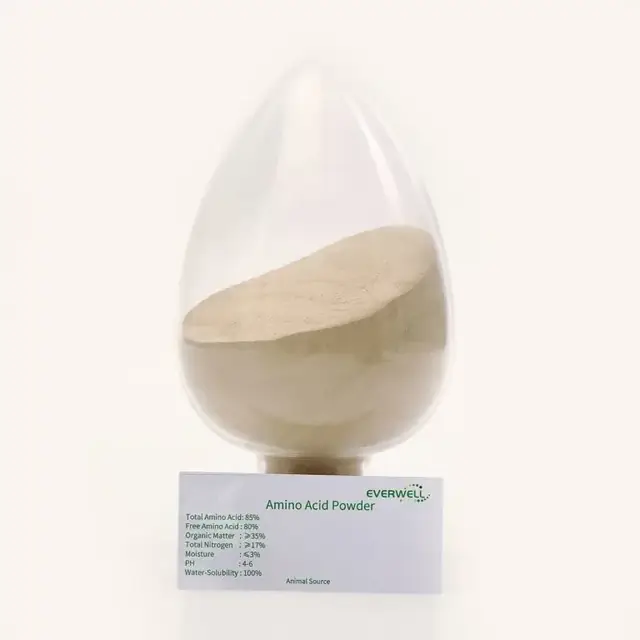
Amino Acids 80
The density grade: ≥ 80% total amino acids, ≥ 80% organic matter, and 75.37% free amino acids measured by Eurofins. Glycine and proline rich, for conc
View specification
Amino Acids 35
The volume grade. A fully water-soluble hydrolysed feather protein powder carrying ≥ 17% total nitrogen, priced for foliar and fertigation programmes
View specificationRelated Articles
Amino Acid Fertilizer for Vegetables: Foliar Guide by Crop
Evaluation windows, rate calculation and spray practice for protein hydrolysates across fruiting, leafy, cucurbit, root and legume vegetables.
Read more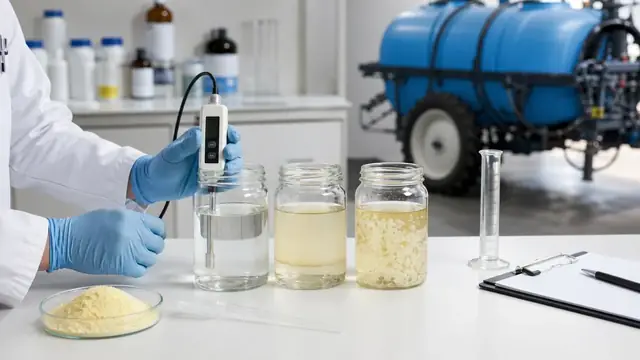
Mixing Amino Acid Powder: A Safer Compatibility Guide
Why category-level compatibility claims fail, how labels and water quality govern the answer, and how to run a jar test that means something.
Read more
Amino Acid Powder Shelf Life and Storage: A Buyer's Guide
What shelf life, expiry and retest dates actually mean, how to store sealed and opened bags, and how to judge caking without guessing.
Read moreQuestions On This Topic
Can amino acid fertilizer replace urea or a full NPK program in rice?
No. A foliar application delivers only a small supplemental amount and cannot meet the crop's nitrogen, phosphorus and potassium demand. Base nutrition stays tied to yield target, soil and water conditions and local guidance.
Which single stage should I test first?
Active tillering is the easiest to identify and already a monitoring point in rice nutrient management, which makes comparison against an untreated strip straightforward.
How do I set the rate for an 80% powder?
Take the supplier's minimum supported rate as the starting treatment and calculate the finished concentration from product mass and the actual calibrated spray volume. Do not scale a rate from another product by amino acid percentage.
Is a 1% spray concentration safe?
No universal maximum concentration can be assigned to all amino acid powders. Safety depends on salt load, free amino acids and other ingredients, so test on a small representative area first.
Does standing water in the paddy stop foliar uptake?
No, a properly directed spray still reaches the leaves. Paddy conditions do affect application quality and loss, so avoid drift into canals and drains and respect the rainfast period.
Can I apply by drone at a higher concentration and lower volume?
Not as an assumption. Low-volume and aerial application changes droplet size, deposition and leaf concentration, so use it only where the product directions and local aviation or pesticide rules permit.
Ask Us About This Directly
Technical questions are answered by the export and production team, normally within 24 hours.