
Amino Acid Powder Shelf Life and Storage: A Buyer's Guide
Amino acid powder is supplied as a dry, free-flowing fertilizer raw material, but its condition changes when packaging is damaged or when it meets moisture, heat, contamination or repeated temperature swings. After reading this you will know which date on the documents governs your stock, how to store sealed and opened bags, and what to do when a bag comes in caked.
There Is No Generic Shelf-Life Number
The assigned shelf life depends on the formulation, the moisture specification, the packaging system, manufacturing controls, storage conditions and the evidence the manufacturer used to support the date. Two powders with the same total amino acid figure can carry different dates for entirely legitimate reasons.
Use the shelf life, expiry date or retest date shown in the product documents for the specific grade and lot, not an industry average. A certificate of analysis reports results for the tested lot at the time of testing; on its own it does not prove that the lot stays within specification throughout storage.
Shelf Life, Expiry Date and Retest Date Are Not Interchangeable
These three terms are often used loosely, and each leads to a different decision on the warehouse floor. Shelf life is the period during which the manufacturer expects the product to remain within its defined specification when stored in the stated packaging and conditions, supported by product-specific data or a justified stability program. Expiry date is the date after which the product should not be used or released unless the applicable manufacturer, quality system, contract and local rules provide an authorised route for evaluation. Retest date is the date on which a lot should be tested again to determine whether it still meets an agreed specification.
Passing a retest does not automatically create a new legal expiry date or guarantee suitability for every application, and any extension must be approved and documented by the responsible quality authority. The wording on the label and in the contract takes priority; if the documents disagree, have the supplier resolve the discrepancy before shipment or use.
What Actually Determines Stability
Compound amino acid powders are mixtures rather than a single pure chemical. Their amino acid profile, peptide content, residual minerals, moisture, processing route and any permitted processing aids all affect storage behaviour, and total amino acid content alone predicts neither shelf life nor moisture sensitivity.
Dry powders absorb moisture from humid air once a liner is opened or damaged. Uptake can cause caking, reduce flowability, change dissolution behaviour or raise contamination risk. A moisture result is useful, but the limit that matters comes from the agreed product specification; water activity may also be relevant where microbiological stability is a concern and is not interchangeable with moisture percentage.
Packaging carries much of the burden. The outer bag provides mechanical protection while the inner liner or barrier layer usually provides the main defence against moisture, so seal integrity, liner thickness, closure method, puncture resistance and transport damage all matter. A long date on the label means something only while the specified packaging remains intact. Prolonged heat accelerates chemical and physical change, and repeated movement between cold and warm environments can condense water on or inside compromised packaging. Finally, drying, cooling, sieving, metal control, hygiene, filling and sealing set the starting condition of the lot, and every transfer afterwards adds exposure, which makes traceability part of shelf-life control rather than paperwork.
Recommended Warehouse Practice
The product's current SDS and TDS are the first references. In an SDS, Section 7 covers handling and storage conditions while Section 10 addresses stability, conditions to avoid and incompatible materials. A practical plan for a dry amino acid powder follows below.
Where the supplier states a humidity or temperature range, monitor it with suitable equipment and keep the records. Where no range is stated, ask for clarification rather than inventing a universal limit.
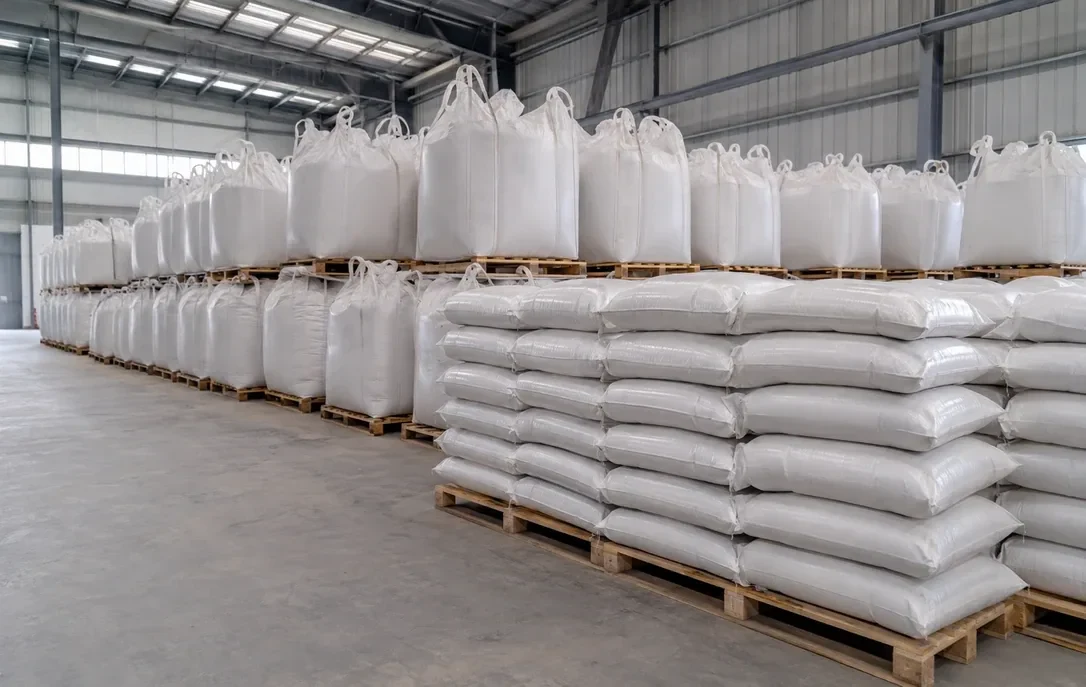
- Keep packaging closed and identifiable, with product name, lot number, production date and expiry or retest date readable
- Protect bags from rain, roof leaks, wall condensation, wet cleaning and contact with damp floors
- Place bags on clean, dry, undamaged pallets or suitable racking, with clearance for inspection and air circulation
- Keep material away from heaters, hot process lines and sun-exposed loading areas, and follow any stated temperature limit
- Segregate incompatible and contaminating materials, keeping animal-derived fertilizer away from feed where regulations require it
- Quarantine torn, wet, unsealed or unidentified bags in a marked area, and never return spilled material to a saleable bag
- Rotate by date and lot using FEFO where an expiry or retest date applies, recording receipts, transfers, partial use and release decisions
- Maintain housekeeping: control pests, manage dust safely and document inspections and corrective actions
Handling Opened Bags
Opening the liner changes the protection the original packaging provides, so plan batch sizes such that opened material is consumed promptly within any open-bag period the supplier states.
Do not transfer product into an unlabelled container. If repacking is unavoidable, use a compatible moisture-barrier package and carry over all traceability and safety information.
- Use clean, dry tools
- Prevent contact with water, soil, lubricants and other products
- Expel excess air only where the packaging procedure permits it
- Close the inner liner securely, then close the outer bag
- Mark the date opened, the remaining quantity and the operator
- Return the bag to the designated dry storage area
Does Caking Mean the Product Has Expired?
Not necessarily. Soft lumps can form from compaction during transport or from limited moisture uptake, and caking by itself does not prove chemical degradation. The inverse also holds: a powder that still looks normal may have changed in a way that is not visible.
Treat significant caking as a deviation rather than a judgement call. Check packaging integrity, storage records and the moisture result where one is specified, then evaluate a representative sample against the agreed specification before releasing or rejecting the lot. Do not decide fitness for use from appearance alone; caking, colour change, damaged packaging, odour or poor dissolution should all trigger quarantine and investigation.
What to Confirm With the Supplier
Everwell Bio supplies a batch-specific COA with every shipment, and the TDS and SDS are available on request. The appearance of the material is a light yellow to brown powder, and the grades are specified with maximum moisture of 5% for the amino acid powders and 6% for the cattle-bone protein powder.
Ask for the storage section of the SDS, the stated shelf life or retest date for the grade you are buying, and any open-bag period, before the first container lands. With a 30-day lead time on regular orders, that information is easier to obtain during qualification than during a warehouse dispute.
Conclusion
Take your dates from the documents for the specific grade and lot, store the material closed, dry, off the floor and away from heat, rotate by FEFO, and quarantine anything that looks or dissolves differently rather than judging it by eye. Email [email protected] to request the current TDS, SDS and a batch COA for the grade you are evaluating, together with the stated storage conditions; replies are sent within 24 hours, Monday to Saturday.
Products Discussed In This Article
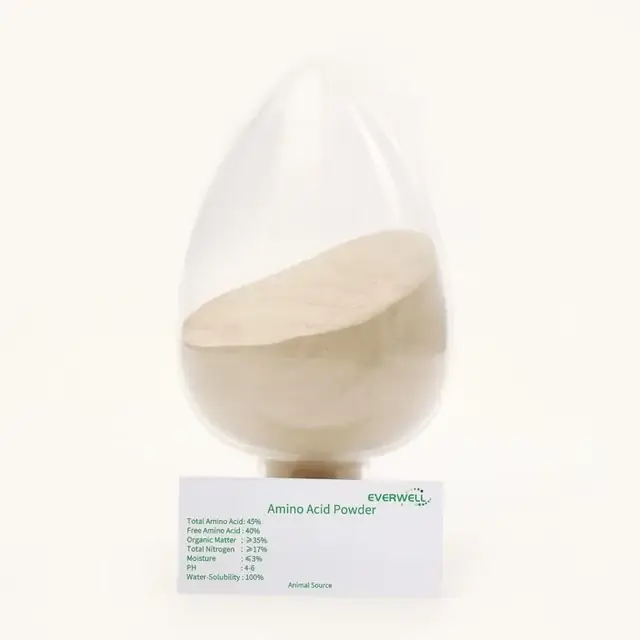
Amino Acids 45
The benchmark grade: ≥ 45% total amino acids, ≥ 60% organic matter, and 41.93% free amino acids measured by Eurofins under GB/T 18246-2019. The grade
View specification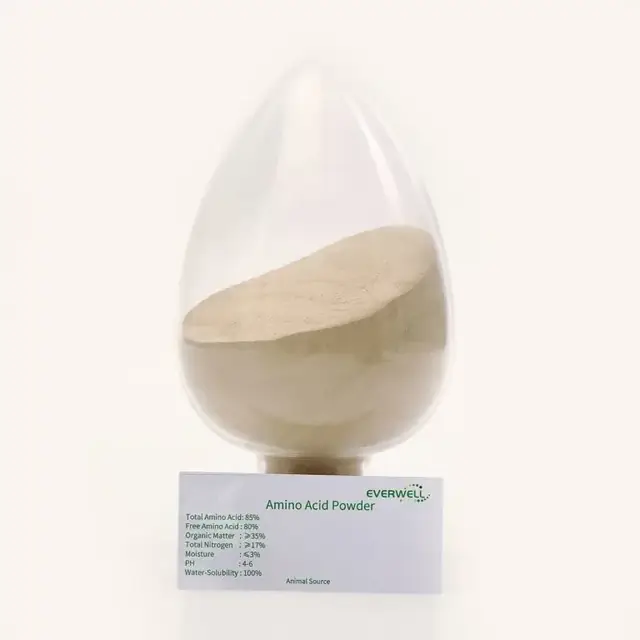
Amino Acids 80
The density grade: ≥ 80% total amino acids, ≥ 80% organic matter, and 75.37% free amino acids measured by Eurofins. Glycine and proline rich, for conc
View specification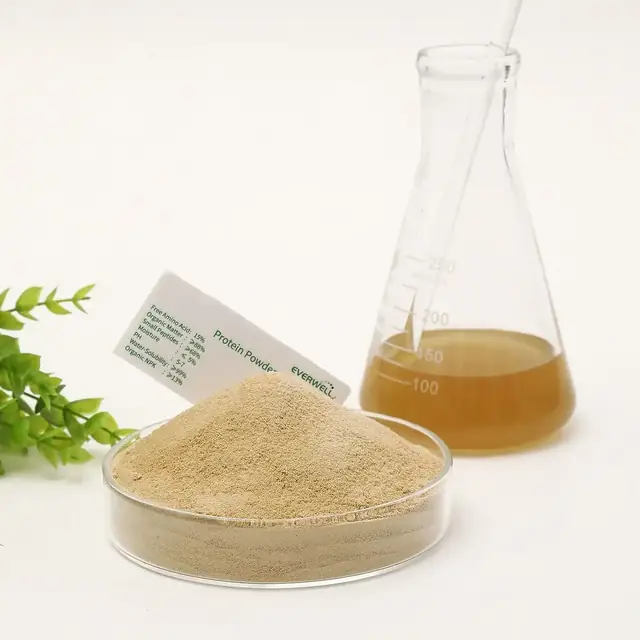
Protein Powder
A collagen-derived protein input at ≥ 90% crude protein and ≥ 80% total amino acids, glycine and proline rich, dissolving at 99% for animal feed, pet
View specificationRelated Articles
Amino Acid Powder Solubility: Testing and Mixing Guide
How to read a water-solubility claim, specify a defensible insoluble-residue method, and run a jar test that reflects real tank conditions.
Read more
Amino Acid vs Humic, Seaweed and Fish Hydrolysate
Four biostimulant categories, what each actually contains, and the buyer checks that decide which one belongs in your formulation.
Read more
Where Compound Amino Acid Powder Is Used: Four Applications
The four working roles of compound amino acid powder in agriculture, and what each one implies for grade choice and documentation.
Read moreQuestions On This Topic
How long does amino acid powder last?
There is no single number. Use the shelf life, expiry date or retest date in the documents for the specific grade and lot, since the date depends on formulation, moisture specification, packaging and storage conditions.
What is the difference between an expiry date and a retest date?
An expiry date is the point after which the product should not be used or released without an authorised evaluation route. A retest date is when the lot should be tested again against an agreed specification; passing does not automatically create a new expiry date.
Does a COA prove the material is still in specification?
No. A COA reports results for the tested lot at the time of testing. It does not by itself demonstrate that the lot has stayed within specification through storage.
Is caked powder unusable?
Not necessarily. Compaction or limited moisture uptake can cause soft lumps without chemical degradation. Treat significant caking as a deviation and check packaging, storage records, moisture and a representative sample.
How should opened bags be handled?
Use clean dry tools, close the inner liner and then the outer bag, mark the date opened and remaining quantity, and return the bag to dry storage. Use the material within any open-bag period the supplier states.
Where in the SDS is storage information?
Section 7 covers handling and storage conditions, and Section 10 covers stability, conditions to avoid and incompatible materials.
Ask Us About This Directly
Technical questions are answered by the export and production team, normally within 24 hours.