
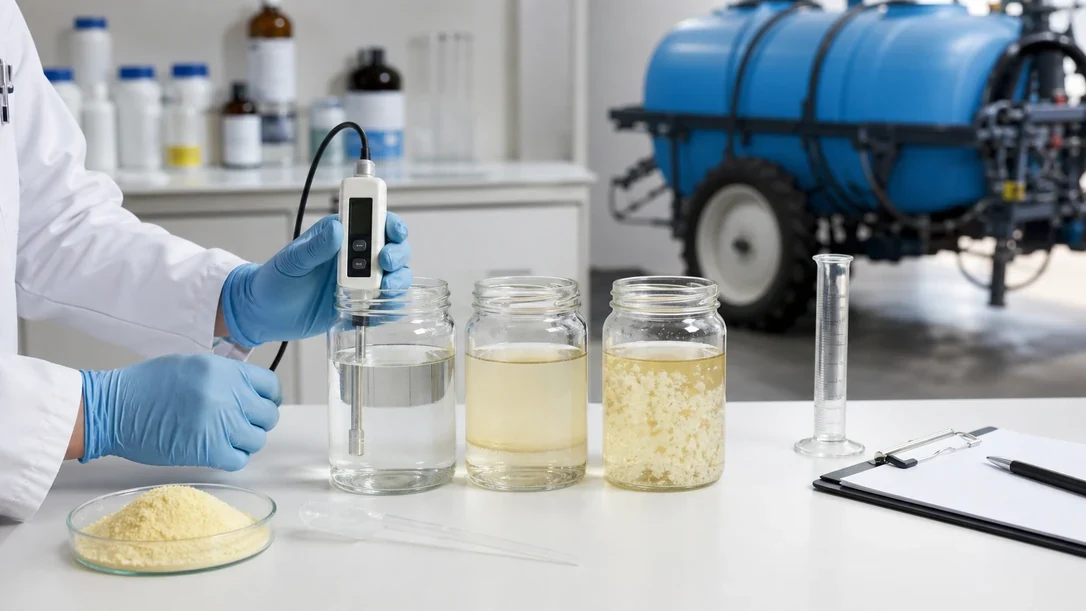
Mixing Amino Acid Powder: A Safer Compatibility Guide
Amino acid powder can sometimes be mixed with fertilizers and crop-protection products, but compatibility is never decided by the words on the drum. It depends on the exact formulations, concentrations, water quality, mixing order, application method and labels. This guide shows how to screen a proposed mix by risk, what the labels require before any test, and how to run a jar test whose result you can rely on.
Why Category-Level Claims Are Risky
Two products sharing a general name can behave completely differently in a tank. An NPK formulation may carry phosphate, sulfate, calcium, magnesium or micronutrients in any proportion. Humic acid may mean potassium humate, sodium humate, a suspension or an acidified liquid. Seaweed extracts vary in salts, pH, carriers and additives. Copper products may be hydroxides, oxychlorides, sulfates or oxides. Pesticides arrive as soluble concentrates, suspensions, emulsions, water-dispersible granules or wettable powders.
The amino acid product is equally variable. Total amino acids, free amino acids, peptides, ash, salts, pH, moisture and any added ingredients all influence how a mixture behaves. A useful compatibility guide therefore describes risk and testing rather than declaring a whole product category compatible. The safest wording for any screening result is potentially compatible after verification.
The Label Comes Before the Jar Test
Where a pesticide or plant-protection product is involved, the applicable label and local regulation take precedence over any physical test, and requirements differ by country. In the United States, EPA policy allows certain pesticide-fertilizer tank mixes when the labelling does not prohibit them and all relevant directions, limitations and precautions are followed. In Canada, tank-mix permissions depend on label statements, and a silent label is not treated the way it is in the United States. UK guidance likewise requires compliance with each authorised product label and evidence supporting the recommended mixture.
Work through the regulatory questions before touching a jar. A website compatibility table cannot substitute for this review.
- Confirm that every pesticide is authorised for the crop, site, timing and intended use
- Check whether each label permits, restricts or prohibits tank mixing
- Apply the most restrictive directions, precautions, buffer zones and protective-equipment requirements
- Do not exceed any labelled rate or dilute below the applicable minimum
- Obtain current manufacturer guidance for the exact commercial products
Water Quality Can Change the Result
Run the jar test in the same water that will fill the spray tank or feed the fertigation system. The properties that most often decide the outcome are pH, alkalinity or bicarbonate level, hardness including calcium and magnesium, electrical conductivity and existing dissolved salts, temperature, suspended solids, and chlorine or other disinfectants where biological products are involved.
Do not acidify water reflexively because its pH sits above a chosen number. Some pesticide labels specify a pH range or a particular buffering agent, while other active ingredients become less stable, more volatile or less crop-safe after inappropriate adjustment. Use a water conditioner, acidifier or compatibility agent only where the relevant labels and technical guidance support it.
Ion-exchange softened water and collected rainwater are not automatically suitable either. Test the actual source rather than assuming that soft water is always the better choice.
Concentrate Compatibility Is Not Final-Tank Compatibility
Never judge a mixture by pouring concentrated products together. Calcium and phosphate, calcium and sulfate, or acidified humates can precipitate at high concentration even when the same materials coexist without trouble in a properly diluted full tank. The reverse trap also exists: a clear dilute mixture can still be chemically or biologically incompatible.
For fertilizer blending or stock solutions, keep incompatible stock concentrates in separate tanks, dilute each component before combining where the formulation allows, confirm the intended concentration, temperature and storage period, and run a stability test that reproduces the real manufacturing and storage conditions. A field jar test is not a formulation stability study.
A Safer Jar-Test Procedure
Wear the personal protective equipment required by the product labels and work in a suitable area. The value of a jar test comes from reproducing the real mixture in miniature, not from an approximate version of it.
Use the same water or permitted liquid-fertilizer carrier, at approximately the same temperature, that the full tank will use. Calculate every jar quantity proportionally from the intended field rates and spray volume rather than adding an arbitrary spoonful of each product. Where a pesticide label gives a mixing sequence, follow it; a common label-directed pattern adds dry dispersible products before liquid suspensions, emulsifiable concentrates and adjuvants, with mixing between additions, but formulation-specific instructions override any generic acronym. For a fertilizer-only test, pre-dissolve the amino acid powder in water where appropriate and add products one at a time under agitation, never combining undiluted concentrates unless the formulation procedure specifically requires it.
Observe after each addition for unusual heat, gas, persistent foam, clumps or rapid separation, then let the completed mixture stand and look again before drawing any conclusion.
What a Jar Test Cannot Tell You
A jar test identifies many physical problems, which is exactly why it is worth doing. It does not prove chemical stability over time, pesticide efficacy, crop safety, residue compliance or legal authorisation for the mixture.
Those questions are answered by the labels, by formulation stability work at the intended concentration and storage period, and by a small treated area evaluated against normal practice before a full tank is committed.
Product Properties That Help the Screening
Everwell Bio's amino acid powders are specified as 100% water soluble at pH 4 to 6 in a 1% solution, produced from hydrolyzed duck feather protein. Knowing the pH range and solubility of the amino acid component narrows the screening, because the acidic pH is relevant where a tank partner specifies a pH window.
Solubility and pH are a starting point, not a verdict. Request the batch COA, TDS and SDS for the exact lot so the salt and moisture figures used in the screening match the material you will actually mix. Where fulvic acid, seaweed extract or potassium ligno sulphonate are part of the planned formulation, treat each as its own compatibility question with its own supplier documentation.
Screening guide by mix partner. Not a substitute for product labels or formulation data.
| Proposed partner | Initial risk assessment | What to verify |
|---|---|---|
| Water-soluble NPK fertilizer | Conditional | Exact salts, final concentration, EC, pH and whether calcium is combined with phosphate or sulfate |
| Urea solution | Conditional | Total foliar salt load, rate, water volume, crop sensitivity and label directions |
| Calcium nitrate or other soluble calcium | Conditional | Avoid direct contact between concentrated calcium solutions and phosphate, sulfate or some humate-containing concentrates |
| MAP, MKP or other phosphate fertilizer | Conditional | Calcium and magnesium in the water or tank can increase precipitation risk, especially in concentrates |
| Sulfate fertilizers | Conditional | Concentrated calcium plus sulfate can form solids; test at the intended concentration |
| Micronutrient salts or chelates | Conditional | Metal, ligand, pH range, concentration and other chelates or phosphates in the tank |
| Fulvic or humic substances | Conditional to higher risk | Product form, pH, calcium, acidification and whether the humic fraction remains soluble |
| Seaweed extract | Conditional | Salts, pH, carriers, preservatives and the complete finished formulation |
| Insecticide or fungicide | Label-dependent | Tank mixing must be permitted under the applicable label and local rules; check formulation and crop or site restrictions |
| Copper product, Bordeaux mixture or lime sulfur | Higher risk | Do not generalize across products; follow the exact labels and supplier compatibility information; separate application is safer when unsupported |
| Herbicide | High caution | Only use a supported and legally permitted combination; additives can change herbicide activity, crop injury or off-target risk |
| Microbial inoculant or biological pesticide | High caution | Viability can be affected by pesticides, disinfectants, salts, pH or storage time; confirm with both suppliers |
Conclusion
Screen the proposed mix by partner type, clear the labels and local rules first, then run a proportional jar test in your own water and follow it with a small treated area before committing a full tank. For the pH, solubility and batch COA figures you need to complete that screening, email [email protected] with your intended formulation and rates; a free 200-500 g sample with its batch COA is available for the jar test, and replies go out within 24 hours, Monday to Saturday.
Products Discussed In This Article
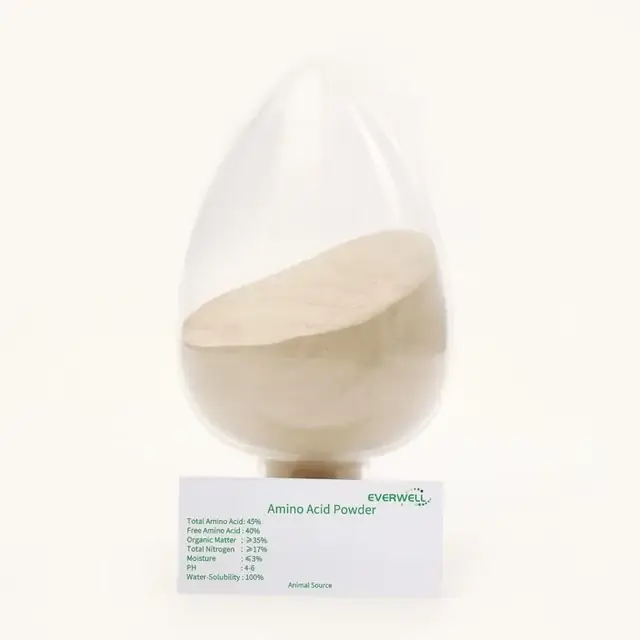
Amino Acids 45
The benchmark grade: ≥ 45% total amino acids, ≥ 60% organic matter, and 41.93% free amino acids measured by Eurofins under GB/T 18246-2019. The grade
View specification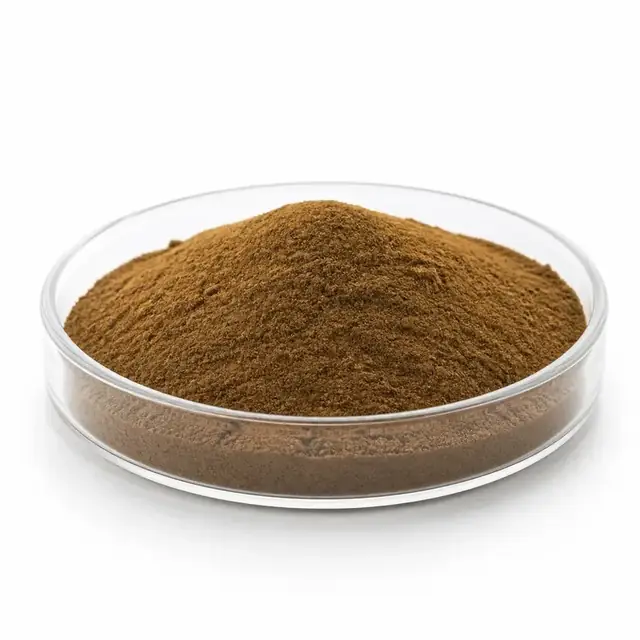
Fulvic Acid 50%
A mid-grade fulvic acid at ≥ 50% active content on a dry basis, supplied through our qualified partner network and consolidated into the same containe
View specification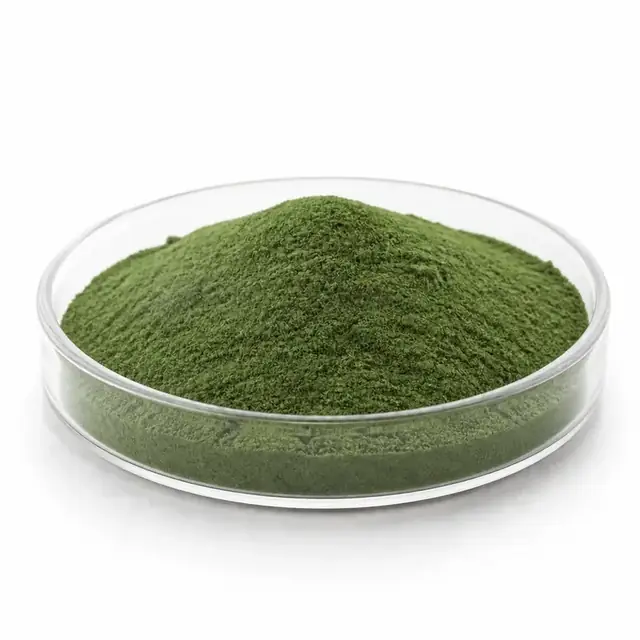
Seaweed Extract 30%
A cold-water extract of brown seaweed standardised to 30% alginic acid on a dry basis, carrying alginates, mannitol and betaines, supplied through the
View specificationRelated Articles
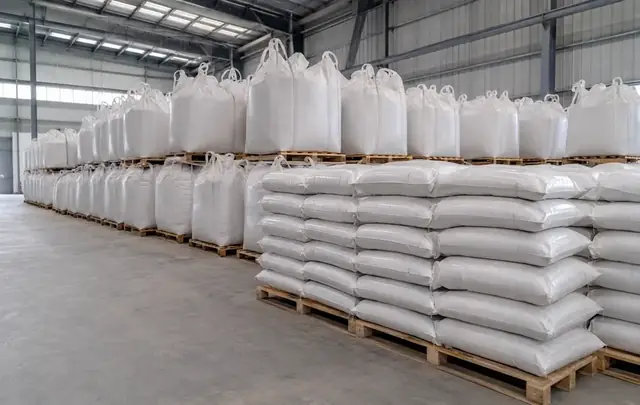
Amino Acid Powder Shelf Life and Storage: A Buyer's Guide
What shelf life, expiry and retest dates actually mean, how to store sealed and opened bags, and how to judge caking without guessing.
Read more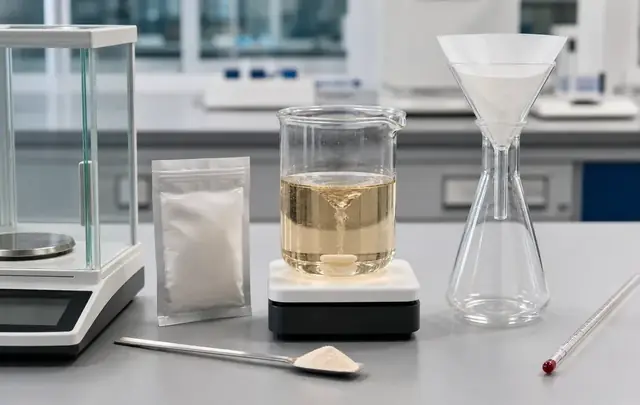
Amino Acid Powder Solubility: Testing and Mixing Guide
How to read a water-solubility claim, specify a defensible insoluble-residue method, and run a jar test that reflects real tank conditions.
Read more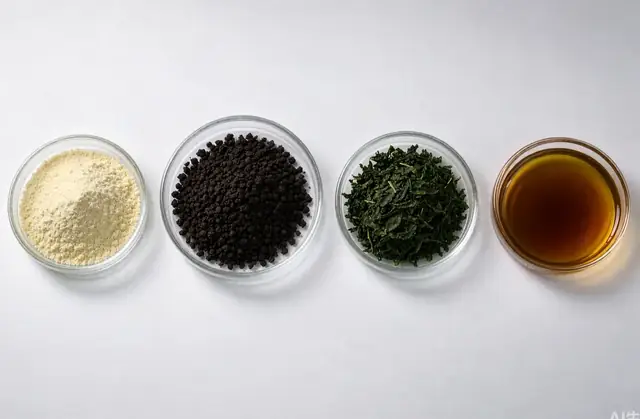
Amino Acid vs Humic, Seaweed and Fish Hydrolysate
Four biostimulant categories, what each actually contains, and the buyer checks that decide which one belongs in your formulation.
Read moreQuestions On This Topic
Can amino acid powder be tank-mixed with NPK fertilizer?
Sometimes, but it must be verified. Check the exact salts, final concentration, EC and pH, and pay particular attention to calcium combined with phosphate or sulfate.
Is a jar test enough to approve a tank mix?
No. It catches many physical problems but cannot demonstrate chemical stability, pesticide efficacy, crop safety, residue compliance or legal authorisation.
Which partners carry the highest risk?
Copper products, Bordeaux mixture and lime sulfur are screened as higher risk, while herbicides and microbial or biological products require high caution and confirmation from both suppliers.
Should I acidify my spray water before adding the powder?
Not by default. Some labels specify a pH range or buffering agent, and inappropriate adjustment can make other active ingredients less stable or less crop-safe.
Why can concentrates fail when the diluted tank is fine?
Calcium and phosphate, calcium and sulfate, or acidified humates can precipitate at high concentration. Keep incompatible stock concentrates in separate tanks and dilute before combining where the formulation allows.
What is the pH of the amino acid solution itself?
The published specification states pH 4 to 6 in a 1% solution, with 100% water solubility. Use the batch COA for the lot you will actually mix.
Ask Us About This Directly
Technical questions are answered by the export and production team, normally within 24 hours.