
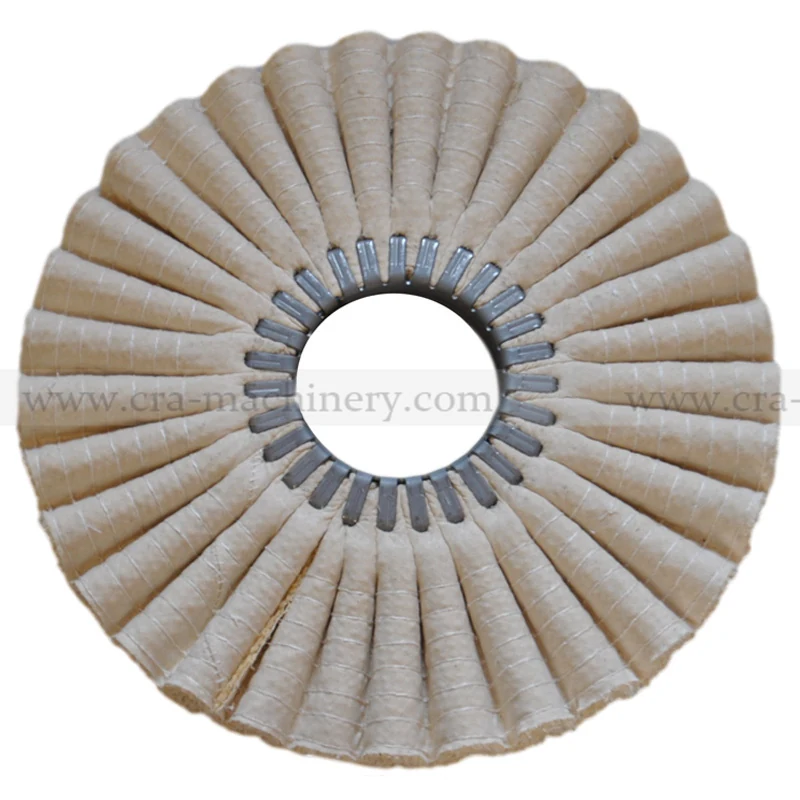
Bias Sisal Corrugated Polish Buffs
Bias Sisal Corrugated Polish Buffs are designed for sanding and pre-bright finishing of stainless steel, chrome, and iron surfaces including pots and pans, tableware, tubes, and pipes. The buff has a structured corrugated weave with consistent airflow channels, enabling efficient heat dissipation...
Product Overview
Bias Sisal Corrugated Polish Buffs are designed for sanding and pre-bright finishing of stainless steel, chrome, and iron surfaces including pots and pans, tableware, tubes, and pipes. The buff has a structured corrugated weave with consistent airflow channels, enabling efficient heat dissipation and material removal. Available in multiple weaves and diameter ranges, it is suitable for industrial polishing lines requiring repeatable performance. The structure is formed using bias-cut sisal or fabric, treated with water-based resin in yellow, blue, green, or red. Dimensions are fixed per specification, with thickness at 30 mm. Custom sizes can be made on request.


Key Benefits
- Corrugated structure provides consistent airflow during polishing, reducing heat build-up
- Water-based resin treatment improves durability and prevents fibre shedding
- Available in multiple weave counts and diameter ranges to match different polishing tasks
- Uniform ply spacing ensures consistent finish across batches
- 30 mm thickness supports heavy-duty sanding and pre-bright applications
- Can be produced in-house using CRATOOLS forming and pressing machines for cost control
Application Scenarios
- A cookware manufacturer replacing imported buffs with in-house produced corrugated sisal buffs
- A metal finishing shop adding a pre-bright stage for stainless steel tableware using consistent buffing performance
- A polishing line upgrading from flat sisal buffs to corrugated types for better heat management
- A distributor producing custom buffs for regional markets with specific diameter and weave requirements
Who It Is For
- Cookware and tableware manufacturers
- Sanitary ware and metalware polishing lines
- Jewellery and small metal part polishing workshops
- Distributors of polishing consumables in regions with high freight costs
Problems It Solves
- Flat or non-ventilated sisal buffs overheat during prolonged use, leading to inconsistent finishes
- Manual buff production leads to variable ply spacing and inconsistent performance between batches
- Imported buffs have long lead times and high freight costs for regional markets
- Lack of standardised corrugated buff structure limits repeatability in industrial polishing lines
Technical Features
- Corrugated weave structure with regular airflow channels
- Bias-cut sisal or fabric used in construction
- Water-based resin treatment in yellow, blue, green, or red
- Fixed thickness of 30 mm across all sizes
- Multiple weave counts and diameter combinations as per specification
- Structure designed for sanding and pre-bright finishing on ferrous and non-ferrous metals
Specifications
| Model | Bias Sisal Corrugated Polish Buffs |
|---|---|
| Thickness | 30 mm |
| Weave Count | 20, 32, 34, 36, 44 |
| Inner Diameter | 60 to 90 mm, 127 to 130 mm, 150 mm, 178 to 180 mm |
| Outer Diameter | 150 to 250 mm, 300 to 400 mm, 350 to 450 mm, 400 to 500 mm |
| Material Type | Sisal (Africa white, Brazil, Guangxi), Fabric stitched or pure sisal |
| Treatment | Water-based resin glue, available in yellow, blue, green, red |
| Application | Sanding and pre-bright finishing of stainless steel, chrome, iron |
| Custom Dimensions | Available on request |
Values taken from the manufacturer data for this model. Anything not listed is confirmed on request before order.
Materials
- Africa white sisal 10×8
- Brazil sisal
- China Guangxi sisal 8×7
- Fabric stitched with sisal
- Pure sisal cloth
- Water-based resin glue in yellow, blue, green, red
Manufacturing And Process
Step 1
Prepare bias-cut sisal or fabric rolls using a CRA-500 bias cutting and rolling machine
Step 2
Load the material into the forming machine (CRA-800 or CRA-300) with the correct clamp set for the target diameter
Step 3
Form the corrugated structure by folding and clamping the material into a stacked ring
Step 4
Transfer the formed body to a CRA-600 pressing machine to consolidate the ply stack
Step 5
Trim the edges on a CRA-700 edge trimming machine to define the running face
Step 6
Inspect the finished buff for uniformity and thickness before packaging
Quality Control
- All samples tested before shipment to verify structure and resin adhesion
- Thickness measured at multiple points to ensure 30 mm consistency
- Resin treatment checked for even coating and colour uniformity
- Sample buff tested on target material (e.g. stainless steel) for performance
- Free sample testing available on buyer’s own material before purchase
Customization Options
- Custom diameter and weave combinations available upon request
- Custom resin colour or treatment type if needed
- Custom thickness beyond 30 mm can be quoted
- Can be produced using buyer’s own fabric or sisal with prior testing
- Machine line integration (CRA-500, CRA-800, CRA-600, CRA-700) available as a package
Compared With The Alternatives
| CRA-800 Bias Airway Buffs Forming Machine | The CRA-800 forms ventilated airway wheels with radial holes, not corrugated structure; use it for different airflow patterns |
|---|---|
| CRA-300 Iris Machine | The CRA-300 forms small iris-style wheels for bench use; not suitable for the larger 150 to 500 mm corrugated buffs |
| Manual buff formation | Hand forming leads to inconsistent ply spacing and lower output; the corrugated structure requires precise machine control |
Use Guide
- Use only bias-cut sisal or fabric; straight-cut material will not form the corrugated structure correctly
- Verify resin treatment is fully cured before use to avoid fibre shedding
- Match the clamp set to the target inner and outer diameter before forming
- Press the formed body immediately after forming to prevent ply relaxation
- Contact us on WhatsApp for the English operation video if setting up the first production run
Bias Sisal Corrugated Polish Buffs FAQ
What are the standard sizes for these buffs?
Available in 20 weaves (60–90 mm inner, 150–250 mm outer), 32 weaves (127–130 mm inner, 300–400 mm outer), 34 weaves (150 mm inner, 350–450 mm outer), 36 and 44 weaves (178–180 mm inner, 400–500 mm outer).
Can I get a different thickness than 30 mm?
Yes, custom thickness is available on request. Contact us with your specification.
What materials are used in the buff?
Sisal (Africa white, Brazil, Guangxi) or fabric stitched with sisal. All treated with water-based resin in yellow, blue, green, or red.
What is the purpose of the corrugated structure?
It creates regular airflow channels to dissipate heat during sanding and pre-bright finishing, improving performance and reducing burn marks.
Do I need other machines to produce these buffs?
Yes. The process requires bias cutting (CRA-500), forming (CRA-800 or CRA-300), pressing (CRA-600), and edge trimming (CRA-700).
What is the lead time for delivery?
5 to 15 workdays if in stock, otherwise 15 to 60 workdays depending on quantity and model.
Can I test my own material before ordering?
Yes, free sample testing is available. You cover freight and supply the material you plan to use.


Lines Industries And Guides
Corrugated and Weave Buff Line
Corrugated and weave buffs are formed on the CRA-360 automatic forming machine using cotton, treated cotton or sisal cloth. The...
Stainless Steel Cookware and Pot Polishing
Stainless steel cookware and pot polishing lines use sisal plane buffs for sanding or matt finishing, followed by cotton or...
Tableware and Cutlery Finishing
Tableware and cutlery finishing lines use sisal plane buffs for initial sanding or matt finish, followed by cotton or treated...
What Corrugated and Weave Buffs Are Used for
Guide
Get A Price On The Bias Sisal Corrugated Polish Buffs
Send the quantity, the diameters and the material you run. We answer with price, lead time and packing within 24 hours.