
CNC turning for pins, shafts, and rotational parts
CNC turning holds bar or tube in a chuck and rotates it while a tool removes material. For cylindrical parts — pins, shafts, spacers, or any rotational feature — it is the economical first choice on the AS Precision floor.
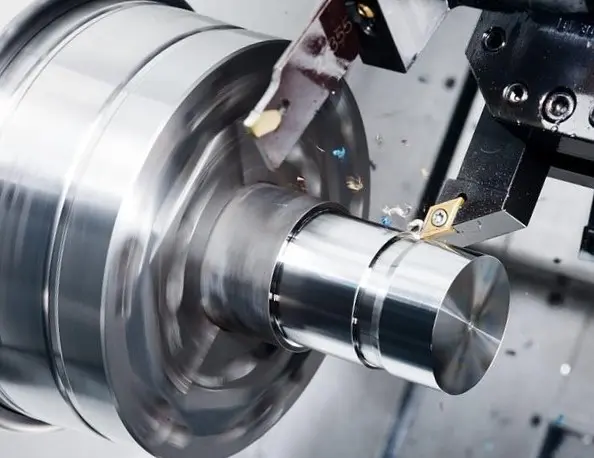
Since 2005 AS Precision has programmed turning jobs from simple diameters to parts that need knurling, micron-rigid tools, or high-polish tooling. Surface roughness on turned work is generally better than on milled work.
Operations on the turning page
Facing, boring, reaming, taper turning, drilling, knurling, threading, grooving, parting, hard turning (Rockwell C above 45, usually after heat treat), and spherical generation around a fixed axis.
Materials we turn
Metals: aluminum, magnesium, steel, stainless, brass, copper, bronze, titanium, nickel alloy. Plastics: nylon, polycarbonate, POM, ABS, PP. Specials named on the source page: glass, wood, aerospace alloys.
Where these parts go
Mobile phones, medical devices, optical equipment, automobiles, lighting, and office equipment. Industry tiles also list agricultural, machine tool, high-tech, aerospace, semiconductor, electronics, shipbuilding, and food.
Questions buyers actually send
When is turning cheaper than milling?
When the part is defined by rotation — pins, shafts, spacers, grooves, threads — a lathe or Swiss machine removes less air and holds diameter more directly.
Can you turn after heat treatment?
Hard turning is listed for stock above HRC 45, usually after heat treatment.
Can Vietnam run the same turning job?
The Vietnam factory page states it produces turning parts, simple milling, and Swiss-type parts, typically at larger quantity.