Preservatives and humectants shipped worldwide from Huaibei Anhui China

From preservative selection to challenge test results. A preservation system is a decision made across four steps: choose the spectrum, set the dosage, confirm compatibility with the base, and prove it with challenge testing. This solution covers all four with the products behind them.
Wet wipes, cleansers and high-water emulsions carry a different risk profile than anhydrous products. The format decides whether you need broad-spectrum coverage or a mild system.
Phenoxyethanol covers bacteria, yeast and mould up to a 1.0 percent limit. 1,2-Hexanediol offers milder preservation around 5 percent where a clean-label claim is required.
Ethylhexylglycerin significantly amplifies antimicrobial efficacy and improves skin feel, so the same protection is achieved at a lower preservative level.
The pre-made blend is stable across pH 3 to 12, up to 120 degrees Celsius and in high-surfactant or high-salt systems. Confirm the behaviour in your own base before scale-up.
The blend passes preservative challenge tests such as ISO 11930 at 0.5 to 1.0 percent total dosage. Run the test on your finished formulation, not on the ingredient.
Once validated, every batch ships with a Certificate of Analysis so the system you validated is the system you receive.
Broad-spectrum cosmetic preservative effective against bacteria yeast and mould
CAS 122-99-6 →
Preservative booster deodorant agent and skin conditioner in one ingredient
CAS 70445-33-9 →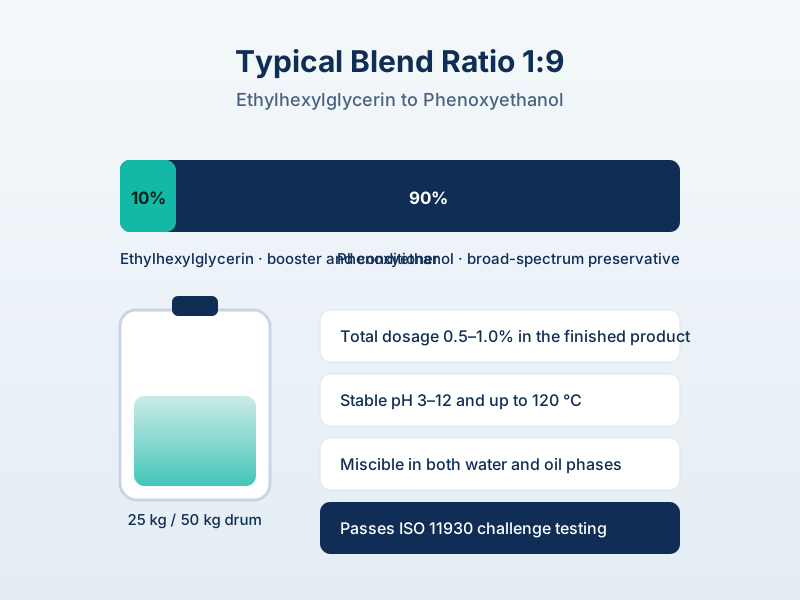
Synergistic preservative system dosed as a single raw material
CAS 122-99-6 and 70445-33-9 →
Humectant mild preservative and solvent for preservative-free claims
CAS 6920-22-5 →A four-question method for picking between phenoxyethanol, 1,2-hexanediol, a booster and a ready-made blend, with the dosage limits that apply to each.
Process GuideWhat a challenge test proves, what it does not, and how to read a supplier claim that a preservative system passes at a given dosage.
The commercial part moves inside 24 hours for a quotation. Formulation validation depends on your own challenge testing and stability schedule, which we cannot shorten.
No. Dosage windows, compatibility guidance and document preparation are part of the supply relationship.
Yes. Many customers buy one part of a system from us. We will tell you plainly when a combination is not worth changing.
The format, the water content, the target market and the volume. That is enough to return a recommendation and a price.
Describe the base, the format and the market. We will tell you which ingredient and dosage to start from, and say so when the answer is not one of our products.