Preservatives and humectants shipped worldwide from Huaibei Anhui China

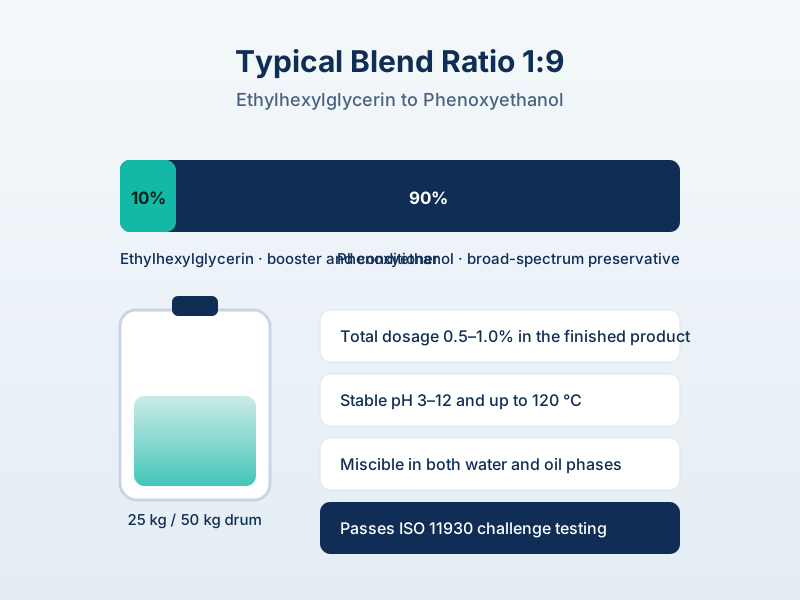
Synergistic preservative system dosed as a single raw material
A scientifically optimised blend that combines the broad-spectrum antimicrobial efficacy of phenoxyethanol with the multifunctional boosting properties of ethylhexylglycerin. The pair amplifies preservation performance while improving sensory profile and skin compatibility, and it passes preservative challenge tests such as ISO 11930 at 0.5 to 1.0 percent total dosage. Because it arrives pre-blended, your production floor weighs one raw material instead of two.
CAS 122-99-6 and 70445-33-9 Blending Series
Challenge test performance is achieved at a total dosage of 0.5 to 1.0 percent, which keeps the finished product inside the 1.0 percent phenoxyethanol limit.
The booster significantly amplifies activity against bacteria, yeast and fungi compared with the preservative used alone.
The blend imparts a smooth, non-sticky texture and enhances spreadability, so tighter preservation does not cost you the sensory panel.
Stability holds across pH 3 to 12 and up to 120 degrees Celsius, and in high-surfactant or high-salt systems where other systems separate.
A pre-blended system removes a dosing step and the ratio error that comes with weighing two preservatives on a busy line.
| Ratio | Typically 1:9, ethylhexylglycerin to phenoxyethanol |
|---|---|
| Efficacy | Passes preservative challenge tests such as ISO 11930 at 0.5 to 1.0 percent total dosage |
| Solubility | Fully miscible in water and oil phases |
| Compatibility | Stable in high-surfactant and high-salt systems |
| Process window | Stable across pH 3 to 12 and up to 120 degrees Celsius |
| CAS No. | Phenoxyethanol 122-99-6, Ethylhexylglycerin 70445-33-9 |
|---|---|
| Typical ratio | 1:9 ethylhexylglycerin to phenoxyethanol |
| Total dosage | 0.5 to 1.0 percent |
| pH stability | 3 to 12 |
| Temperature stability | Up to 120 degrees Celsius |
| Solubility | Fully miscible in water and oil phases |
| Packaging | 25 kg drum, 50 kg drum, customizable |
We partner only with manufacturers that have proven track records and modern facilities. Certificates of Analysis are provided for every shipment, and products are produced to meet relevant standards such as ISO, USP and EP where applicable.
The manufacturer is audited before the first order, not after a complaint.
Every shipment carries a Certificate of Analysis tied to the lot you receive.
MSDS/SDS, Certificate of Origin and the commercial and transport documents travel with the goods.
Safety information above comes from the product documentation for Phenoxyethanol and Ethylhexylglycerin Blend. Confirm every limit against the regulation in force in your destination market before you commit a formulation to production.
| Option | Behaviour | Best suited to |
|---|---|---|
| Phenoxyethanol and Ethylhexylglycerin Blend | Pre-mixed system, 0.5 to 1.0 percent total, ISO 11930 validated | One-step dosing with proven challenge test results |
| Phenoxyethanol alone | Broad spectrum but no sensory or booster benefit | Simple aqueous formulations on a tight budget |
| Phenoxyethanol plus separate ethylhexylglycerin | Same chemistry, two weighing steps and a ratio to control | Plants that need to vary the ratio per product |
| 1,2-Hexanediol system | Milder, humectant-led, supports preservative-free claims | Clean-label ranges |
Drum sizes listed in the specification table, or packaging as per customer request.
Document pack prepared for your destination market, whether EU, United States or China NMPA.
For blended systems, the ratio can be discussed against the formulation you are preserving.
Broad-spectrum cosmetic preservative effective against bacteria yeast and mould
CAS 122-99-6 →
Preservative booster deodorant agent and skin conditioner in one ingredient
CAS 70445-33-9 →
Humectant mild preservative and solvent for preservative-free claims
CAS 6920-22-5 →What a challenge test proves, what it does not, and how to read a supplier claim that a preservative system passes at a given dosage.
Buying GuideA four-question method for picking between phenoxyethanol, 1,2-hexanediol, a booster and a ready-made blend, with the dosage limits that apply to each.
Typically 1:9, ethylhexylglycerin to phenoxyethanol. Other ratios can be discussed against your formulation.
The blend passes preservative challenge tests such as ISO 11930 at a total dosage of 0.5 to 1.0 percent.
It is stable across pH 3 to 12 and up to 120 degrees Celsius, and in high-surfactant or high-salt systems.
Either. The blend is fully miscible in both water and oil phases.
Natural and organic formulations are one of its listed applications. Confirm the blend against the specific certification standard your range is audited to.
Keep total blend dosage at 0.8 percent or less for oily and acne-prone targets, and pair it with calming agents such as panthenol or bisabolol for sensitive skin.
Send the grade, the annual volume, the packaging you prefer and the destination market. Pricing and the document pack come back within 24 hours.