Preservatives and humectants shipped worldwide from Huaibei Anhui China

Preservative booster deodorant agent and skin conditioner in one ingredient
Ethylhexylglycerin is a multifunctional ingredient that does three jobs at once: it boosts traditional preservatives such as phenoxyethanol, it acts as an effective deodorant agent, and it conditions skin. It improves spreadability and leaves a soft, smooth after-feel, which is why formulators reach for it when a preservative system needs to be milder without becoming weaker.
CAS 70445-33-9 Preservatives With Humectant Properties
Because it raises the performance of a traditional preservative, the same protection can be achieved with less of the preservative itself.
It works as an effective deodorant agent, which makes it a direct functional ingredient in deodorant and antiperspirant formats rather than a passive additive.
Spreadability improves and the finish is soft and smooth, addressing the tackiness complaint that follows heavy humectant loads.
Typical leave-on use sits between 0.3 and 1.0 percent, so it changes the performance of a formulation without changing its cost structure.
| Grade | High-quality standard grade |
|---|---|
| Primary functions | Preservative booster, deodorant agent, skin conditioner |
| Sensory effect | Improves spreadability and gives a soft, smooth skin feel |
| System design | Can be used to create milder preservation systems |
| CAS No. | 70445-33-9 |
|---|---|
| Grade | High-quality standard |
| Typical use level | 0.3 to 1.0 percent in leave-on products |
| Function | Preservative booster, deodorant agent, skin conditioner |
| Packaging | 25 kg drum, 50 kg drum |
| Appearance | TBC on request |
| Purity | TBC on request |
We partner only with manufacturers that have proven track records and modern facilities. Certificates of Analysis are provided for every shipment, and products are produced to meet relevant standards such as ISO, USP and EP where applicable.
The manufacturer is audited before the first order, not after a complaint.
Every shipment carries a Certificate of Analysis tied to the lot you receive.
MSDS/SDS, Certificate of Origin and the commercial and transport documents travel with the goods.
Safety information above comes from the product documentation for Ethylhexylglycerin. Confirm every limit against the regulation in force in your destination market before you commit a formulation to production.
| Option | Behaviour | Best suited to |
|---|---|---|
| Ethylhexylglycerin | Booster, deodorant agent and conditioner, not a standalone preservative | Improving an existing preservative system |
| Phenoxyethanol | Standalone broad-spectrum preservative capped at 1.0 percent | Carrying the preservation of a formulation |
| Glycerin | Humectant with no antimicrobial function | Hydration claims and texture |
| Phenoxyethanol and Ethylhexylglycerin Blend | The booster already combined with the preservative | One-step dosing on the production floor |
Drum sizes listed in the specification table, or packaging as per customer request.
Document pack prepared for your destination market, whether EU, United States or China NMPA.
For blended systems, the ratio can be discussed against the formulation you are preserving.
Broad-spectrum cosmetic preservative effective against bacteria yeast and mould
CAS 122-99-6 →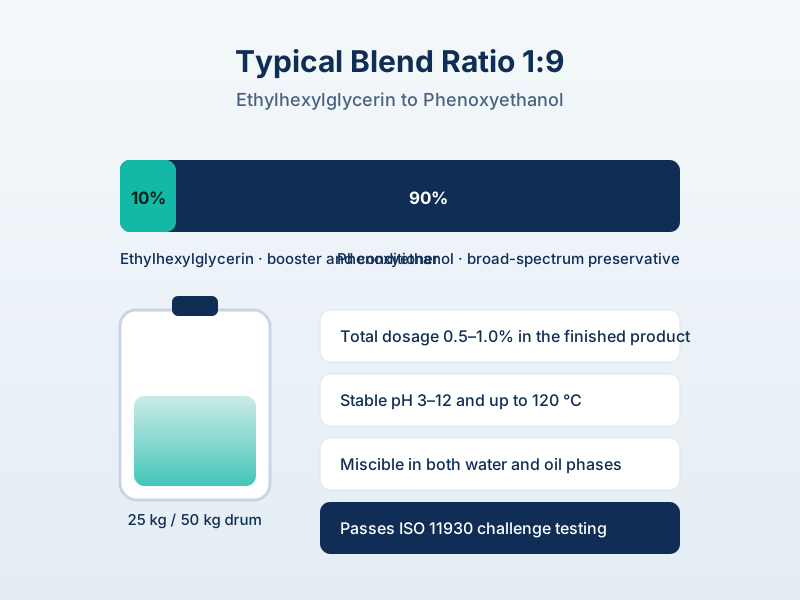
Synergistic preservative system dosed as a single raw material
CAS 122-99-6 and 70445-33-9 →
USP grade humectant for hydration barrier support and texture control
CAS 56-81-5 →Deodorant activity with a cosmetic skin feel
Preservation and hydration for creams lotions serums and masks
Preservation for surfactant systems and moisture for conditioners
From preservative selection to challenge test results
Moisture claims that survive substantiation and sensory panels
A four-question method for picking between phenoxyethanol, 1,2-hexanediol, a booster and a ready-made blend, with the dosage limits that apply to each.
Process GuideWhat a challenge test proves, what it does not, and how to read a supplier claim that a preservative system passes at a given dosage.
No. It is a booster for traditional preservatives such as phenoxyethanol, along with being a deodorant agent and a skin conditioner. Build your system around a preservative and use ethylhexylglycerin to raise its performance.
Typical leave-on use is 0.3 to 1.0 percent. At those concentrations it is safe and low in irritancy for most users.
Sensitive skin may experience contact allergy or dermatitis, showing as burning or itching. Advise consumers to discontinue use and consult a dermatologist if that happens.
Avoid high-concentration AHAs or retinol in the same formulation to prevent irritation, and use caution in products for oily skin where overuse may worsen sebum production.
25 kg drums and 50 kg drums.
In glycerin systems, an addition of 0.1 percent ethylhexylglycerin is used to improve photostability. Confirm the effect in your own formulation before relying on it in a claim.
Send the grade, the annual volume, the packaging you prefer and the destination market. Pricing and the document pack come back within 24 hours.