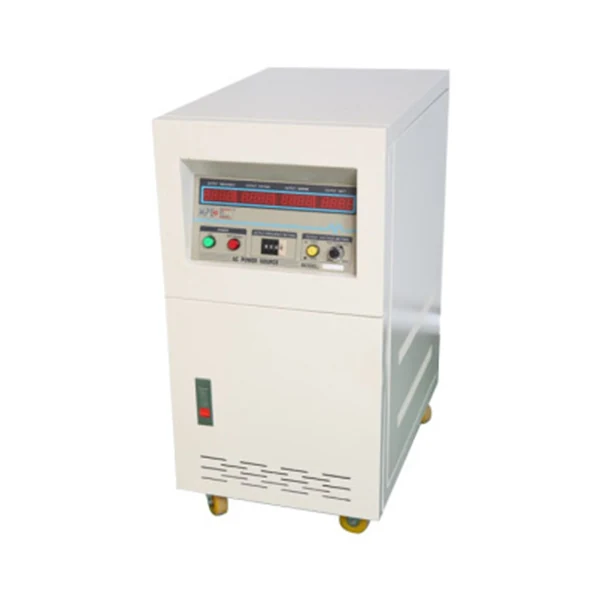
HPA Programmable AC Power Source
The HPA series is a variable frequency AC power source that reproduces the voltage and frequency used in any country on a single bench. It delivers...
View Specifications
Six questions decide which AC source fits your bench: voltage range, frequency range, waveform, isolation, overload behaviour and metering.
List the destination voltages and frequencies first. A source covering 0 to 300 VAC and 40 Hz to 499.9 Hz spans the common 50 Hz and 60 Hz markets and the 400 Hz avionics and marine case in one unit.
HPA Programmable AC Power Source
A pure and stable sine wave with galvanic isolation keeps utility distortion out of the measurement. Without it, the same unit under test measures differently on a Monday morning and a Friday afternoon.
Transformers and motors draw many times their rated current on switch on. A sustained 300 percent overload capability lets the source start them instead of tripping.
Look for an electronic circuit and instant trip breaker with alarms for overload, over temperature, instant cut off and short circuit, and a clear reset procedure.
An LED display of output voltage, frequency, ampere, wattage and power factor removes a separate meter from the setup and makes the test log faster to fill in.
Check the source is rated for resistive, capacitive, inductive and non linear loads before you assume it will drive a switch mode power supply under test.
The HPA series is a variable frequency AC power source that reproduces the voltage and frequency used in any country on a single bench. It delivers...
View SpecificationsOnly if you supply avionics, marine or military equipment. The same unit covers it, so specifying it early costs nothing later.
Input frequency can be 50 Hz, 60 Hz or 400 Hz.
Send the numbers from your own site and we will tell you which model the guide points to.