
What is Vector Control Technology in Variable Frequency Drives
Variable Frequency Drives (VFDs) have revolutionized the way electric motors are controlled in modern industry. Among the various control methods employed in VFDs, vector control technology...
Inverter Knowledge · Published 2025-09-08
Variable Frequency Drives (VFDs) have revolutionized the way electric motors are controlled in modern industry. Among the various control methods employed in VFDs, vector control technology stands out as one of the most advanced and effective approaches for achieving precise motor performance. This article explores the fundamentals of vector control technology, its working principles, and its significance in the field of motor control.
-
Introduction to Vector Control
Vector control, also known as field-oriented control (FOC), is a sophisticated method for controlling the torque and speed of three-phase AC motors, such as induction motors and permanent magnet synchronous motors (PMSMs). Unlike traditional scalar control methods (such as V/f control), which only regulate the magnitude of voltage and frequency supplied to the motor, vector control employs mathematical transformations to decouple the motor’s magnetic flux and torque components. This enables independent and highly precise control of each parameter, similar to the way DC motors are controlled.
-
The Principle Behind Vector Contro
The fundamental principle of vector control is based on the transformation of three-phase stator currents into a rotating reference frame using mathematical models. This process involves several key steps:
– Clarke and Park Transformations:The three-phase currents are first converted into two orthogonal components (d-axis and q-axis) using Clarke and Park transformations. The d-axis component represents the magnetic flux, while the q-axis component represents the torque.
– Decoupling Control:By controlling the d-axis and q-axis currents independently, the VFD can regulate the motor’s flux and torque separately and precisely.
– Feedback and Estimation:Vector control systems use feedback from sensors (such as encoders or resolvers) or estimators to continuously monitor the motor’s position, speed, and current. This data is used to adjust the control signals in real-time, ensuring optimal performance.
-
Advantages of Vector Control
Vector control technology offers several significant advantages over traditional control methods:
– High Dynamic Performance:Vector control enables rapid and precise response to changes in load and speed, making it ideal for applications requiring dynamic performance, such as robotics, elevators, and CNC machines.
– Full Torque at Low Speeds:Unlike scalar control, vector control allows motors to produce full torque even at low speeds, which is essential for applications like hoists and conveyors.
– Smooth Operation:The decoupling of flux and torque results in smoother motor operation, reduced vibration, and lower noise levels.
– Accurate Speed and Position Control:With the integration of feedback devices, vector control provides accurate speed and position control, which is critical for precision applications.
-
Types of Vector Control
There are two main types of vector control:
– Open-Loop (Sensorless) Vector Control:This method does not use physical sensors to detect rotor position or speed. Instead, it relies on mathematical estimators and algorithms. While it is less expensive and easier to maintain, it may not be as accurate as closed-loop systems, especially at very low speeds.
– Closed-Loop Vector Control:This method uses sensors such as encoders or resolvers to provide real-time feedback on rotor position and speed. It offers superior accuracy and dynamic performance but increases system complexity and cost.
-
Applications of Vector Control
Vector control technology is widely used in industries that demand precise motor control and high performance. Typical applications include:
– Industrial automation and robotics
– Elevators and escalators
– Machine tools and CNC equipment
– Electric vehicles and traction systems
– Pumps, fans, and compressors requiring variable speed operation
Vector control technology represents a significant advancement in the field of motor control, enabling AC motors to achieve performance levels previously only attainable with DC motors. By mathematically decoupling flux and torque,Variable Frequency Drives (VFDs) equipped with vector control deliver precise, efficient, and responsive control across a wide range of industrial applications. As industries continue to demand higher efficiency and precision, the adoption of vector control technology is expected to grow, driving innovation and productivity in motor-driven systems.
Drives That Apply Here
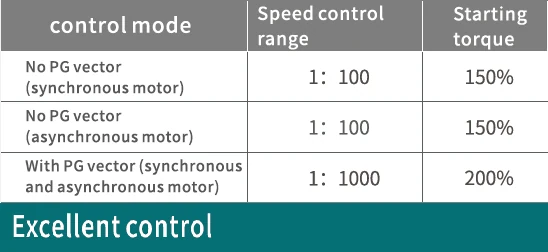
KV600 Series High Performance Vector Inverter
The heavy-load drive in the KEVAN range - closed-loop vector control, expansion cards and torque at near-zero speed for wire drawing, hoists and extruders.
View Specifications →KV100 Series Economic Frequency Inverter
A cost-controlled general-purpose drive for lathe spindles, fans, pumps and conveyor lines, built to hold full output in a 50 C cabinet.
View Specifications →Related Cases
Related Articles
- Choosing Solar Water Pump Inverters for Sustainable Land Management
- The Application of Solar Water Pump Inverters in Automated Irrigation District Management Part Two
- The Application of Solar Water Pump Inverters in Automated Irrigation District Management
- System Integration and Compatibility Considerations for Solar Photovoltaic Power Inverters
Questions About This Topic
Which KEVAN series applies to what this article describes?
How do I pick the right rating for my motor?
Can I test one unit before committing to a batch?
Is the product documentation available?
How much starting torque does the KV600 deliver?
What speed control range is achievable?
Turn This Into a Model Number
Send your motor details and we will recommend the series and rating that fits.