
KEVAN VFD vs Traditional Motor Control: What’s the Difference and Why It Matters for Your Application
In modern industrial automation, choosing the right motor control solution can significantly impact your system’s efficiency, precision, and operating costs. While traditional motor control...
Industry · Published 2026-05-14
In modern industrial automation, choosing the right motor control solution can significantly impact your system’s efficiency, precision, and operating costs. While traditional motor control methods remain in use across many facilities, Variable Frequency Drives (VFDs) — especially those from KEVAN — offer distinct advantages that are transforming how motors are managed.
This article explores the key differences between KEVAN VFDs and traditional motor control, helping you make an informed decision for your next project.
1. Control Method: Open-Loop vs. Closed-Loop
Traditional motor control often relies on open-loop systems. The motor runs at a fixed speed or follows a basic start/stop command without real-time feedback. This approach is simple and low-cost, but it cannot adjust to load changes, leading to inefficiencies and potential inaccuracies.
KEVAN VFDs, on the other hand, support both open-loop and closed-loop control. By integrating optional feedback devices (such as encoders), KEVAN VFDs can monitor motor speed, current, and torque in real time, automatically adjusting output to match load demands. This closed-loop capability ensures higher precision, stability, and protection for your equipment.
✅ KEVAN Advantage: Real-time load adaptation for pumps, fans, and conveyors.
2. Energy Efficiency: Save Where It Matters
Traditional motor control methods — such as direct-on-line (DOL) or star-delta starters — run motors at full speed regardless of actual load. This wastes significant energy, especially in variable-torque applications like pumps and fans.
KEVAN VFDs reduce energy consumption by matching motor speed to load requirements. For example, a pump running at 80% speed consumes only about 50% of full-load power. This translates to 30–50% energy savings in many applications.
✅ KEVAN Advantage: Built-in energy saving algorithms and PID control for pump and fan applications.
3. Precision and Control Flexibility
Traditional motor control offers limited flexibility — typically just start, stop, and basic overload protection. Complex tasks like position control, torque regulation, or multi-speed profiles are not possible.
KEVAN VFDs provide multiple control modes:
- V/F control for general-purpose applications
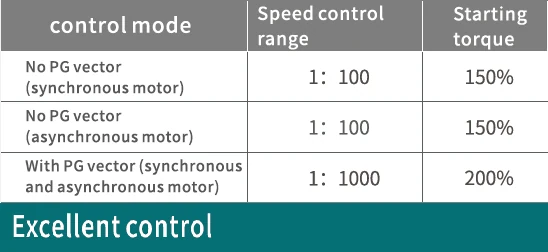
- Vector control (open-loop) for high torque at low speeds
- Closed-loop vector control for precision applications (with encoder feedback)
This makes KEVAN VFDs suitable for a wide range of applications, from simple conveyor belts to high-precision machine tools and hoisting equipment.
✅ KEVAN Advantage: Flexible control modes to match your specific application needs.
4. Response Speed and Dynamic Performance
Traditional motor controls react slowly to load changes because they lack real-time feedback. Sudden torque demands can cause stalling or tripping.
KEVAN VFDs respond in milliseconds, automatically increasing torque when needed. This is critical for applications like:
- Cranes and hoists (preventing load drops)
- Extruders and mixers (maintaining constant speed under variable load)
- Centrifuges (smooth acceleration and deceleration)
✅ KEVAN Advantage: Fast dynamic response for demanding industrial environments.
5. Application Scenarios: When to Choose What
| Application | Traditional Control | KEVAN VFD |
|---|---|---|
| Fixed-speed fan/pump | ✅ Acceptable | ✅ Better efficiency |
| Variable flow pump | ❌ Not suitable | ✅ Recommended |
| Conveyor belt (simple) | ✅ OK | ✅ More flexible |
| Hoist / crane | ❌ Risky | ✅ Required |
| Centrifuge | ❌ Poor control | ✅ Recommended |
| Multi-motor sync | ❌ Not possible | ✅ Yes (with options) |
✅ KEVAN Advantage: One solution for simple to complex applications.
Conclusion
While traditional motor control still has a place in cost-sensitive, fixed-speed applications, KEVAN VFDs offer superior energy efficiency, precision, and adaptability for modern industrial needs. Whether you are upgrading an existing system or designing a new one, KEVAN provides reliable, high-performance VFDs from 0.75kW to 1000kW, supporting 220V, 380V, and 660V inputs.
📞 Contact KEVAN today to find the right VFD for your application.
Drives That Apply Here
KV600 Series High Performance Vector Inverter
The heavy-load drive in the KEVAN range - closed-loop vector control, expansion cards and torque at near-zero speed for wire drawing, hoists and extruders.
View Specifications →KV100 Series Economic Frequency Inverter
A cost-controlled general-purpose drive for lathe spindles, fans, pumps and conveyor lines, built to hold full output in a 50 C cabinet.
View Specifications →Questions About This Topic
Which KEVAN series applies to what this article describes?
How do I pick the right rating for my motor?
Can I test one unit before committing to a batch?
Is the product documentation available?
How much starting torque does the KV600 deliver?
What speed control range is achievable?
Turn This Into a Model Number
Send your motor details and we will recommend the series and rating that fits.