
How Do Servo Controllers Differ from TraditionalMotor Controls?
SHENZHEN, China – Shenzhen KEVAN Drive Technology Co., Ltd., a professional industrial drives and servo controller manufacturer , today published a technical insight comparing servo...
Product News · Published 2025-09-15
SHENZHEN, China – Shenzhen KEVAN Drive Technology Co., Ltd., a professional industrial drives and servo controller manufacturer, today published a technical insight comparing servo controllers with traditional motor control methods. The article highlights why closed-loop servo systems are becoming the preferred choice for modern industrial automation.
As industries increasingly demand higher precision, faster response, and better energy efficiency, the difference between servo controllers and traditional motor control has become a critical consideration for engineers and procurement professionals worldwide.
Servo Controller vs Traditional Motor Control: Key Differences
1. Feedback Mechanism
A servo controller operates using a closed-loop control system. It relies on real-time feedback from sensors such as encoders or resolvers to monitor motor position, speed, and torque. The controller continuously compares the actual position with the target and adjusts the input signal accordingly. This enables high precision and fast response under dynamic load conditions.
Traditional motor control, in contrast, typically uses an open-loop system. It drives the motor based on preset signals without feedback. While simpler and lower in cost, open-loop control cannot compensate for load changes, friction, or external disturbances, resulting in lower accuracy and stability.
2. Control Strategies
Servo controllers offer flexible control modes, including position control, speed control, and torque control. This makes them suitable for complex applications such as robotic arms, CNC machines, and automated assembly lines.
Traditional motor control is generally limited to basic start/stop and speed regulation, making it inadequate for high-precision or multi-axis coordinated motion.
3. Response Speed
Thanks to real-time feedback and advanced algorithms, servo controllers achieve response times in milliseconds. They are ideal for applications requiring rapid acceleration, deceleration, or direction changes.
Traditional motor control responds more slowly and is better suited for simple, steady-state operations like fans, pumps, and conveyors.
4. Energy Efficiency
A servo controller dynamically adjusts power output based on actual load, reducing unnecessary energy consumption. Traditional motor control often runs at full speed regardless of load, leading to higher energy waste.
5. Typical Applications
Servo controllers are widely used in robotics, aerospace, medical devices, CNC machining centers, and automated packaging lines — anywhere high precision and fast response are required.
Traditional motor control remains common in cost-sensitive applications such as industrial fans, water pumps, conveyor belts, and simple hoists.
Why KEVAN Drive Technology Focuses on Servo Controllers
As a technology-driven manufacturer, KEVAN recognizes that the future of industrial automation lies in high-performance servo controllers. With decreasing costs and increasing capabilities, servo systems are rapidly replacing traditional motor control in many sectors.
KEVAN offers a range of advanced servo controllers and integrated drive solutions that combine precision, reliability, and energy savings. The company also provides customized control systems for customers with specific motion control requirements.
Read the Full Technical Article
The complete comparison — including detailed technical tables and application examples — is available on KEVAN’s new international website. Engineers and procurement teams are invited to explore the advantages of servo-based motion control for their projects.
Contact KEVAN Overseas Sales
Overseas Sales Contact: Mr. Li
Phone: +86-13725501611
Email: [email protected]
Company Address:
Room 501, Building 11, Nangang Second Industrial Park
No. 1026, Songbai Road, Sunshine Community, Xili Street
Nanshan District, Shenzhen, China
Welcome to visit the new international website of Shenzhen KEVAN Drive Technology Co., Ltd., your trusted partner for servo controllers, industrial drives, and control systems.
Drives That Apply Here
KV600 Series High Performance Vector Inverter
The heavy-load drive in the KEVAN range - closed-loop vector control, expansion cards and torque at near-zero speed for wire drawing, hoists and extruders.
View Specifications →KV100 Series Economic Frequency Inverter
A cost-controlled general-purpose drive for lathe spindles, fans, pumps and conveyor lines, built to hold full output in a 50 C cabinet.
View Specifications →Related Cases
Questions About This Topic
Which KEVAN series applies to what this article describes?
How do I pick the right rating for my motor?
Can I test one unit before committing to a batch?
Is the product documentation available?
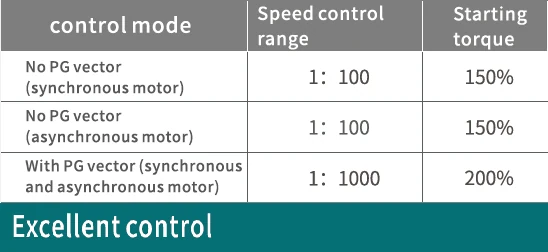
How much starting torque does the KV600 deliver?
What speed control range is achievable?
Turn This Into a Model Number
Send your motor details and we will recommend the series and rating that fits.