
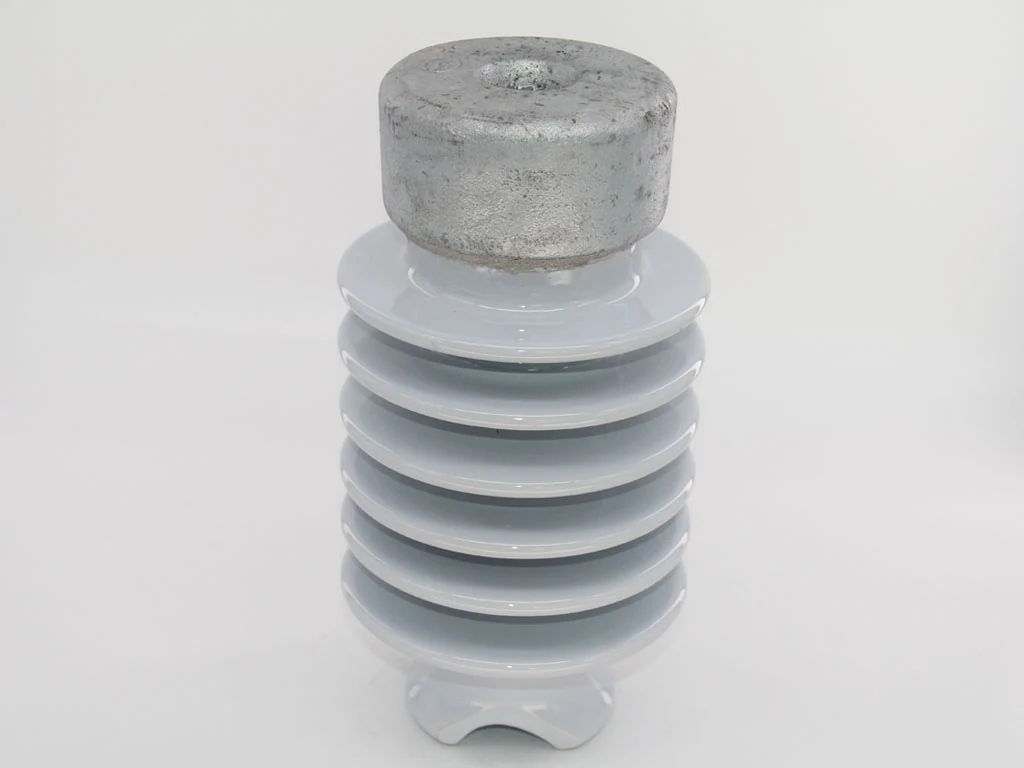
Mounting Type Determines Insulator Selection
The mounting method defines whether a pin type, line post, station post, suspension disc, strain or spool insulator is used. A pin type insulator is mounted directly on a crossarm with a metal pin. A line post or station post is mounted on a pole or tower with a flange or base. A suspension disc is hung from a crossarm with a clevis or shackle. The mechanical loading direction and structural role determine the required insulator type.
Cantilever Strength Defines Post Insulator Use
Station post and line post insulators must resist bending forces from conductor tension and wind. The cantilever strength rating indicates the maximum load the insulator can withstand without breaking. For example, the ANSI TR-208 station post has a 9kN cantilever strength, while the ANSI 57-2 line post has a 12.5kN rating. Higher values allow use in higher wind zones or on longer spans.
Station Post Insulators ANSI TR-208
Suspension Insulators Handle Tensile Loads
Suspension discs are designed to carry tensile loads from the weight of conductors and ice. The tensile strength rating is critical. The ANSI TR-208 station post has a 44.5kN tensile strength, while the ANSI 52-4 suspension disc has a 67kN combined mechanical and electrical rating. The tensile strength must exceed the maximum conductor tension under worst-case conditions.
Clevis Type Suspension Insulators ANSI 52-4
Pin Type Insulators for Lower Voltage Lines
High voltage pin type insulators like ANSI 56-3 are used on distribution lines where the voltage is below 35kV. They are mounted on a pin and must resist both bending and tensile forces. The ANSI 56-3 has a 13.6kN cantilever strength and a 34.5kV type application voltage, making it suitable for medium voltage distribution systems.
High Voltage Pin Type Insulators ANSI 56-3
Leakage Distance and Pollution Performance
The leakage distance determines how well the insulator resists flashover in polluted or wet conditions. Longer leakage distances improve performance in coastal or industrial areas. The ANSI 57-2 line post has a 559mm leakage distance, while the ANSI 56-3 pin type has 533mm. The IEC C4-125 station post has a 500mm leakage distance. Choose based on the expected pollution level at the site.
Line Post Insulators ANSI 57-2
Electrical Ratings Must Match System Voltage
The type application voltage must match the system voltage. The ANSI 57-2 line post is rated for 35kV, and the ANSI 56-3 pin type for 34.5kV. The IEC C4-125 station post is rated for 125kV lightning impulse withstand, which corresponds to a system voltage in the 50–60kV range. Do not use an insulator with a lower type application voltage than the system.
Station Post Insulators IEC C4-125
Non-Standard Designs Are Available
When no standard insulator fits the application, Huahao designs custom insulators based on the specific duty. Engineers assist in developing insulators for non-standard mounting, unusual loading, or unique environmental conditions. Provide the drawing or duty requirement to [email protected] for support.