
Why the Standard on the Drawing Changes What You Order
A porcelain insulator is specified by a class designation, not by a part number. The class fixes the coupling geometry, the disc or shed profile, the mounting dimensions and the minimum mechanical and electrical ratings. Two suppliers quoting the same class are quoting parts that will physically interchange on the structure. Two suppliers quoting different classes are not comparable on price, however similar the photographs look. Getting the standard right at enquiry stage is what stops a delivered pallet from being unusable on site.
How ANSI Classes Are Written
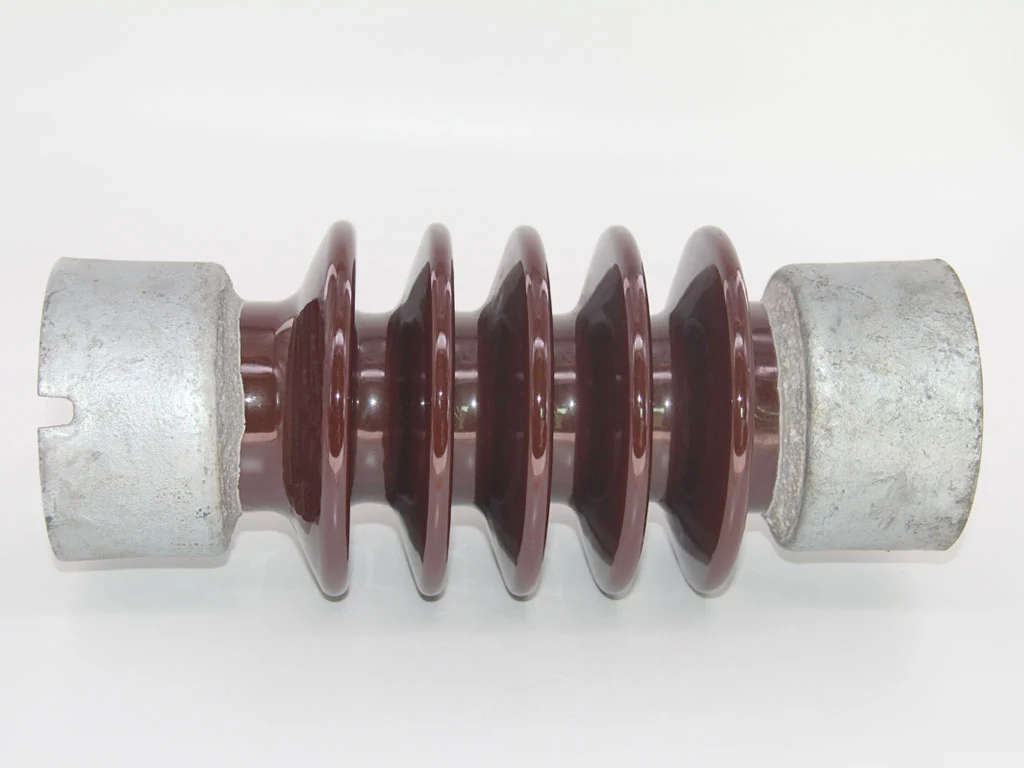
ANSI insulator classes use a two-part number such as 52-4, 55-4 or 57-2. The first part identifies the family: 52 for suspension discs, 53 for spools, 54 for strain insulators, 55 and 56 for pin types, 57 for line posts. The second part identifies the size and rating step within that family. So ANSI 55-4 and ANSI 56-3 are both pin type insulators, but 56-3 is the larger high voltage member: 267mm diameter against 140mm, and a 34.5kV type application voltage against 13.2kV.
High Voltage Pin Type Insulators ANSI 56-3
How IEC Designations Differ
IEC designations describe the insulator by its duty rather than by a family index. IEC C4-125 is a station post insulator with a 4kN cantilever rating and a 125kV lightning impulse withstand voltage, and the designation states both directly. The practical consequence for a buyer is that an IEC part is compared on its published mechanical and impulse figures, while an ANSI part is compared first on its class and then on the figures published for that class.
Station Post Insulators IEC C4-125
Metric and Imperial Figures Describe the Same Part
ANSI class data is published in inches and pounds and converted to millimetres and kilonewtons. An ANSI TR-208 station post is 6 9/16 inches (167mm) in diameter and 14 inches (356mm) high, with a 2,000 pound (9kN) cantilever strength and a 10,000 pound (44.5kN) tensile strength. Both sets of figures are the same part. Ask for whichever unit your specification uses so the comparison table you build is consistent.
Station Post Insulators ANSI TR-208
What the Standard Does Not Tell You
A class designation fixes geometry and minimum ratings. It does not fix glaze colour, cement quality, galvanizing thickness or the pollution environment the insulator will survive. Two ANSI 52-4 discs from different plants can meet the same 15,000 pound (67kN) combined mechanical and electrical rating and still behave differently after ten years in a coastal corridor. That is why the leakage distance, the radio influence voltage limit and the quality system behind the part still belong in your enquiry.
Clevis Type Suspension Insulators ANSI 52-4
Reading a Data Sheet in the Right Order
Start with the mounting and coupling, because a mismatch there cannot be engineered around on site. Then check the mechanical rating against your worst case conductor tension including ice and wind. Then check the electrical figures against your insulation coordination study, remembering that a flashover or withstand voltage is a test rating and not the system voltage. Leakage distance comes last but decides long-term performance in polluted air.
Line Post Insulators ANSI 57-2
Specifying to More Than One Standard
Tenders in export markets often carry a local standard alongside ANSI or IEC. Huahao builds to GB, ANSI, BS, DIN, AS and IEC standard designs, and also designs insulators for specific non-standard applications where no published class fits the structure. If your drawing calls for a profile that is not in a catalogue, send it over rather than forcing the nearest standard part into the design.