
The Joint Is The Product
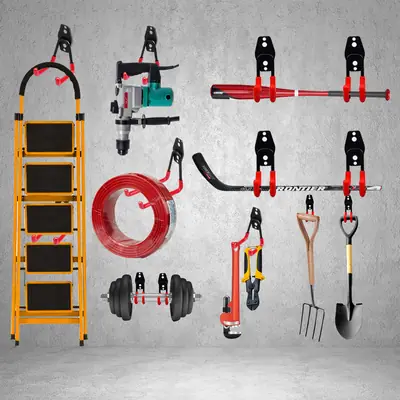
A garage storage hook is a bent steel bar joined to a fixing plate. Everything that determines whether it holds happens at that joint. Under load, the hook tries to rotate away from the plate, and the weld is what resists it.
This is why weld count is a specification point rather than a detail. Adding a third welding spot between the hanger and the base plate spreads the load across a wider footprint instead of concentrating it on two points.
Bar Diameter and Bend Radius
A larger bar diameter raises capacity but also raises the minimum diameter of the item the hook can hold comfortably. A tight bend radius work-hardens the steel at the bend, which is where a fatigued hook usually straightens.
For ladders and hoses, an open sweep matters more than raw capacity — an item that will not seat properly in the hook puts its load on the tip instead of the root.
Plate Thickness and Fixing Pattern
A thin plate will dish around the screw heads under load, which lets the whole hook rock. Two fixing holes set well apart resist rotation better than two holes close together.
The fixings supplied with the hook have to suit the wall. A hook rated for 42 kg fixed with a plasterboard screw is rated for nothing.
Coating
Garages are damp, and hooks get wet items hung on them. A coated hook that has been scratched by a ladder rail will corrode at the scratch, so coating hardness matters as much as coverage.
Where a hook carries a painted or finished item — a bicycle frame, a garden tool handle — a soft coating or a sleeve on the hook protects what is hanging on it.
Reading A Stated Load
A stated capacity is only meaningful with the conditions attached: which fixing, which wall, and static or dynamic load. A published figure such as 42 kg / 92 lb per hook describes the hook, not the wall it goes on.
For a retail programme, agree how the figure will be printed on the packaging before the artwork is signed off.