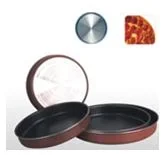
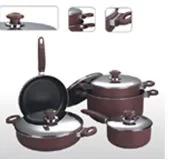
Aluminium cookware is sold by its exterior finish, and the finish names sound like marketing until you understand that each one is a different manufacturing process with a different cost and a different failure mode.
Painted Is The Promotional Tier
Wet paint on a prepared aluminium body. It is the cheapest way to get a strong colour, the colour range is effectively unlimited, and a painted set photographs beautifully for a catalogue cover.
Its weakness is the rim and the area above the burner. Paint runs thin over a curved rim and discolours where a flame licks up the side of the pan. For a cupboard kept set at a promotional price that is an acceptable trade, and it is why painted cookware dominates seasonal offers.
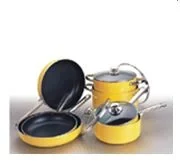
Powder Coating Is The Middle Tier
Powder is applied dry, electrostatically, then cured. Because it is attracted to the metal rather than brushed or sprayed wet, it covers rims and curves evenly instead of running thin exactly where wear happens first.
It is tougher than paint, cheaper than enamel and takes a wide colour range including deep tones that an enamel line struggles to hold. For most own brand ranges this is the sensible middle.
Enamel Is The Hard Gloss
Enamel is a glass based coating fused to the metal at high temperature. It is hard, glossy, does not fade and cleans without scouring.
Its weakness is impact. Enamel chips if a pan is knocked hard against a sink or another pan, and a chip cannot be repaired. It belongs on pans that live on an open shelf or a pot rail, where appearance after a year is what the customer is paying for.
Hard Anodising Changes The Metal Itself
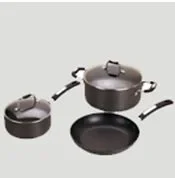
Anodising is electrochemical rather than a coating. It converts the surface of the aluminium into a much thicker and harder oxide layer, so the dark grey finish is the metal, not something applied to it.
Because there is no added layer, there is nothing to chip or flake. It is the premium construction in this group and it carries a premium price. Note that harsh alkaline dishwasher tablets dull anodised surfaces, so hand washing is the safer claim to print.
Forging Is About The Base Not The Surface
Forging is the one entry in this list that is not a finish at all. A forged body starts from a thicker blank, so the base carries more metal. That is what stops the central hot spot and holds temperature when cold food goes into the pan.
It is easy to confuse with the finishes because it appears in the same range names, but it solves a cooking problem rather than an appearance problem. A genuinely premium set often wants forging and anodising together.
Polished Bare Metal Is The Honest Value Answer
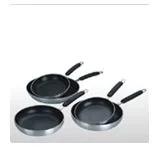
No exterior coating at all. The outside is the polished aluminium, which dulls with heat and cleans back with a proprietary aluminium cleaner.
On a frypan, which sits over direct heat every day, removing the exterior coating removes the layer most likely to fail. It costs less than any coated option and it cannot chip, because there is nothing on it to chip.
Two Things That Are Separate From All Of This
The interior non stick coating is specified independently of the exterior finish. Any of these sets can carry a two layer or a multi layer interior system; that decision follows the price point and the market.
Induction compatibility is also separate. Plain aluminium is not magnetic and will not work on an induction hob. An induction base disc has to be specified and bonded, and it changes both the build and the price. Decide it before sampling, not after.