

Where Compound Amino Acid Powder Is Used: Four Applications
Compound amino acid powder is bought for four distinct reasons, and formulators who are clear about which of the four they are serving make better grade decisions. This article sets out each application, the property that governs it, and the documents you should have in hand before the material enters a formulation.
Start With the Role, Not the Grade
A water-soluble compound amino acid powder is a single material with several jobs. It can be sprayed onto foliage, blended into a product intended to influence plant physiological processes, used as a source of amino acids in a nutritional formulation, or applied to soil where it acts as a chelating agent for metals. The same kilogram of powder behaves differently in each of those settings because the concentration, the water, the contact surface and the tank partners all change.
That is why the sequence matters. Decide the application first, then let the application dictate which specification lines you care about, and only then choose between grades. Working the other way round, starting from a grade percentage and looking for a use, tends to produce formulations whose solubility or nitrogen contribution was never actually checked against the intended job.
Foliar Fertilizer
In foliar use, the powder is dissolved and sprayed onto plant leaves so that nutrients are delivered directly to the tissue rather than routed through the root zone. It is the most demanding of the four applications from a physical point of view, because everything happens at a defined dilution, through a nozzle, in whatever water the grower has available.
The properties that decide success here are dissolution behaviour, solution pH, filterability and compatibility with the other inputs in the tank. Everwell Bio grades are specified at pH 4 to 6 in a 1 percent solution for the Amino Acids 35, 45 and 80 powders and at 100 percent water solubility, but a specification is a starting point, not a guarantee for your water. Run a jar test at the real use concentration, in the real source water, with the real mixing order, before any large-scale spray.
- Check dissolution time at the intended concentration and water temperature
- Record solution pH and any sediment after standing
- Assess filterability against your nozzle and filter specification
- Add tank partners one at a time when compatibility is being assessed
- Run a crop-safety check on a small area before broad application
Plant Growth Regulator Input
The second role is as a component in products intended to influence physiological processes in the plant and to support growth and development. This is the application where claims need the most discipline, because what may be stated on a label is decided by the finished product's registration in the destination market, not by the ingredient's origin or its amino acid percentage.
For the formulator, the practical consequence is documentation. You need the raw-material and process statement, the total and free amino acid figures with their test methods, and the nitrogen figure identified as total or organic nitrogen. Everwell Bio powders come from hydrolyzed duck feather protein processed by controlled hydrolysis, purification, concentration and spray drying, and each shipment carries a batch-specific COA, with TDS and SDS available on request.
Amino Acid Supplement
The third role is the most direct: the powder acts as a source of amino acids where a formulation needs that contribution to support biological functions. Here the only figures that matter are the ones describing what is actually in the bag, and the grade choice is essentially an arithmetic exercise against formulation space and cost.
The grade range exists to give that arithmetic room to move. Amino Acids 35 carries not less than 35 percent total amino acids with not less than 17 percent total nitrogen; Amino Acids 45 carries not less than 45 percent total amino acids with not less than 16 percent total nitrogen; Amino Acids 80 carries not less than 80 percent total amino acids with not less than 12 percent total nitrogen. The nitrogen pattern runs in the opposite direction to the amino acid percentage, which is exactly why nitrogen should never be inferred from the grade name. A separate cattle-bone hydrolyzed protein powder, at not less than 90 percent crude protein and not less than 80 percent amino acids, serves formulations built around protein content rather than a stated amino acid grade.
- Amino Acids 35: at least 35% total amino acids, at least 17% total nitrogen, at least 35% organic matter
- Amino Acids 45: at least 45% total amino acids, at least 16% total nitrogen, at least 60% organic matter
- Amino Acids 80: at least 80% total amino acids, at least 12% total nitrogen, at least 80% organic matter
- Protein Powder: at least 90% crude protein, at least 80% amino acids, pH 5 to 7.5, 99% soluble
Soil Conditioner and Chelating Agent
The fourth role takes the powder into the soil, where it acts as a chelating agent for metals, improving soil conditions and the availability of nutrients already present. This application is less sensitive to nozzle and filter constraints than foliar spraying, but more sensitive to the composition of the remaining material in the product.
Organic matter content is the specification line that tracks this use most closely, and it rises across the range: not less than 35 percent for Amino Acids 35, not less than 60 percent for Amino Acids 45, and not less than 80 percent for Amino Acids 80. Moisture is capped at 5 percent or below across those three grades, which matters for blending and storage in soil-applied granular or soluble products alike.
Matching the Application to a Supply Decision
Once the application is settled, the commercial questions become straightforward. Everwell Bio manufactures these powders at a 20,000 square metre facility in Suzhou with more than 80 workers and a capacity of 4,000 tons per month, shipping around 50 forty-foot high-cube containers each month to more than 20 countries. Regular orders run on a 30-day lead time, on FOB Shanghai or Qingdao terms, with payment by T/T, L/C, D/P or O/A.
Before you commit volume, take material through your own process. Free samples of 200 to 500 g are supplied with the batch COA, which is enough to run dissolution work, a jar test with your tank partners, and a small-scale trial in the application you actually intend. All grades are a light yellow to brown powder; colour within that range is normal and is not a quality indicator on its own.
Four applications and the specification lines that govern them
| Application | What the powder does | Specification lines to check first |
|---|---|---|
| Foliar fertilizer | Sprayed on leaves to deliver nutrients directly to plant tissue | Water solubility, pH in 1% solution, moisture |
| Plant growth regulator input | Component of products intended to influence plant physiological processes | Raw material and process statement, free amino acids and method |
| Amino acid supplement | Supplies amino acids to support biological functions | Total amino acids, total nitrogen, batch COA |
| Soil conditioner | Chelates metals in soil, improving nutrient availability | Organic matter, total amino acids, moisture |
Conclusion
Decide which of the four applications you are formulating for, then pull the specification lines that govern it and test a sample in your own water and process before scaling up. Send your application, target concentration and destination market to [email protected], or call +86 134 0579 7951 or +86 186 5277 5865. We reply within 24 hours, Monday to Saturday, and can send 200 to 500 g of the relevant grade with its batch COA for bench work.
Products Discussed In This Article
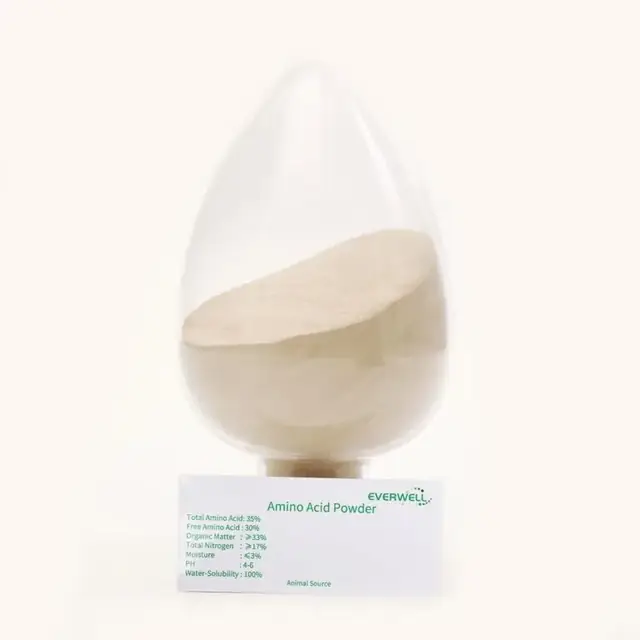
Amino Acids 35
The volume grade. A fully water-soluble hydrolysed feather protein powder carrying ≥ 17% total nitrogen, priced for foliar and fertigation programmes
View specification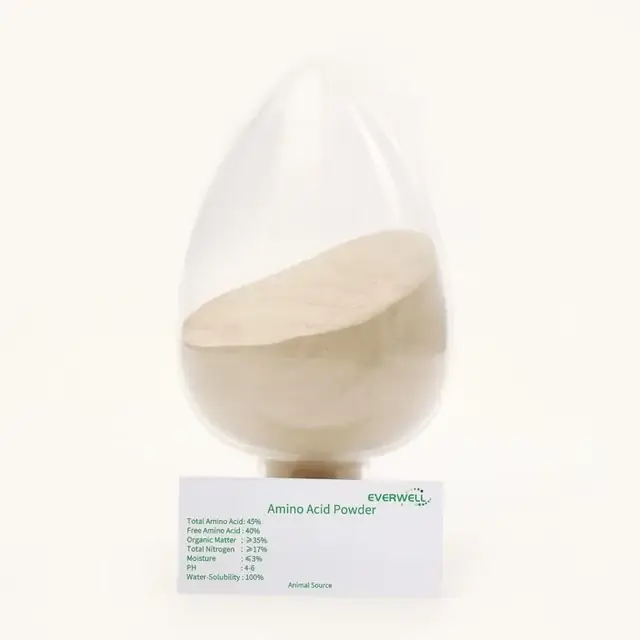
Amino Acids 45
The benchmark grade: ≥ 45% total amino acids, ≥ 60% organic matter, and 41.93% free amino acids measured by Eurofins under GB/T 18246-2019. The grade
View specification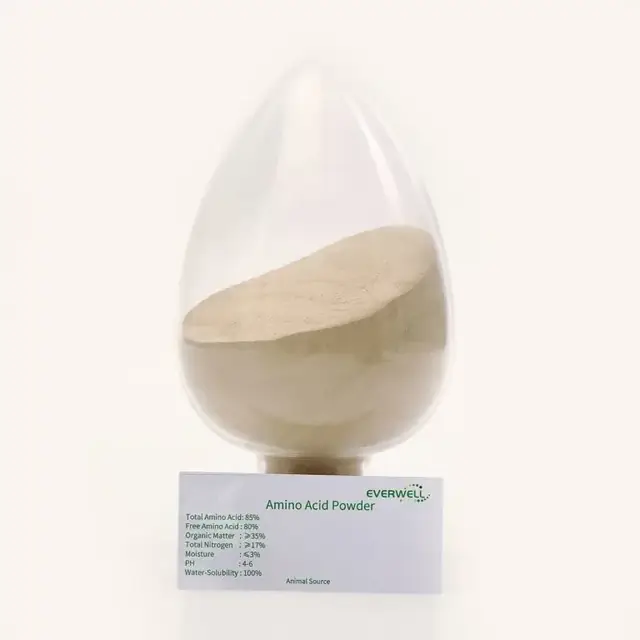
Amino Acids 80
The density grade: ≥ 80% total amino acids, ≥ 80% organic matter, and 75.37% free amino acids measured by Eurofins. Glycine and proline rich, for conc
View specificationRelated Articles
Benefits of Animal-Source Compound Amino Acid Powder in Fertilizer
Four documented benefits of animal-source compound amino acid powder as a fertilizer input, and how to verify each one before formulating.
Read more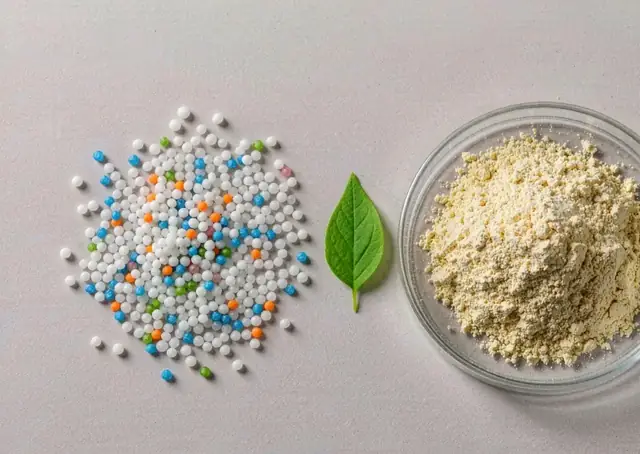
Can Amino Acid Fertilizer Replace NPK? An Evaluation Framework
Why no universal NPK-reduction percentage is defensible, and a nutrient-by-nutrient process for evaluating an amino acid product alongside a fertilizer programme.
Read more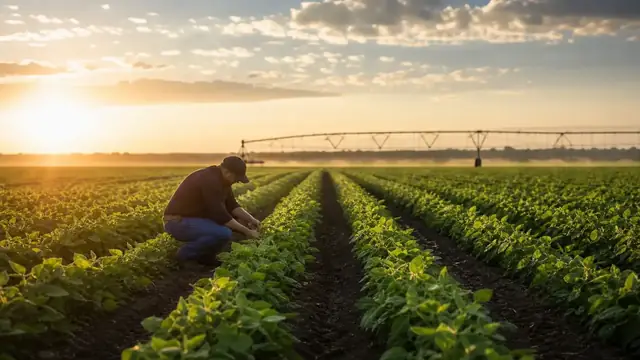
How to Choose 35%, 45% or 80% Compound Amino Acid Powder
A grade-by-grade comparison of Amino Acids 35, 45 and 80, with the cost, nitrogen and solubility checks that should decide the purchase.
Read moreQuestions On This Topic
Can one grade serve all four applications?
Technically yes, but the economics differ. Foliar and supplement uses are usually decided by amino acid concentration and solubility, while soil conditioning tracks organic matter, so the best grade is not the same in every case.
Does a higher amino acid grade contain more nitrogen?
No. Amino Acids 35 is specified at not less than 17% total nitrogen while Amino Acids 80 is specified at not less than 12%, so nitrogen has to be read from the specification rather than inferred.
What is the raw material?
The compound amino acid powders are made from hydrolyzed duck feather protein. A separate hydrolyzed protein powder is produced from cattle bone.
Do I get documentation with a shipment?
Yes. A batch-specific COA accompanies every shipment, and the TDS and SDS are available on request.
Can I test before ordering?
Yes. Free samples of 200 to 500 g are supplied with the batch COA.
What is the lead time?
Regular orders run on a 30-day lead time, FOB Shanghai or Qingdao.
Ask Us About This Directly
Technical questions are answered by the export and production team, normally within 24 hours.