
Amino Acid Powder Solubility: Testing and Mixing Guide
"Water-soluble" is the claim buyers rely on most and question least. After reading this you will be able to write a solubility requirement that a laboratory can actually reproduce, separate product solubility from application compatibility, and decide when a jar test is enough and when a quantitative residue measurement is required.
Why a Percentage Alone Does Not Settle the Question
A powder can disperse in seconds and still leave insoluble particles behind. A solution can look clear in the drum and then precipitate the moment a second fertilizer is added. A material that passes the supplier's own quality-control method can still blind a customer's fine filter because the application concentration, the water chemistry or the tank-mix sequence is different from the laboratory condition.
The conclusion is not that solubility claims are useless. It is that a percentage only means something when it is attached to a defined test method, and that product solubility and application compatibility are two separate properties that have to be verified separately. Total amino acid content tells you nothing about either of them.
- Ask what the specification means by water-soluble: method, water type, sample concentration, temperature, mixing time, filtration, reporting basis and acceptance limit.
- Do not infer solubility from total amino acid content; they are unrelated properties.
- Use a visual jar test to screen dissolution, clarity, foam and settling, never to assign a percentage.
- Measure insoluble residue quantitatively whenever the number controls batch release or purchase acceptance.
- Test the final use dilution and the full tank mix as a separate exercise.
Five Things People Call Solubility
Several distinct observations get filed under one word, and the confusion travels straight into technical data sheets. True water solubility is the saturation concentration of a substance in water at a stated temperature. That concept is clean for an essentially pure substance. Compound amino acid powder is a mixture, and its components dissolve to different extents, so a single saturation figure does not describe it.
Operationally soluble fraction is the portion of the product that stays in solution under a defined laboratory procedure, and the result belongs to that procedure. Insoluble residue is the material retained after a specified filtration, washing and drying sequence; for a powder mixture it is usually the more practical quality-control measure because it is a mass you can weigh.
Dispersibility describes how readily particles distribute through water, and dispersed particles are not necessarily dissolved. Clarity or turbidity is an appearance measurement: a solution can be deeply coloured and fully compliant, or visually clear while carrying very fine suspended solids. These five terms should never be swapped for one another in a TDS or a COA.
What Changes a Solubility Result
A figure such as 98 to 100 percent looks precise, but two laboratories cannot compare results unless they work under equivalent conditions. A long list of variables moves the number, and most of them are not stated on a typical certificate.
This is why the wording of the purchase specification matters more than the headline claim. A requirement phrased as "insoluble residue, maximum X percent, method Y" is enforceable. "100% soluble" is not. The actual limit and the actual method have to come from the agreed specification between buyer and supplier; this article does not assign them.
- Water source and ionic composition, and starting pH
- Sample-to-water ratio and test temperature
- Particle size and degree of agglomeration
- Order and rate of addition to the vessel
- Agitation type, speed and duration
- Standing time before observation or filtration
- Filter material, pore size and washing procedure
- Drying temperature and endpoint
- Whether the result is reported as received or on a dry-matter basis
Grade Percentage Is a Composition Statement, Not a Solubility Result
A 35, 45, 65 or 80 percent total amino acid grade describes composition according to the applicable assay. It does not state how much of the complete powder dissolves in water. Minerals, peptides, processing residues, moisture and other permitted components all sit inside the same kilogram and all of them can influence an operational solubility test.
The reverse assumption is equally unreliable. A higher total amino acid percentage is not automatically more soluble, more stable in storage, or less hygroscopic. Any of those statements requires data generated on the specific products being compared, under the same method, at the same time.
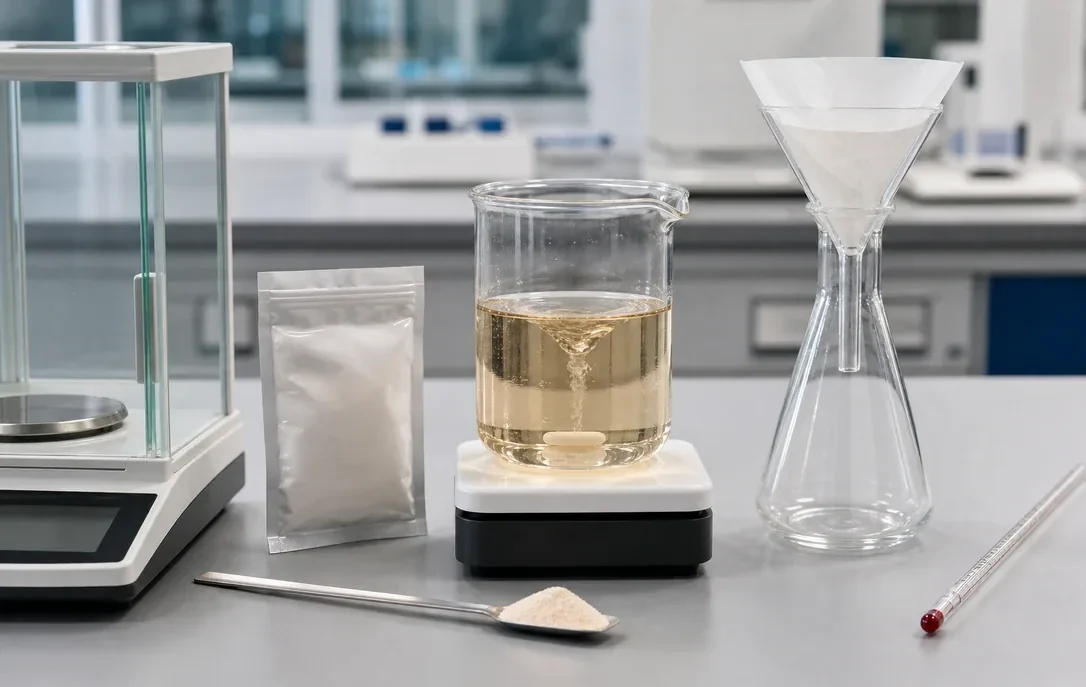
A Defensible Insoluble-Residue Test
The procedure you use should be an approved internal, national, international or mutually agreed method. The outline below is not a substitute for that method; it is here to show why a quantitative determination is a different exercise from a jar demonstration, and what has to be recorded for a result to be defensible.
Before starting, record the product and lot, the sampling procedure, sample mass, water specification and volume, starting pH, test temperature, mixing equipment, agitation speed, mixing time, standing time, filter type and pore size, washing procedure, drying conditions and reporting basis. Use a representative sample and run an appropriate blank so that residue contributed by the water, the filter or the apparatus is corrected out.
Condition and weigh the filter or filtration vessel as the method directs. Weigh the test portion accurately. Add the specified water at the specified temperature to a clean vessel, then add the powder at a controlled rate while mixing, avoiding dust loss and material stranded on the vessel wall. Mix for the prescribed time and allow any prescribed equilibration period. Filter using the specified apparatus and rinse the vessel and residue only as far as the method allows, because uncontrolled washing biases the result. Dry the retained residue to the required endpoint, cool appropriately, weigh, correct for the blank and calculate on the stated basis.
Insoluble residue in percent is the corrected dry residue mass divided by the sample mass, multiplied by 100; the operationally soluble fraction is 100 minus that figure. The calculation is valid only for the defined procedure and does not establish the thermodynamic solubility of every component in a complex mixture. Run replicates, set repeatability acceptance criteria where the result controls release, and record colour, clarity, turbidity, foam, pH and settling as separate observations rather than converting visual impressions into a number.
Running a Jar Test That Means Something
A jar test earns its place as a rapid screen and as preparation for application. Its value depends entirely on whether it reproduces the customer's realistic conditions rather than laboratory conditions chosen for convenience.
Use clean transparent containers, include a water blank, and photograph the samples at defined times. Record whether the powder wets, disperses, dissolves, foams, forms gel-like material, settles, floats, or changes after other inputs are introduced. What you must not do is read a percentage off the glass. If a number is needed, send a representative sample for the agreed quantitative method.
- Actual source water, or a documented standard water
- The intended product concentration, not a convenient dilution
- The water temperature expected in the field
- Representative agitation, mixing order and contact time
- The final tank-mix partners, added one at a time when compatibility is under assessment
Temperature: Control It, Do Not Invent Cut-Offs
Higher temperature can speed wetting and dissolution. It can also change viscosity, reaction rate, evaporation and compatibility, so faster is not automatically better. There is no universal temperature at which every compound amino acid powder suddenly degrades, and a figure such as "above 50 degrees Celsius" should not be presented as a general boundary without product-specific evidence behind it.
The practical rule is to work at the temperature stated in the supplier's preparation instructions or in the test method, and for comparison testing to hold temperature inside the method's tolerance. The OECD guideline for water-solubility testing of pure substances illustrates how much reporting depends on controlled temperature, pH, analytical method and possible instability. Compound fertilizer mixtures are harder cases than pure substances and still need an appropriate agreed method of their own.
None of this can guarantee that a given sprayer, dripper or membrane stays clear. Equipment filtration, particle tolerance, water quality and operating practice sit outside any solubility statement a supplier can issue.
Conclusion
Rewrite your solubility requirement before you rewrite your supplier list. Put the method, water, concentration, temperature, filtration and reporting basis into the specification, ask for insoluble residue against a stated limit rather than a round solubility claim, and run your own jar test at the real use dilution with the real tank partners. Everwell Bio supplies a batch-specific COA with every shipment, with TDS and SDS available, and free samples of 200 to 500 g with batch COA for bench testing. Send your water analysis, intended concentration and tank-mix list to [email protected] and we will reply within 24 hours.
Products Discussed In This Article
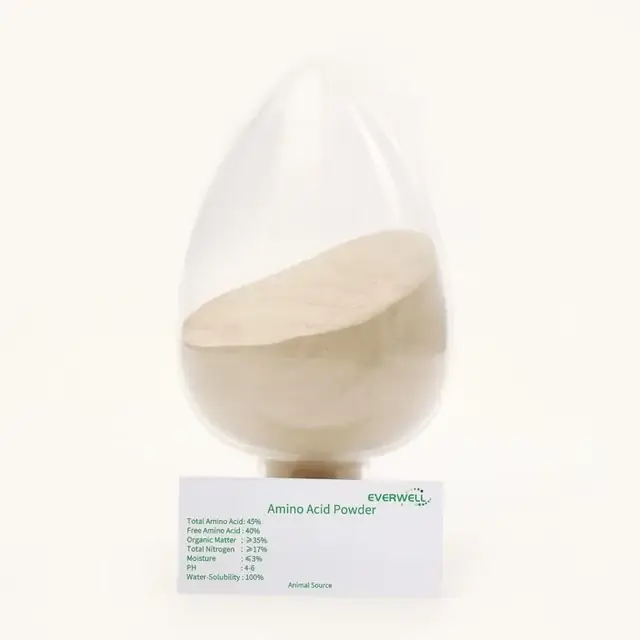
Amino Acids 45
The benchmark grade: ≥ 45% total amino acids, ≥ 60% organic matter, and 41.93% free amino acids measured by Eurofins under GB/T 18246-2019. The grade
View specification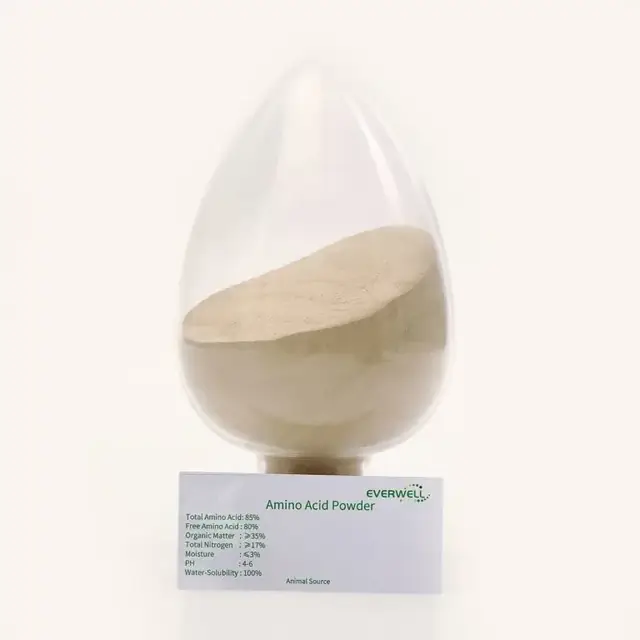
Amino Acids 80
The density grade: ≥ 80% total amino acids, ≥ 80% organic matter, and 75.37% free amino acids measured by Eurofins. Glycine and proline rich, for conc
View specification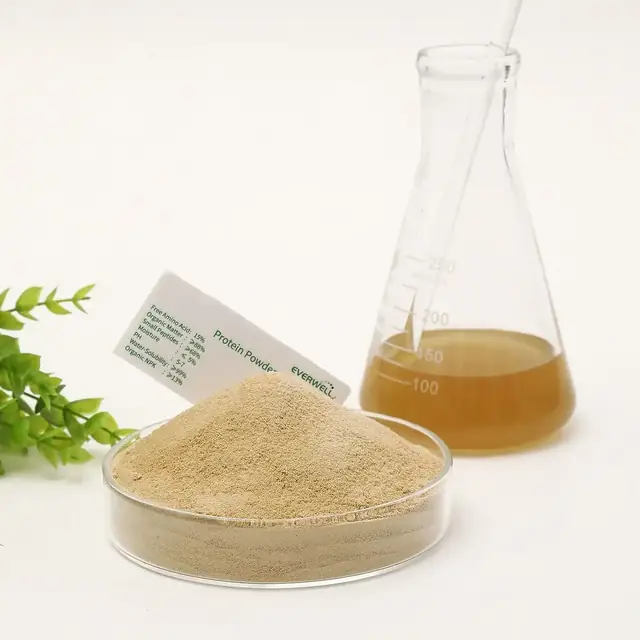
Protein Powder
A collagen-derived protein input at ≥ 90% crude protein and ≥ 80% total amino acids, glycine and proline rich, dissolving at 99% for animal feed, pet
View specificationRelated Articles
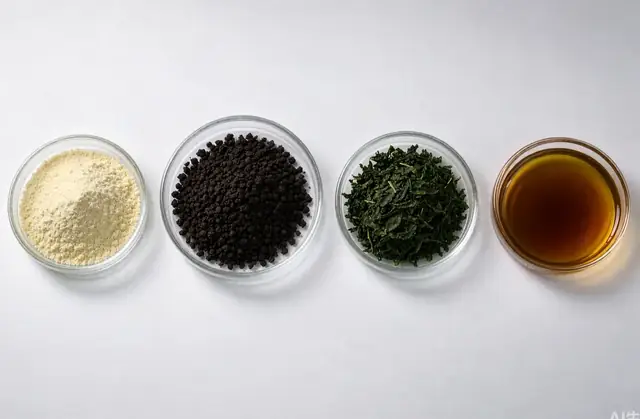
Amino Acid vs Humic, Seaweed and Fish Hydrolysate
Four biostimulant categories, what each actually contains, and the buyer checks that decide which one belongs in your formulation.
Read more
Where Compound Amino Acid Powder Is Used: Four Applications
The four working roles of compound amino acid powder in agriculture, and what each one implies for grade choice and documentation.
Read more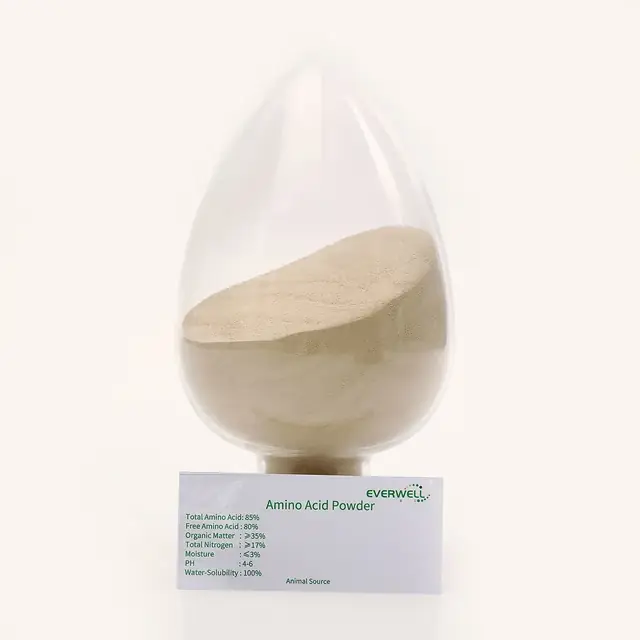
Benefits of Animal-Source Compound Amino Acid Powder in Fertilizer
Four documented benefits of animal-source compound amino acid powder as a fertilizer input, and how to verify each one before formulating.
Read moreQuestions On This Topic
Does 100% water-soluble mean no residue at all?
Not on its own. The claim only becomes checkable when it is tied to a method, water type, concentration, temperature and filtration procedure, with an acceptance limit expressed as maximum insoluble residue.
Is an 80% grade more soluble than a 35% grade?
Not necessarily. Total amino acid content is a composition result and solubility is a separate property; comparing them requires data on the specific products under one method.
Can I determine solubility percentage from a jar test?
No. A jar test screens dissolution, clarity, foam and settling, and it is the right tool for checking your own water and tank mix, but a number must come from a quantitative residue determination.
My solution precipitated after I added another fertilizer. Is the powder off specification?
Not necessarily. A product can meet its own specification and still precipitate on contact with hard water, extreme pH, concentrated salts or an incompatible input. Test the tank mix separately.
What temperature should I dissolve at?
Use the temperature in the supplier's preparation instructions or in the test method. There is no universal degradation threshold that applies to every amino acid powder.
Can I get material to test before ordering?
Yes. Free samples of 200 to 500 g are supplied with the batch COA so you can run your own dissolution and compatibility work.
Ask Us About This Directly
Technical questions are answered by the export and production team, normally within 24 hours.