
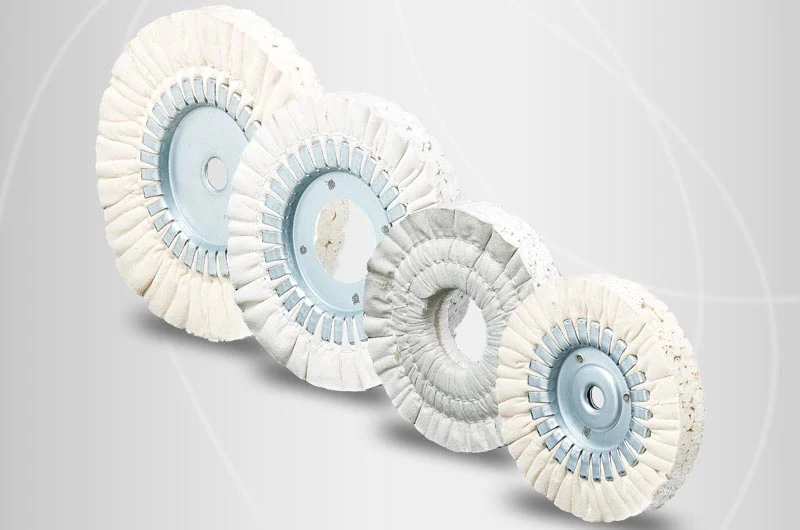
Wood Edge Banding Buffs
Wood Edge Banding Buffs are used in wood working processes for edge banding buffing and polishing, available with or without inner plates. They are produced in outer diameters from 120 mm to 200 mm, thicknesses from 10 mm to 25 mm, and with hole sizes of 50, 56, or 60 mm for all cotton...
Product Overview
Wood Edge Banding Buffs are used in wood working processes for edge banding buffing and polishing, available with or without inner plates. They are produced in outer diameters from 120 mm to 200 mm, thicknesses from 10 mm to 25 mm, and with hole sizes of 50, 56, or 60 mm for all cotton construction, or 14, 19, 22, 50, and 52 mm for metal clamp versions. The production line uses the CRA-300 forming machine, CRA-600 pressing machine, and CRA-700 trim/edge cutting machine. One operator can run the forming step, replacing manual folding and ensuring consistent ply spacing across shifts.
Key Benefits
- One operator replaces multiple hand workers on the forming step for wood edge banding buffs
- Covers the 120 to 200 mm diameter range used in wood edge banding applications
- Runs both cotton fabric and metal clamp centres on the same machine
- Maintains consistent ply spacing and wheel shape across shifts and operators
- Integrates directly into a three-machine line: CRA-300 forming, CRA-600 pressing, CRA-700 trimming
- English interface and control panel match the operator manual for clear operation
Application Scenarios
- A wood finishing shop adding in-house buff production to reduce reliance on external suppliers
- A small-scale buff manufacturer expanding into wood edge banding buffs without manual labour
- A factory upgrading from hand-formed wheels to a repeatable, machine-based forming process
- A workshop already using the CRA-300 forming machine and needing to add pressing and trimming
Who It Is For
- Wood working and furniture manufacturing plants
- Wood edge banding and finishing lines
- Polishing workshops producing custom buffs for wood applications
- Distributors of wood finishing tools looking to produce their own edge banding buffs
Problems It Solves
- Manual forming of wood edge banding buffs leads to inconsistent ply spacing and variable finish quality
- Hand assembly limits daily output and requires multiple workers per shift
- Purchasing finished buffs from abroad adds freight cost and long lead times
- Changing between different hole sizes or diameters requires retraining rather than tooling change
Technical Features
- Hydraulic system with left and right cylinders for clamping and indexing
- Adjustable batching speed for cotton fabric and metal clamp centres
- Turntable indexes the wheel body between folds to maintain consistent ply spacing
- Cutter section trims the formed body before unloading
- Control panel with circuit board and pressure gauge for monitoring hydraulic pressure
- Clamp set designed for 120 to 200 mm outer diameter range with multiple hole size options
Specifications
| Model | CRA-300 Airway Buffs Ventilated Buffs Forming Iris Machine |
|---|---|
| RPM of Batching | Adjustable |
| Max Buff Diameter | 200 mm |
| Min Buff Diameter | 120 mm |
| Max Thickness | 25 mm |
| Min Thickness | 10 mm |
Values taken from the manufacturer data for this model. Anything not listed is confirmed on request before order.
Materials
- All cotton fabric for non-metal centre construction
- Metal clamp centres with hole sizes of 14, 19, 22, 50, and 52 mm
- Cotton fabric with resin treatment available in yellow, blue, green, or red
- Prepared bias-cut fabric rolls for consistent folding
- Iron plate centres with round or hexagon hole for metal clamp versions
Manufacturing And Process
Step 1
Prepare bias-cut cotton fabric rolls on a CRA-500 or equivalent machine
Step 2
Load the fabric roll and select the iron claw or iron plate for the wheel centre
Step 3
Set the batching speed and clamp set for the target outer diameter and thickness
Step 4
The turntable indexes and the cylinders fold and clamp each ply onto the centre
Step 5
The formed body is trimmed and unloaded, then sent to pressing on a CRA-600
Step 6
Edge cutting on a CRA-700 gives the finished wheel its running face
Quality Control
- Hydraulic pressure held at 7 MPa on both moulding and finishing to ensure consistent ply density
- Sample wheels formed and checked before shipment
- Free sample testing available on the buyer's own fabric or metal clamp centres
- Installation and operation training provided so the first production run is supervised
Customization Options
- Voltage and phase configured for the destination market
- Clamp sets supplied for the diameter and thickness bands the buyer actually produces
- Iron claw or iron plate tooling matched to the buyer's existing centres
- Machine can be quoted as part of a CRA-300, CRA-600, CRA-700 production line
Compared With The Alternatives
| CRA-800 Bias Airway Buffs Forming Machine | The CRA-800 covers 200 to 600 mm wheels; use the CRA-300 for 120 to 200 mm wood edge banding buffs |
|---|---|
| Manual forming of wood edge banding buffs | Hand forming requires no capital outlay but cannot maintain consistent ply spacing or reach 4000 pieces per day |
| CRA-360 Airflow Corrugated Buffs Making Machine | The CRA-360 forms corrugated buffs with a different structure, not suitable for wood edge banding applications |
Use Guide
- Confirm incoming fabric is cut on the bias before forming; straight cut material will not fold evenly
- Change the clamp set to move between diameter bands; a set change takes about the same effort as a tooling swap
- Keep the hydraulic pressure gauge at 7 MPa; a drop indicates loose ply spacing before it affects wheel diameter
- Send formed bodies to pressing the same shift to prevent ply stack relaxation
- Contact us on WhatsApp for the English operation video if the operator is new to forming
Wood Edge Banding Buffs FAQ
What diameters can this machine make?
From 120 mm to 200 mm outer diameter. For larger wheels, use the CRA-800.
How many people are needed to run it?
One operator. The clamping, indexing, and trimming are handled by the machine's hydraulic and control system.
What is the daily output?
Up to 4000 pieces per day at maximum rate. Real output depends on diameter, thickness, and material.
Do I need other machines to make a finished wheel?
Yes. The CRA-300 forms the wheel, which then goes to pressing on a CRA-600 and trimming on a CRA-700.
What is the lead time?
5 to 15 workdays if the machine is in stock, otherwise 15 to 60 workdays depending on quantity and model.
What are the payment terms?
Orders up to 10000 USD are 100% in advance. Above 10000 USD it is 30% T/T deposit with the balance before shipment.
Can you test my own fabric before I buy?
Yes, sample testing is free. You cover the freight and send the specific material you plan to run.


Lines Industries And Guides
Timber Cutting and Board Joining Line
CRATOOLS builds timber cutting and board joining lines using its own machines and saw blades. The line processes logs, round...
Timber and Wood Board Processing
CRATOOLS has produced timber wood cutting machines for 10 years and manufactures saw blades in-house. The company supplies a...
Choosing a Multi Rip Saw for Square Timber or Round Wood
Guide
Get A Price On The Wood Edge Banding Buffs
Send the quantity, the diameters and the material you run. We answer with price, lead time and packing within 24 hours.