
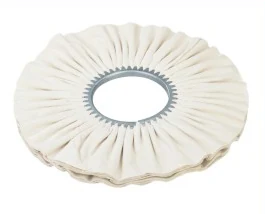
Bias Airway Cotton Buffs
Bias Airway Cotton Aluminum Buffing Wheels are made by folding cotton cloth into an irregular shape and fixing it with an iron plate. The resulting wheel has pleats that create airflow for cooling during polishing, providing good coverage on complex or irregular surfaces. These wheels are used for...
Product Overview
Bias Airway Cotton Aluminum Buffing Wheels are made by folding cotton cloth into an irregular shape and fixing it with an iron plate. The resulting wheel has pleats that create airflow for cooling during polishing, providing good coverage on complex or irregular surfaces. These wheels are used for high-class product polishing where heat dissipation and surface contact are critical.
Key Benefits
- Irregular pleated structure provides effective cooling during high-speed polishing
- Iron plate centre ensures stable fixation and consistent rotation
- Cotton cloth offers a soft, consistent finish suitable for fine polishing
- Good surface coverage on complex or irregular shapes
- Reduced risk of burn marks due to airflow between pleats
- Can be used in continuous polishing lines where consistent performance is needed
Application Scenarios
- A metal finishing shop needing consistent polishing on irregularly shaped parts
- A cookware or tableware manufacturer requiring a smooth finish without heat damage
- A jewellery workshop using fine polishing on detailed or curved components
- A factory replacing hand-folded cotton buffs with a repeatable, machine-ready consumable
- A polishing line adding a cooling-effective buff for stainless steel or aluminium surfaces
Who It Is For
- Buffing and polishing wheel manufacturers
- Metal finishing shops with high-volume polishing needs
- Cookware, tableware, and sanitary ware producers
- Jewellery and precision component polishing workshops
- Industrial polishers using cotton-based buffs on sensitive surfaces
Problems It Solves
- Hand-folding cotton buffs leads to inconsistent pleat spacing and uneven cooling
- Lack of a fixed centre causes wobbling or slippage during high-speed polishing
- Heat buildup on complex shapes damages the finish or the workpiece
- Inconsistent buff shape reduces coverage and increases polishing time
- Manual production limits output and increases labour cost per wheel
Technical Features
- Cotton cloth folded into an irregular pleated shape for airflow
- Iron plate centre used to fix the folded cloth structure
- Pleats designed to allow air passage during rotation
- No resin or adhesive used in the basic construction
- Suitable for use with standard buffing machines
- Can be used on both manual and automated polishing lines
Specifications
| Material | Cotton cloth |
|---|---|
| Centre Type | Iron plate |
| Structure | Irregular pleated |
| Cooling Effect | High due to airflow between pleats |
| Application | High-class product polishing |
| Surface Contact | Excellent on irregular shapes |
Values taken from the manufacturer data for this model. Anything not listed is confirmed on request before order.
Materials
- Cotton cloth
- Iron plate centres
- No resin or adhesive specified in source
Manufacturing And Process
Step 1
Cut cotton cloth on the bias to prepare for folding
Step 2
Fold the cloth into an irregular pleated shape manually or with a forming machine
Step 3
Place the folded cloth onto an iron plate centre
Step 4
Secure the cloth to the iron plate using mechanical fastening or stitching
Step 5
Use the wheel in a polishing machine for high-class surface finishing
Step 6
Replace when wear or deformation affects performance
Quality Control
- Pleat spacing checked for consistency before final assembly
- Iron plate centre inspected for flatness and secure fit
- Sample wheels tested on target surfaces before bulk production
- No mention of automated inspection in source, so manual checks are implied
Customization Options
- Iron plate size and hole type can be matched to existing machinery
- Pleat pattern can be adjusted based on surface complexity
- Available in standard sizes; custom sizes not specified
- Can be supplied with or without pre-attached iron plates
Compared With The Alternatives
| Bias Airway Sisal Buffs | Sisal is more abrasive and durable; cotton is softer and better for fine finishing on delicate surfaces |
|---|---|
| Resin Bonded Cotton Buffs | Resin bonded wheels have fixed shape and less airflow; cotton airway wheels allow cooling but require mechanical fixation |
| Manual Cotton Folding | Manual folding leads to inconsistent pleats and cooling; machine-assisted folding ensures repeatable structure |
Use Guide
- Ensure cotton cloth is cut on the bias before folding to maintain pleat integrity
- Use iron plates with matching hole size and shape to your polishing machine's spindle
- Inspect the wheel before use for loose pleats or shifting cloth
- Replace the wheel when pleats become flattened or the iron plate shows wear
- Store wheels in a dry, flat location to prevent deformation
Bias Airway Cotton Buffs FAQ
What is the structure of this cotton buff?
It is made by folding cotton cloth into an irregular pleated shape and fixing it with an iron plate.
What is the cooling effect of this wheel?
The irregular pleats allow airflow during rotation, providing a high cooling effect.
Is this wheel suitable for irregular surfaces?
Yes, the pleated structure provides excellent coverage on complex or curved shapes.
What type of centre is used?
An iron plate is used to fix the folded cotton cloth.
Can this wheel be used on high-speed polishing machines?
Yes, it is suitable for use on standard buffing machines, provided the iron plate fits the spindle.
Is resin or adhesive used in construction?
No, the source text does not mention resin or adhesive; the cloth is fixed by the iron plate.
What is the typical application?
High-class product polishing, especially on irregular or sensitive surfaces where cooling and coverage are important.


Get A Price On The Bias Airway Cotton Buffs
Send the quantity, the diameters and the material you run. We answer with price, lead time and packing within 24 hours.